

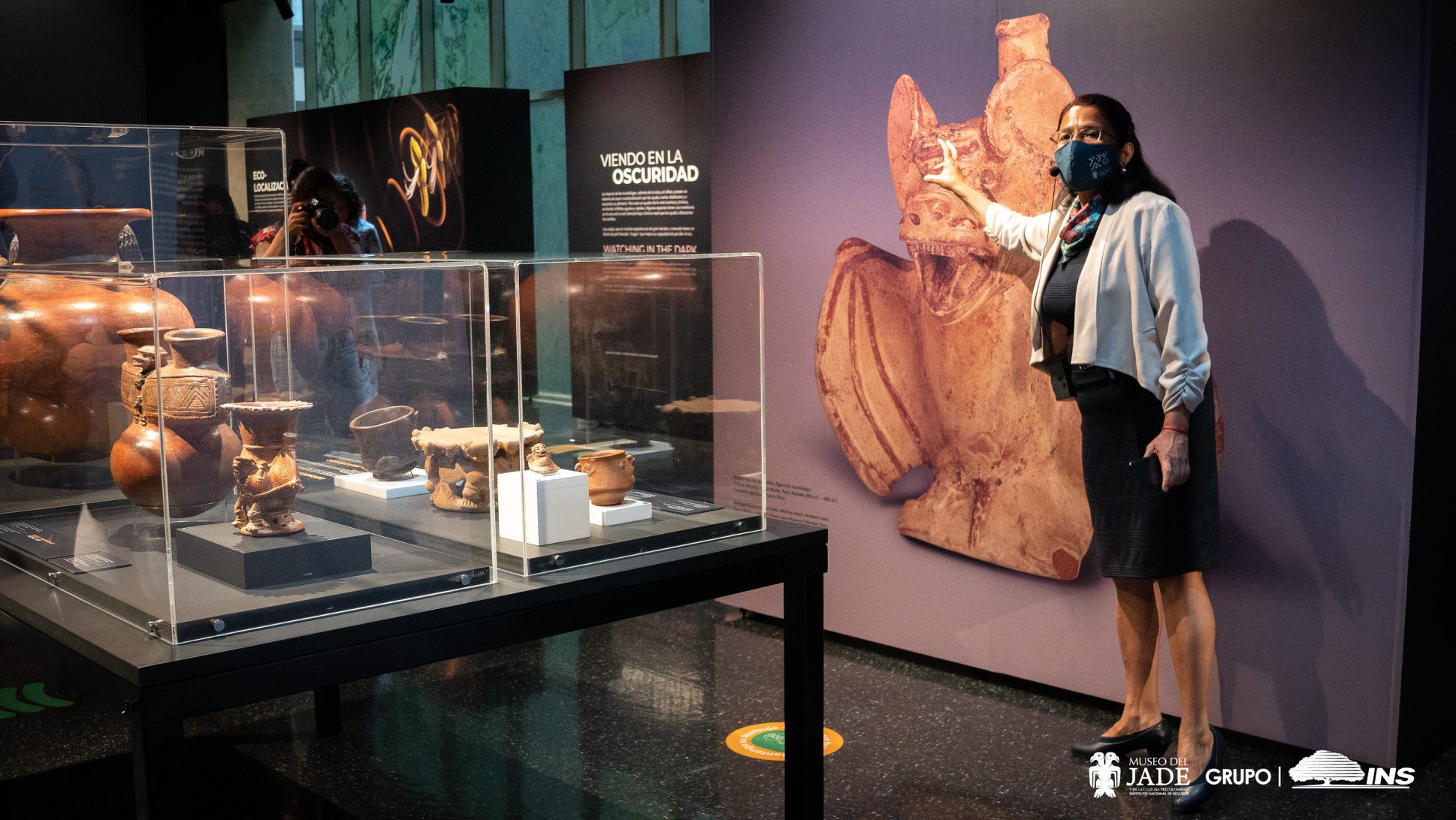
Costa Rica’s awe-inspiring El Museo de Jade (The Jade Museum) takes visitors on a voyage through the diverse artistic history of Pre-Columbian communities. Located in San José’s Plaza de la Cultura (Plaza of Culture), the museum was created with the intent to stave off tomb raiders and the loss of valuable historical artifacts. Multisensory exhibits housing some 7,000 pieces go far beyond the opportunity to view all manner of jade artifacts; they represent a rare journey back in time.
The Instituto Nacional de Seguros (INS) was founded in 1924, originally as a bank and then later becoming the institute it is today, offering insurance to those living in Costa Rica. In the 1970s, serious losses of national treasures due to tomb raider theft prompted the government to pass a law forbidding the removal of historic artifacts from the country. The INS began to amass its collection in hopes of preserving the nation’s historic patrimony. In 1977, the “Archaeological Collection of the National Insurance Institute” opened its doors and three years later, its name was changed to The Jade Museum.
These secrets of Pre-Columbian jade
are a marvel that is worth the trip alone to San José.
Each of the museum galleries, set up in a series, represents a moment in Pre-Columbian history. It was a time in Costa Rica when jade was considered the most precious of all minerals. The museum intends to show that jade’s importance transcended just art, and was integral to every aspect of indigenous life.
Your time travel begins in “The Threshold,” portraying the genesis of the indigenous community’s history and the importance of jade. Central to this exhibit is a block of jade in its natural state. From there you enter “The Jade,” proceeding through the elaboration process of jade, routes of trade and jade’s importance in ritual. “The Day” displays the everyday life of the people, their livelihood, architecture and navigation. This leads naturally to “The Night,” a space dedicated to ritual, mythology and the underworld and its connection to this precious mineral. “Memory” comes next, giving you a chance to see what life was like among the indigenous of Costa Rica. The exhibit focuses on music, technology and human diversity, especially in gender roles. The last room is “Collection,” its objective being to protect objects found in three archaeological regions of the country: Greater Nicoya, Central Region and Greater Chiriquí. This collection is considered a moving exhibit, with objects serving as a framework for future investigations, as well as temporary and itinerant exhibitions.
These secrets of Pre-Columbian jade are a marvel that is worth the trip alone to San José, next time you head there. The Jade Museum offers guided tours, audio guides and workshops. It also offers space for theater, art and music events that are ongoing and diverse.
Pro Tip: Take advantage of the Museum Walk (Paseo de Museos) and delve deeper into Costa Rican history. Purchase one ticket and visit the Jade Museum, as well as the Museums of the Central Bank of Costa Rica (Gold and Numismatic), and National Museum, for an all-inclusive price: 5,000 colones for locals and $31 for foreigners. This gives you one kilometer packed with archaeological, artistic and historic exhibitions.
Otto Apuy – Multimedia Artist
Envision Festival Spotlights International Artists
Max Gea – Musician
Juan Carlos Camacho – Blending of Art and Architecture
Joe Hrbek – Gold Coast’s Iron Sax Man
Stephanie Waltrip – Musician
David Villalobos – Young and the Restless
Rebeca Alvarado Soto: The art of the dance
Fiery Flamenco Guitar
Leatherback Rock
Marvin Dolgay – MusicianSee the magazine article:anVuZSUyMGlzc3VlHear the introduction: