


Learning food vocabulary is one of the easiest and most useful ways to build confidence in Spanish. Vegetables appear everywhere: in markets, on restaurant menus, in family kitchens, at roadside sodas, and in everyday conversation. When you know the names of common vegetables, you can shop smarter, order meals more easily, and feel more connected to the culture around you. That is especially true in Costa Rica, where fresh produce plays a big role in daily life and where words like “ayote,” “culantro,” and “vainicas” pop up often in home cooking.
If you have ever wanted a simple, practical way to improve your Spanish, starting with vegetables is a smart move. These are words you will actually use. Ask for avocados at the feria, talk about tomatoes for your salad, or understand what is going into a soup or casado. Food words stick in your mind because they are visual, familiar, and tied to daily habits. That makes them ideal for travellers, expats, students, and anyone trying to speak more naturally.
What does “Eat Your Vegetables” mean in Spanish?
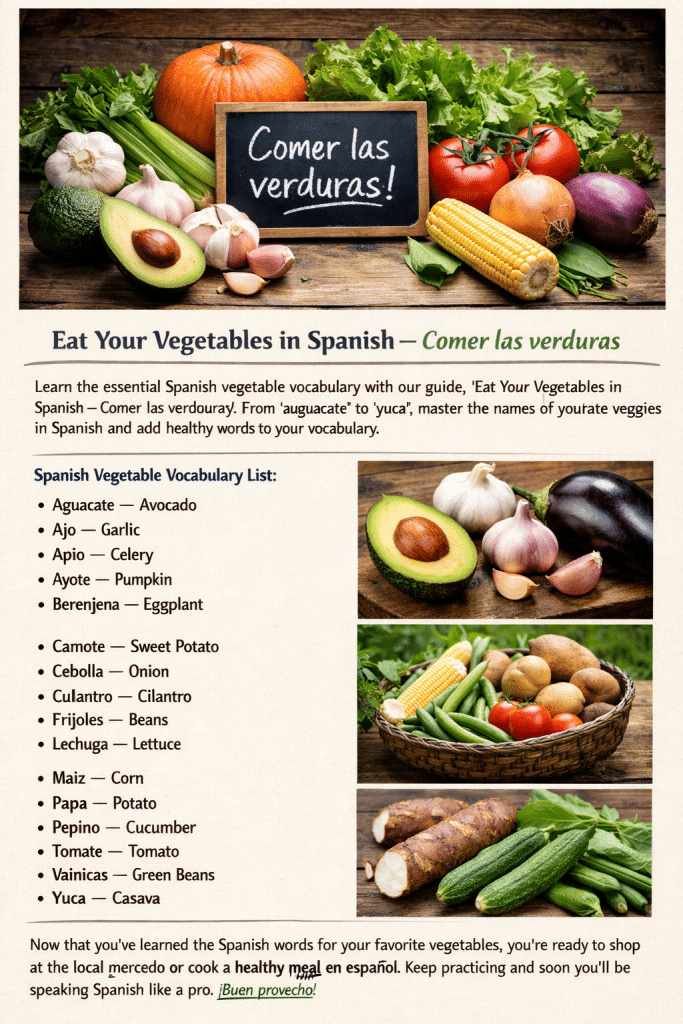
“Eat your vegetables” in Spanish is “Comer las verduras.”
It is a useful phrase because it connects a simple command with everyday vocabulary. Once you know the phrase, you can build on it by learning the names of the vegetables themselves. This gives you a practical mini-lesson that is easy to remember and immediately useful in real life.
Which Spanish vegetable words should you learn first?
These Spanish vegetable words are among the most useful for beginners and everyday speakers.
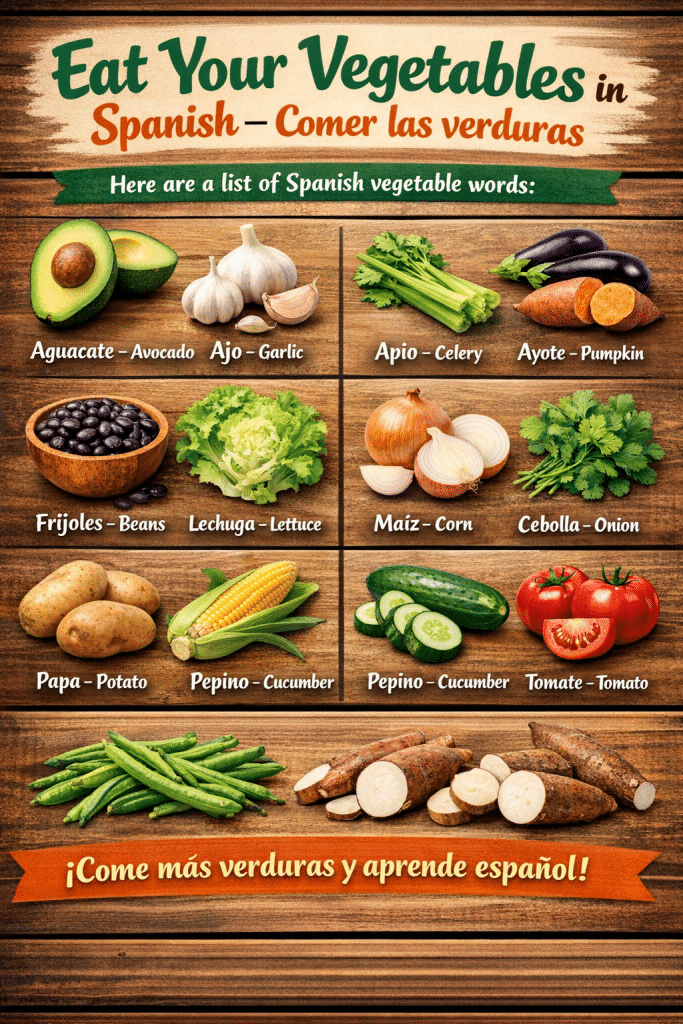
Here is your core vocabulary list:
|
Spanish |
English |
|
aguacate |
avocado |
|
ajo |
garlic |
|
apio |
celery |
|
ayote |
pumpkin |
|
berenjena |
eggplant |
|
camote |
sweet potato |
|
cebolla |
onion |
|
culantro |
cilantro |
|
frijoles |
beans |
|
lechuga |
lettuce |
|
maíz |
corn |
|
papa |
potato |
|
pepino |
cucumber |
|
tomate |
tomato |
|
vainicas |
green beans |
|
yuca |
cassava |
These are not just classroom words. They are practical terms you will hear in shops, homes, and restaurants across Latin America. Some are especially handy in Costa Rica. “Ayote” is a word you will hear for squash or pumpkin, “culantro” is common in local cooking, and “vainicas” is used for green beans. Learning local usage can make your Spanish sound more natural and help you understand menus and conversations more clearly.
Why is vegetable vocabulary so useful in Spanish?
Vegetable vocabulary is useful because it helps with real-life communication right away.
Many new Spanish learners begin with greetings and numbers, which are important, but food words often become useful faster. Imagine walking through a farmers’ market and recognising “tomate,” “cebolla,” and “pepino.” Suddenly, Spanish stops feeling like a subject and starts feeling like a living part of your day. That shift matters. It builds confidence.
Vegetable words also help with reading menus, buying groceries, asking questions about ingredients, and making healthier choices while travelling. If you have dietary preferences or simply want to know what is on your plate, these words become essential. Knowing the difference between “papa” and “camote,” or between “culantro” and “apio,” can make a conversation much easier.
How can you remember Spanish vegetable words quickly?
The fastest way to remember Spanish vegetable words is to connect them to things you see, eat, and say every day.
Start with repetition in real situations. When you slice an onion, say “cebolla.” When you buy tomatoes, say “tomate.” When you see avocado on a menu, say “aguacate.” The more you attach the word to the object, the faster it sticks.
You can also group words by use. Salad words like “lechuga,” “pepino,” and “tomate” belong together. Cooking words like “ajo,” “cebolla,” and “culantro” form another group. Hearty side dish words like “papa,” “camote,” “yuca,” and “maíz” make another family of terms. Grouping vocabulary this way makes it easier for your brain to file and retrieve the words.
Another trick is to practise with mini-phrases instead of isolated nouns. Try saying “Quiero aguacate,” “Necesito cebolla,” or “Me gusta el tomate.” Even basic sentence use helps the vocabulary move from recognition to active speaking.
What are the most common Spanish vegetable words in daily conversation?
The most common vegetable words in daily conversation include “ajo,” “cebolla,” “tomate,” “papa,” “lechuga,” and “frijoles.”
These are common because they appear in many dishes and are easy to work into conversation. Beans, onions, tomatoes, potatoes, and lettuce are regular ingredients in homes and restaurants across the Spanish-speaking world. In Costa Rica, “frijoles” is especially important because beans are such a major part of local meals. “Tomate” and “cebolla” are everywhere, and “culantro” appears often in seasoning and soup bases.
Then there are the regionally memorable words. “Ayote” has a very Central American feel. “Vainicas” is especially useful in Costa Rica. “Yuca” is another excellent word to know because cassava shows up boiled, fried, or mashed in many Latin American cuisines.
How can travellers use these Spanish food words in Costa Rica?
Travellers can use these words to shop, order meals, ask questions, and connect more warmly with locals.
At a market, you might ask for “aguacate,” “maíz,” or “pepino.” In a restaurant, you may want to know whether a dish includes “cebolla” or “ajo.” If you are exploring traditional Costa Rican food, you are likely to hear words like “frijoles,” “culantro,” “ayote,” and “yuca.” Even a few correct words can completely change the tone of an interaction. Locals usually appreciate the effort, and that small attempt at speaking Spanish often opens the door to friendlier, richer exchanges.
This is one reason food vocabulary is such a strong starting point. It is immediate, practical, and cultural all at once. You are not just memorising random words; you are learning how people live, cook, and share meals.
Why “Comer las verduras” is a smart phrase for learners
“Comer las verduras” is a smart phrase because it is simple, memorable, and tied to useful everyday language.
It carries a familiar idea that many people remember from childhood, so it is easy to keep in your head. At the same time, it leads naturally into the names of the vegetables themselves. That makes it a perfect phrase for lessons, blog posts, social media graphics, educational posters, and beginner Spanish practice.
For parents teaching children, for travellers heading to Costa Rica, or for anyone building practical Spanish from the ground up, this phrase offers a clear and friendly entry point. It is functional language with a real-world payoff.
Closing
Learning Spanish does not always have to start with grammar charts and long vocabulary drills. Sometimes the most effective words are the ones sitting right in front of you on the kitchen counter or stacked high at the market. “Comer las verduras” gives learners a memorable phrase, and words like “aguacate,” “ajo,” “frijoles,” and “yuca” give them tools they can use immediately.
The beauty of food vocabulary is that it travels well. It helps you at home, on holiday, in Costa Rica, and anywhere Spanish is spoken. Learn these words, use them often, and let every meal become a small language lesson. Before long, you will not just recognise the words on a menu or in a conversation. You will use them with ease, and that is where real progress begins.
FAQ
How do you say “eat your vegetables” in Spanish?
You say “Comer las verduras.”
What is “avocado” in Spanish?
“Avocado” in Spanish is “aguacate.”
What is “garlic” in Spanish?
“Garlic” in Spanish is “ajo.”
What is “pumpkin” in Spanish?
“Pumpkin” in Spanish is “ayote.”
What is “green beans” in Spanish?
“Green beans” in Spanish is “vainicas.”
What is “cassava” in Spanish?
“Cassava” in Spanish is “yuca.”
Is “culantro” the same as cilantro?
In many places the words are related, but usage can vary by country. In Costa Rica, “culantro” is a very familiar kitchen word.
Why should beginners learn food words first?
Because they are practical, easy to visualise, and useful in daily life.
Odd Body Parts in Spanish
List of Spanish Verbs
Spanish words you use at Work
Random Spanish Words
Useful Spanish Words when you at a bar: I’ll Drink to that
Spanish words regarding Pets
Spanish Pronunciations: Vowels and Consonants
Spanish – Great minds think alike
Spanish – A dash of Pura Vida
Spanish – Step up your game
Spanish – Leveling Up, the 20/90 Challenge
Spanish- Tips for a New Year of Language Learning
Spanish – Relax, Engage, Learn
Spanish – Banter, a pura vida life skill
Spanish – Here’s looking at you, kid
Spanish – Yearning for Learning
Spanish – Seven Motivating Reasons to Start Learning today
Spanish – Verbs to live by
Spanish – Beware of false friends
Breaking the barriers of learning Spanish

Howler Staff are John, Terry and whomever else we can get to write great articles.