
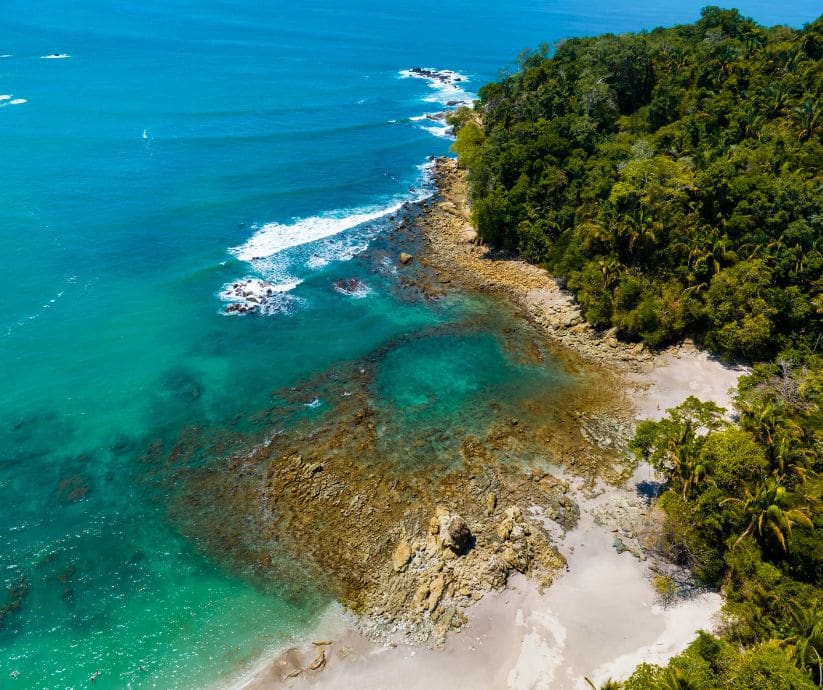
If you like white-sand beaches, exotic animals and flat, shady jungle trails, then Cahuita National Park probably belongs on your list of must-see places in Costa Rica.
The concept is delightfully simple — a six-mile (10km) trail along the beach between the towns of Cahuita and Puerto Vargas, on the south Caribbean coast. A few signs, a couple of picnic tables, and that’s it! Nature takes care of the rest.Even better, there is no charge to enter from the north (Cahuita), though donations are welcome. There is an admission fee to enter at Puerto Vargas. All you need to bring are flip-flops, a bathing suit and maybe a bottle of water and a camera. I didn’t find bug spray to be necessary, and sunscreen is needed only if you’re planning on beach time, as the trails are well shaded by the jungle canopy.
Howler monkeys, sloths, raccoons, coatis, toucans, parrots, herons, kingfishers, lizards, crabs, snakes and ants are abundant. You’ll see a fair number of Homo sapiens too, but in places you’ll find gorgeous beaches that you have all to yourself.
SEE THIS ARTICLE IN THE DIGITAL MAGAZINE!
JTNDaWZyYW1lJTIwc3JjJTNEJTIyaHR0cHMlM0ElMkYlMkZ3d3cuZ29vZ2xlLmNvbSUyRm1hcHMlMkZlbWJlZCUzRnBiJTNEJTIxMW0xOCUyMTFtMTIlMjExbTMlMjExZDM5MzIuMzQ4MzMzOTA4MTUzNiUyMTJkLTgyLjg0MTE4NjE0OTI3MjkzJTIxM2Q5LjczNjUzMjE4MDE1MTU5MiUyMTJtMyUyMTFmMCUyMTJmMCUyMTNmMCUyMTNtMiUyMTFpMTAyNCUyMTJpNzY4JTIxNGYxMy4xJTIxM20zJTIxMW0yJTIxMXMweDhmYTY1MTU0MmViOThlODMlMjUzQTB4M2E0NDhhMzFmM2ZhYjczZCUyMTJzUGFycXVlJTI1MjBOYWNpb25hbCUyNTIwQ2FodWl0YSUyMTVlMCUyMTNtMiUyMTFzZW4lMjEyc2NyJTIxNHYxNjE0MDI0NjE0OTcwJTIxNW0yJTIxMXNlbiUyMTJzY3IlMjIlMjB3aWR0aCUzRCUyMjYwMCUyMiUyMGhlaWdodCUzRCUyMjI1MCUyMiUyMHN0eWxlJTNEJTIyYm9yZGVyJTNBMCUzQiUyMiUyMGFsbG93ZnVsbHNjcmVlbiUzRCUyMiUyMiUyMGxvYWRpbmclM0QlMjJsYXp5JTIyJTNFJTNDJTJGaWZyYW1lJTNFThe snorkeling here is excellent, with colorful coral reefs and lots of fish, though you have to hire a guide to snorkel here.
One great way to explore the park is to pack a picnic and spend three or four hours walking from Cahuita to Puerto Vargas, with an obligatory beach break to get wet. If you have your own car, leave it parked in Cahuita and take a bus or taxi to get back.
A national marine monument was established here in 1970, primarily to protect the fragile coral reef, and it became a national park in 1978. The park protects a land area of 2,732 acres (1,106 hectares) and a huge marine area of 55,200 acres (22,300 hectares).
The park is 42km south of Puerto Limón and a short drive north from the hopping tourism hub of Puerto Viejo.
JTNDaWZyYW1lJTIwc3JjJTNEJTIyaHR0cHMlM0ElMkYlMkZ3d3cuamlnc2F3cGxhbmV0LmNvbSUyRiUzRnJjJTNEcGxheSUyNmFtcCUzQnBpZCUzRDFkMTdlNGFmY2M4MSUyNmFtcCUzQnZpZXclM0RpZnJhbWUlMjIlMjBzdHlsZSUzRCUyMndpZHRoJTNBMTAwJTI1JTNCaGVpZ2h0JTNBNTAwcHglMjIlMjBmcmFtZWJvcmRlciUzRDAlMjBhbGxvd2Z1bGxzY3JlZW4lM0UlM0MlMkZpZnJhbWUlM0U=