Fun Facts About Our Official Mascot
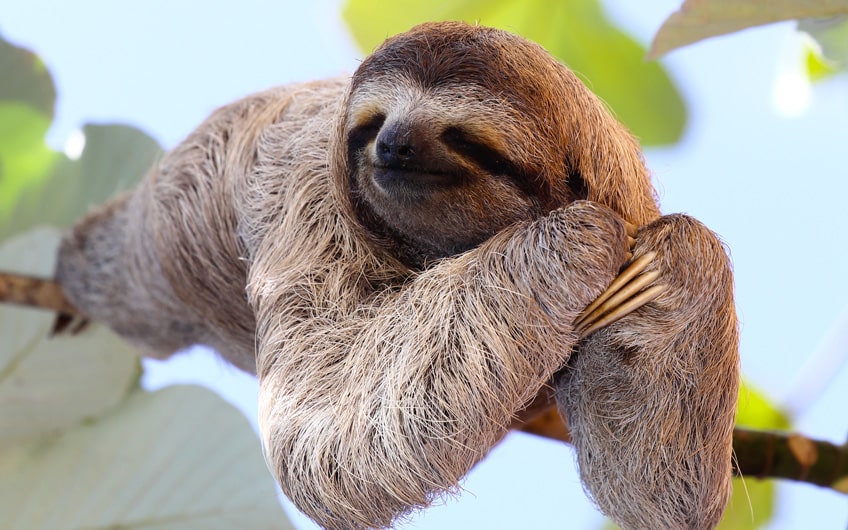
Sloths have become Costa Rica’s unofficial national mascot, emblematic of the pura vida lifestyle. They are just so darn cuddly! Here are a few obscure sloth facts you may not have already known.
While everything else these mammals do seems slow-paced, their mating ritual is anything but that.
- Sloths live in the tropical rainforests throughout Central and South America. Their populations are densest in Costa Rica, Nicaragua and northern Brazil.
- Food takes about a month to digest in a sloth’s stomach, fermenting all the while. For this reason, they are not a preferred delicacy by their primary predators — jaguars and snakes.
- In everyday tasks and chores, humans move about four times faster than sloths, which makes the sloths appear to function in slow motion.
- The Megatherium, ancestor to the current sloth we know, roamed South America during the Pliocene and Pleistocene eras, five million to three million years ago. The Megatherium was the size of an elephant; so no, they did not hang from trees.
- Nearly all mammals have seven cervical (neck) vertebrae. The three-toed sloth has nine, allowing them to rotate their heads nearly 270 degrees.
- All sloths have three toes on each back leg. A two-toed sloth is distinguished from its three-toed cousin by having one less toe on each of its front legs.
- Thomas Jefferson, the third President of the United States, was an avid amateur paleontologist. He helped excavate and discover the first giant sloth species found in North America. The genus was later named Megalonyx Jefersoni.
- Saving the best for last: when female sloths go into heat, they sing in a distinct screech, beckoning the male sloths to “come hither.” While everything else these mammals do seems slow-paced, their mating ritual is anything but that. On average, the entire ordeal, including foreplay, takes a total of less than 30 seconds. No, that’s not a misprint.
Learn more in this Howler article: Difference Between Two-Toed and Three-Toed Sloths