

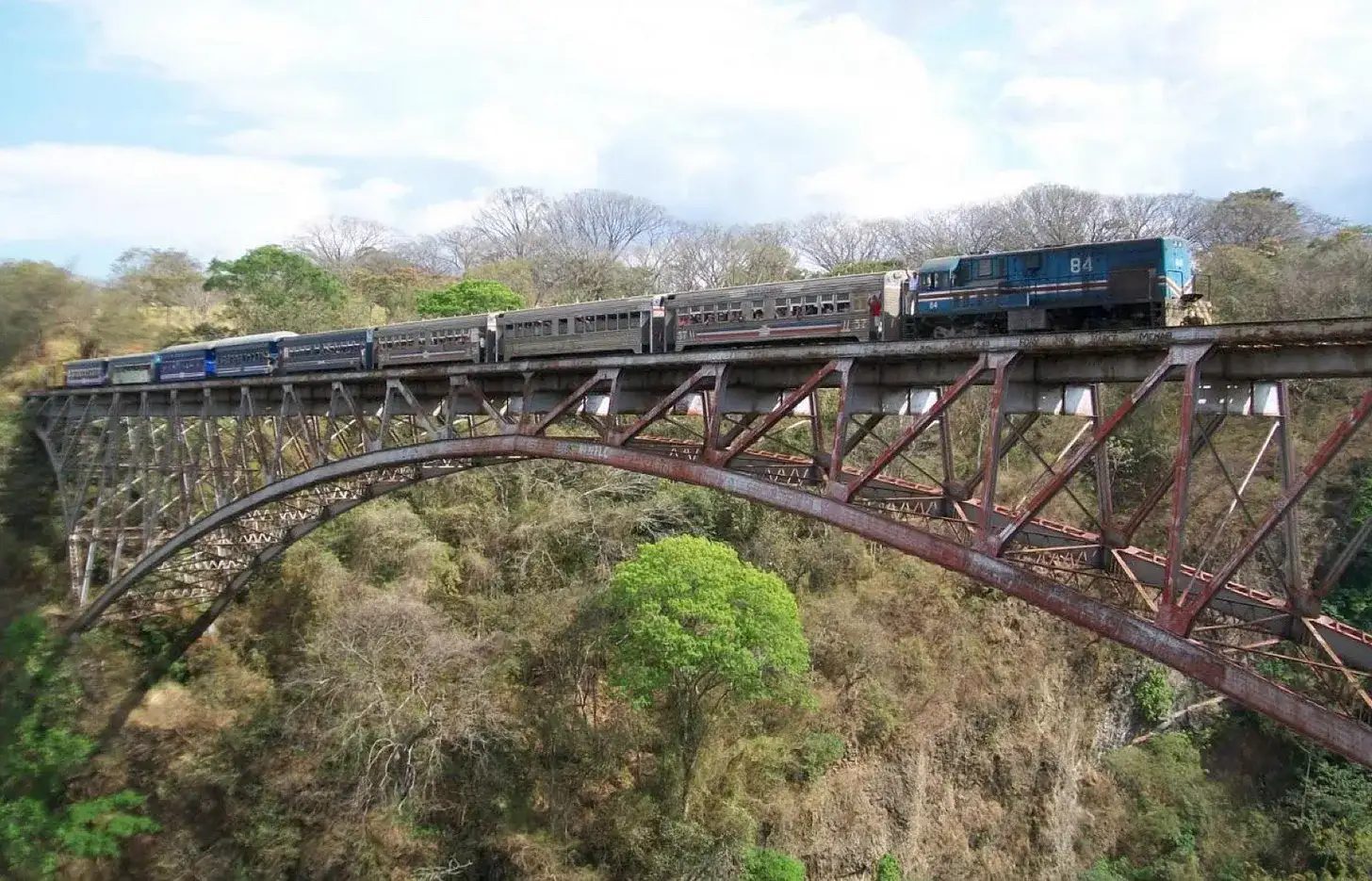
One could argue that Costa Rica’s railroads birthed modern-day Central America.
In the late 1800s, U.S. entrepreneur Henry Meigs signed a contract with the Costa Rican government to build a railroad from San José to the Caribbean. When Meigs died in 1877, his nephew, Minor Cooper Keith, took over the project.
The railroad project itself — meant to facilitate coffee exports — was an abject disaster. Malaria, yellow fever and other tropical diseases killed thousands of workers, and the line wasn’t finished until 1890. In the process, Costa Rica defaulted on its payments and instead compensated Keith with 800,000 acres of tax-free land.
Keith, ever the entrepreneur, began planting bananas on his newfound Costa Rican land and exporting the tropical fruit to the United States. The banana trade made him enormously wealthy, and he soon grew his empire across Central America and Colombia.
Eventually, Keith merged his enterprise with the Boston Fruit Company to form the United Fruit Company (now known as Chiquita). Over the next seven decades, United Fruit expanded its land ownership and workforce, strong-arming governments1 into favorable treatment to preserve its lucrative monopoly.
The development of many Central American countries (the so-called “banana republics”) is inextricably linked to United Fruit.
And it all started with a railroad in Costa Rica.
Keith’s railroad in Costa Rica operated as a for-profit business, so it didn’t meet the country’s needs for passenger travel and coffee exports.
In 1897, Costa Rica commissioned a competing project — a railroad from San José to the Pacific port of Puntarenas. By 1907, the country had completed tracks to Orotina but had run out of money; this forced travelers and transporters to use oxcarts for the final stretch.
Two Spanish visitors described the oxcart journey from Orotina to the Pacific Ocean as “four deadly hours” under a merciless sun that threatened “suffocation in the dust.”
In an effort not to kill any weary Spaniards, Costa Rica finished the full route from San José to the Pacific Ocean in 1910.
Over the following decades, Costa Rica modernized and improved its railroads, which were a source of national pride. The biggest advance came in 1932, when the country inaugurated an electric railroad to the Pacific.
With its railroads, Costa Rica established itself in the international market through its coffee exports. And in the process, the railroads provided fast, safe and cheap transport from the capital to the coasts, helping to stimulate growth outside of the cities.
Towns were formed along the Pacific railroad, and agriculture projects expanded near the route. Puntarenas developed into a small city, and areas as far away as the Nicoya Peninsula suddenly had stronger economic and cultural ties to San José.
“Undoubtedly, the symbol of Costa Rican progress was embodied in the Pacific Railroad, a purely state institution that emerged at a key moment in the history of Costa Rica,” wrote the University of Costa Rica’s (UCR) Javier Agüero García.
By the 1990s, Costa Rica’s railroads were in rough shape. An analysis from the UCR noted the Costa Rican Railway Institute (INCOFER) was an agency in “permanent crisis.”
The reasons for this are numerous, full of politics and quite boring. To summarize: An improving road network allowed for shipping through trucks, which was cheaper. Economic diversification impacted some of the railroad’s main revenue streams (cement and fertilizers). And the public began criticizing its spending habits.
INCOFER, for its part, said that its earnings were being unfairly diverted to other institutions.
In any event, by the 1990s the railroads were losing millions of dollars per year, were seldom-used by the traveling public and had aging infrastructure. Unwilling to invest in necessary infrastructure projects, the government decreed a “technical closure” of INCOFER in 1995.
The rails would remain vacant for 3 years, and by the time INCOFER was reactivated, it had a much smaller footprint.
Instead of the coast-to-coast network upon which Costa Rica once relied, today the country has an urban passenger route just in the San José area and a small freight route in the Caribbean.
Costa Rica’s railroad legacy has been left behind.
Today, Costa Rica’s roads are overcrowded, and the transport sector is one of the biggest barriers to the country’s decarbonization goals. In that context, Costa Rica once again has its eyes set on a railroad.
The plan is trifold: An expanded urban passenger train will improve mobility in San José; an electric freight train will move goods in the Caribbean; and a cargo and passenger route will provide traffic-free transport to the Pacific Ocean.
But what remains of the Pacific railroad is in critical disrepair. (Ironically, construction of the inadequate Route 27 destroyed important parts of the railway.) The electric train in San José will alone cost $1.55 billion, while the feasibility of a Caribbean electric freight line is still being explored.
If all goes as planned, says INCOFER president Elizabeth Briceño Jiménez, Costa Rica will one day “return to the rail legacy of our grandparents.”
1 ‘Strong-arming’ may be too weak a descriptor, as United Fruit (through its U.S. government ties) fomented a massacre in Colombia and overthrew a democratically elected government in Guatemala.