

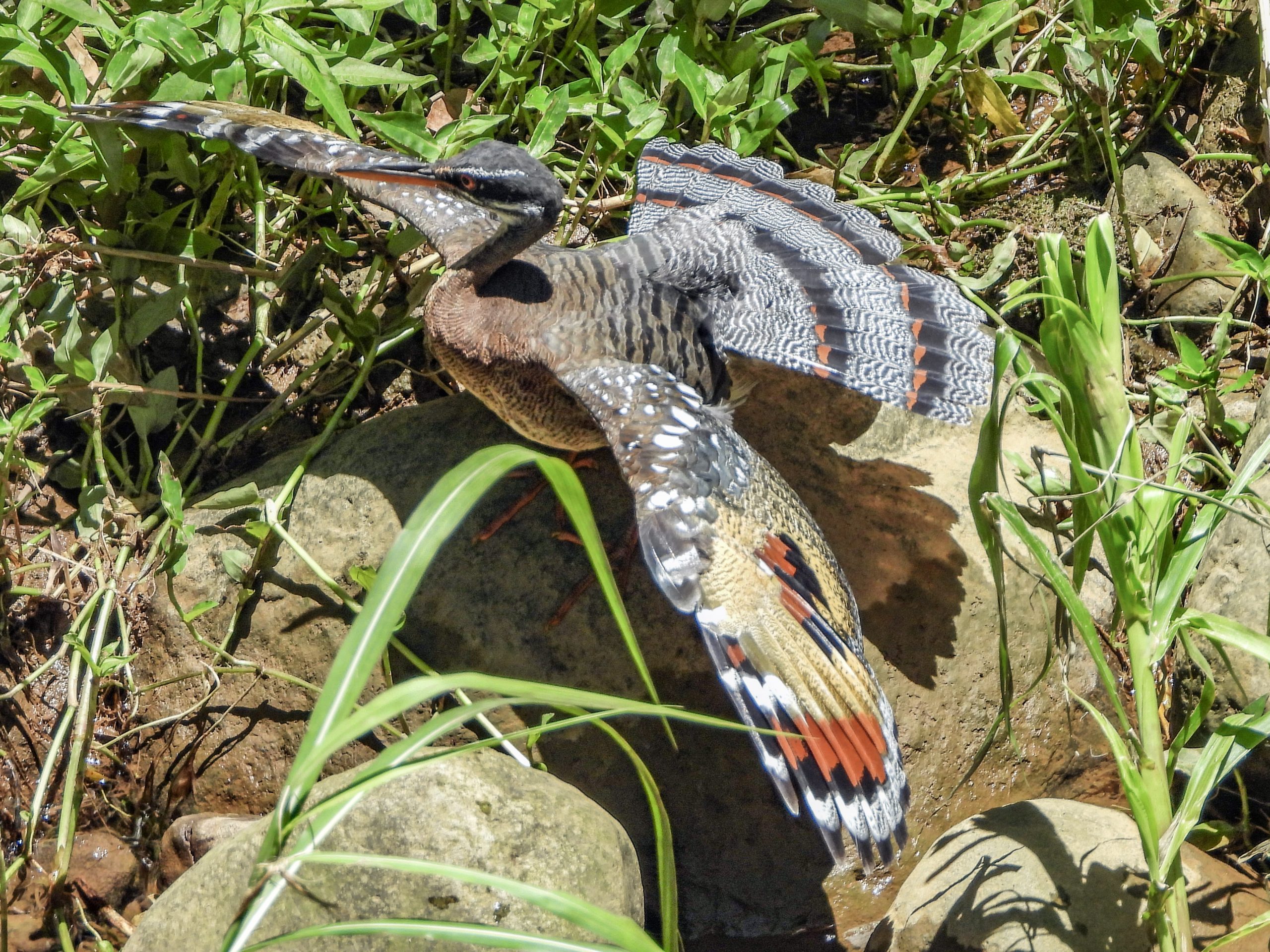
One of the more sought-after prizes for birding tourists here in Costa Rica is the sunbittern (Eurypyga helias ). Found in a range extending south from Guatemala and throughout South America. It lives near water in mid-elevation and foothill areas of the country.
Here in Costa Rica, subitterns can be seen in places like the Orosi Valley near Rio Perlas, Valle de los Quetzales near San Ramón, or Tuis near Rancho Naturalista Lodge. They are usually found alone, or sometimes in nesting pairs, building their nest in trees out of mud and leaves.
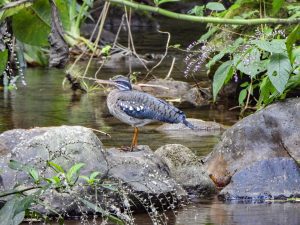 The sunbittern’s call is a long “peep” as they signal to each other. Heron-like in shape, with a striped black-and-white head and barred back, they are somewhat unassuming birds … that is, until startled or threatened. Then they will open their wings, dipping their head forward.
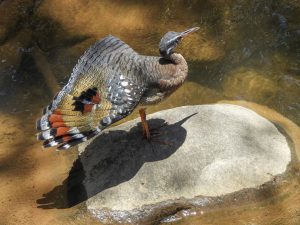
When the sunbittern displays, it becomes one of the most dazzling birds in the world. The intricate yellow, red and black “eye spot” pattern on their spread wings is truly remarkable and otherworldly. A must photograph!
Birders from all over the world travel here to Costa Rica, at times, just to attempt to see and photograph this incredible display. I, myself, spent about five years trying to get photos of the sunbittern display until I was successful. One of a kind
What makes the sunbittern even more special and unique is its history. It is the sole member of the entire family it belongs to; there is no other genus or species. In fact, the only bird that shares anything in common with the sunbittern is the kagu (Rhynochetos jubatus) found in New Caledonia!
How is a bird in Latin America solely related only to one other bird found only in a set of islands in the southwest Pacific?
 The answer starts 225 million years ago, when all the land masses of the earth were joined in a supercontinent, called Pangea by geologists. About 25 million years later, Pangea split in two, the north called Laurasia and the south called Gondwanaland. Somewhere, sometime, between 200 and 65 million years ago, the common ancestor bird — or dinosaur — of the sunbittern and the kagu emerged. The species diverged later when they were separated by the splitting continents.
Sunbitterns are originally native to Gondwanaland. A holdover from greater than 65 million years ago, they are still walking around in the streams and rivers here in Costa Rica, thrilling observers with their remarkable display of color. If you get a chance, try to see one in your time here.
If you like bird stories and photographs, and want a daily serving of one of the thousands of birds from all seven continents I have photographed, follow my facebook page @Bird of the Day.