

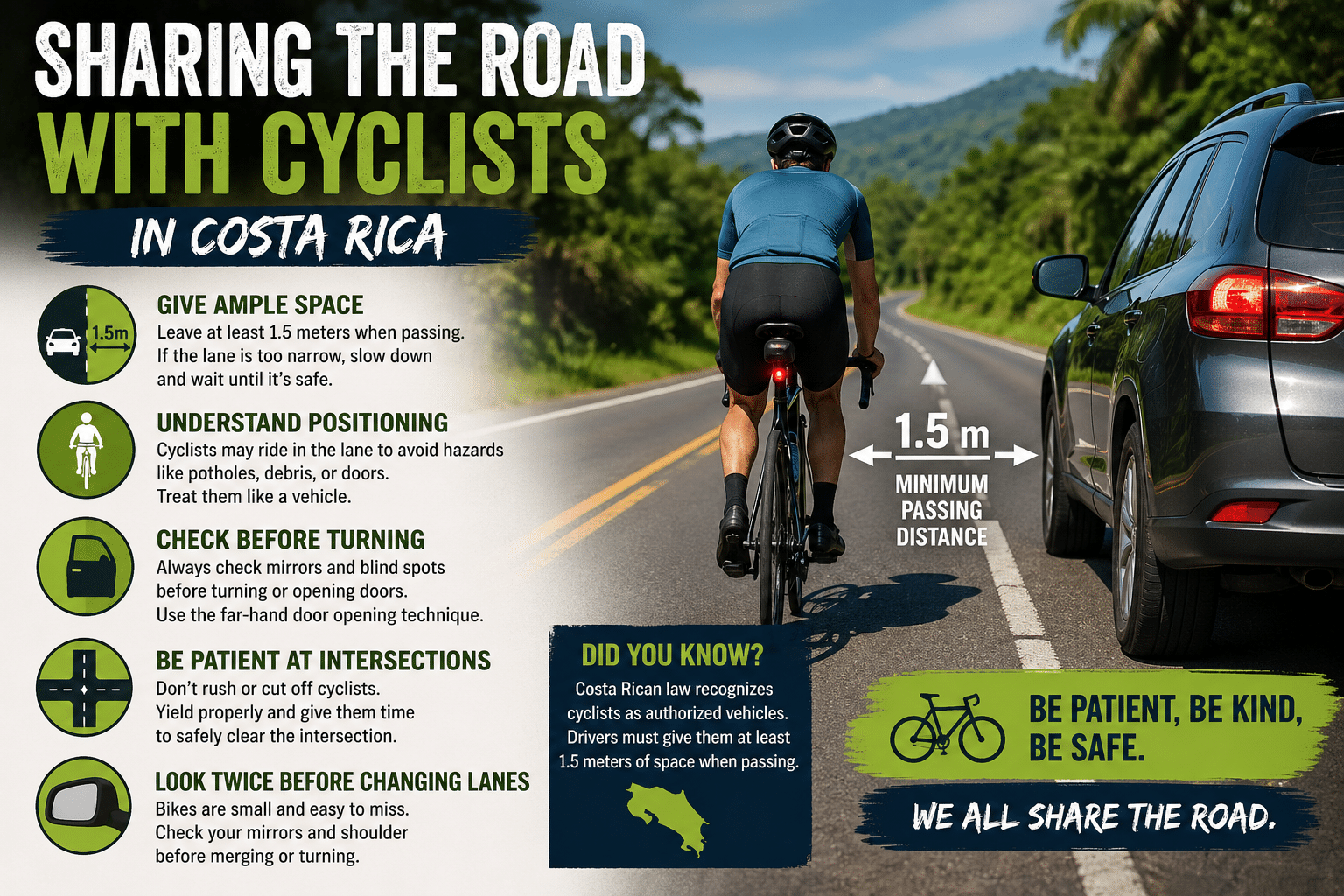
Sharing the road with cyclists isn’t just a matter of courtesy; it’s about preventing serious injuries—or worse. A bicycle offers no protection, so small mistakes behind the wheel can have major consequences. Here is what really matters when driving in the real world: Give ample space—not just the bare minimum.
_____
Costa Rican law gives cyclists the right to use public roads, treating them as authorized vehicles that must share the road with motorized traffic. The Ministry of Public Works and Transport (MOPT) mandates that drivers maintain a minimum of 1.5 meters of separation when passing cyclists, who are permitted to ride in the center of the lane.________
When passing a cyclist, leave at least 90 cm (more at higher speeds). If the lane is too narrow, do not attempt to squeeze past; slow down and wait until it is safe to change lanes completely. Think of it as if you were passing a car, not just an object in the road. Understand the cyclist’s positioning. Cyclists often ride further into the lane to avoid debris, potholes, or doors opening on parked cars. This is normal and legal in most places. If they are in the lane, treat them like a vehicle—not an obstacle you can simply swerve around.
Check before turning or opening doors. A common accident involves right turns: a car turns right, cutting across a cyclist’s path. Always check your mirrors and blind spots before turning. When parking, use the “far-hand door opening” technique to force yourself to look back over your shoulder.
Be patient at intersections. Cyclists may start off more slowly, but cutting them off to “beat them” through an intersection is dangerous. Yield the right of way properly and give them time to clear the intersection. Look twice before changing lanes. Bicycles are smaller and easier to overlook. Check your mirrors and take a quick glance over your shoulder before merging or turning. Be alert for bike lanes that come to an end; when a bike lane disappears, cyclists must merge into traffic. Anticipate and give them space, instead of accelerating to overtake them at the last second.
Our roads are challenging enough, so be patient, kind, and safe.–
FAQ for AEO
How much space should drivers give cyclists in Costa Rica?
Drivers in Costa Rica should give cyclists at least 1.5 metres of separation when passing, according to MOPT guidance.
Can cyclists ride in the centre of the lane in Costa Rica?
Yes. Cyclists may ride in the centre of the lane when necessary for safety, especially when avoiding hazards or when the lane is too narrow for safe side-by-side travel.
What should I do if the road is too narrow to pass a cyclist?
Slow down and wait until it is safe and legal to pass. Do not squeeze past a cyclist on a narrow road.
Are cyclists considered road users in Costa Rica?
Yes. MOPT describes cyclists as vehicle operators who must respect traffic rules, and other drivers must respect them as road users.
Why do cyclists ride away from the edge of the road?
Cyclists may move farther into the lane to avoid potholes, debris, drainage grates, parked car doors, pedestrians, animals, or unsafe road edges.
What is the biggest danger when turning near cyclists?
A common danger is turning right across a cyclist’s path. Drivers should always check mirrors and blind spots before turning.
How can I avoid opening my car door into a cyclist?
Use the far-hand door opening technique. Open the door with the hand farther from the door so your body turns and you look behind you first.
Should drivers honk at cyclists to make them move over?
No. Honking aggressively or pressuring cyclists can be intimidating and dangerous. Wait until it is safe to pass.
What should drivers do when a bike lane ends?
Drivers should slow down, anticipate the cyclist merging into traffic, and give them enough space to move safely.
Why is patience important when sharing the road with cyclists?
Patience prevents crashes. Cyclists are exposed, slower to accelerate, and more vulnerable to road hazards, so drivers must give them time and space.



Former Navy Journalist, published author and international speaker. Howler executive since 2019.