
Language Blunders: Funniest Miscommunications Between Costa Rican Locals and Tourists
Navigating the linguistic labyrinth of a foreign language can be like playing a game of telephone with a parrot as the mediator—especially in a place as linguistically rich as Costa Rica. Every tourist dreams of seamlessly blending in, armed with a freshly minted Spanish app and high school Spanish that confidently borders on mediocre. Meanwhile, the ever-accommodating Ticos (Costa Rican locals) often step up to the conversational plate with their own versions of English, leading to exchanges that are nothing short of comedy gold. Here are some of the most side-splitting miscommunications that have graced the verdant backdrop of this Central American paradise.
The Case of the Explosive Chicken
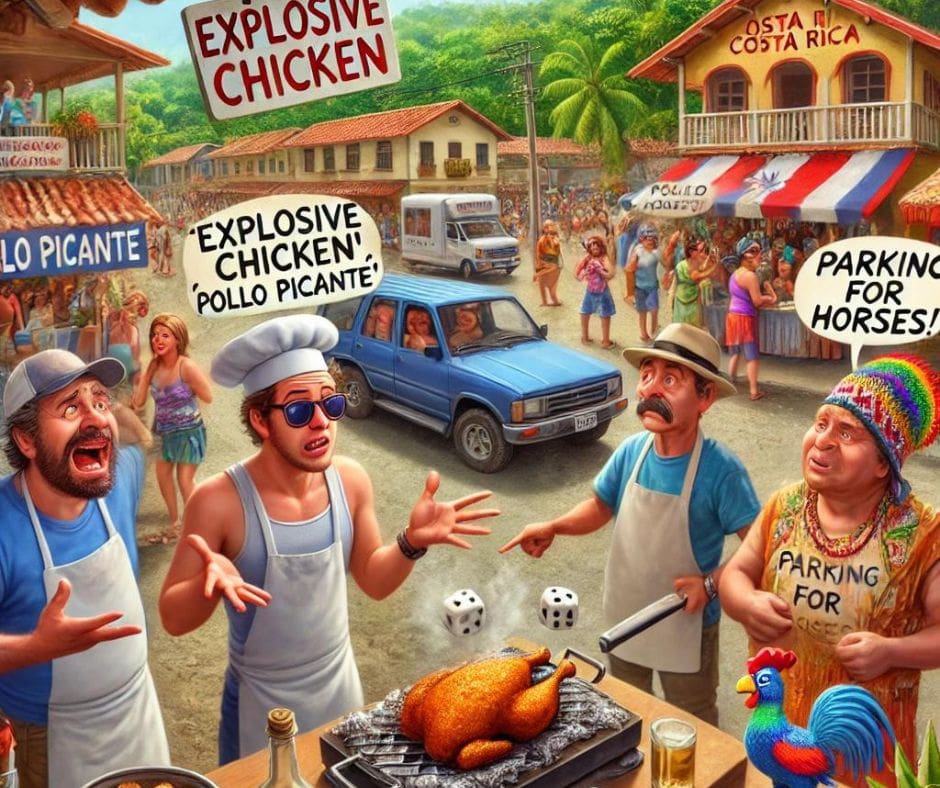
One fine sunny day, a well-intentioned tourist sauntered into a small local eatery with a hankering for some spicy food. With the courage of a conquistador, he declared, “Quiero pollo explosivo!” The bewildered cook, a master of Costa Rican cuisine but not of an explosive ordinance, paused. In Spanish, the tourist had confidently asked for “explosive chicken.” After a hearty laugh and a quick Spanish lesson, the tourist happily settled for “pollo picante,” still fiery but significantly less dangerous.
Where Can I Park My Horse?
A Tico trying his best English once directed a befuddled tourist back to his hotel. With earnest eyes and a confident nod, he advised, “You go straight, then left, and there is a big parking for your horse.” The tourist, momentarily envisioning a throwback to cowboy days, soon realized the local meant “space” not “horse” (‘espacio’ sounding suspiciously like ‘horse’ in English). To the relief of the tourist, his rented Hyundai would have a place to rest, no hay required.
Dancing with the Devil
During a lively cultural festival, a tourist, eager to participate, wanted to know when the “Dance with the Devils” ceremony started. She asked a local, “¿Cuándo comienza la danza con los diablos?” However, her pronunciation led her to inquire about the start time for “the dance with the dice” (“dados” in Spanish). The local, puzzled but ever-helpful, scurried away and returned with a pair of dice and a puzzled look, ready to roll the night away.
The Misadventured Guava
A linguistic mix-up turned a simple fruit purchase into a wild goose chase for an exotic animal. When a tourist attempted to buy guava (guayaba in Spanish), his mispronunciation led him to ask for an “iguana” (iguana). The market vendor, scratching his head but keen to oblige, began discussing prices for the reptile instead of the fruit. It took several minutes and multiple bystanders to untangle the fruity from the scaly in this conversation.
Unintended Marriage Proposal
A romantic evening took a turn for the comical when a tourist attempted to compliment his date, a local Costa Rican. Aiming to say, “You have beautiful eyes” (“Tienes ojos bonitos”), he stumbled and said, “Tienes ojos bonitos matrimonio,” which translates to “You have beautiful eyes, let’s get married.” The unexpected proposal was met with a burst of laughter and, thankfully, an explanation rather than a slap or a sudden engagement.
The Phantom Bathroom
“¿Dónde está el Fantasma?” asked a concerned tourist when trying to locate the restroom (baño). Having confused “baño” with “Fantasma” (ghost), the conversation quickly spiraled into a ghost hunt. The locals, amused and curious, began sharing tales of haunted places nearby, turning a bathroom break into an impromptu ghost tour.
Lost in Sauce
Finally, a culinary quest for a simple sauce turned epic when a tourist asked for “pico de gallo” (a type of salsa) but accidentally demanded “pico de gato,” or beak of the cat. The chef paused, then chuckled, and served up the correct condiment with a side of playful banter about keeping their cats well away from the kitchen.
These linguistic mix-ups, while embarrassing, often end in laughter and a shared sense of human silliness. They remind us that language is not just a tool for communication but also a source of connection, cultural exchange, and endless amusement. So, the next time you find yourself mangling a local language or deciphering a tourist’s creative linguistics, just remember: it’s all part of the travel charm, and who knows? It might just make for a great story back home.