
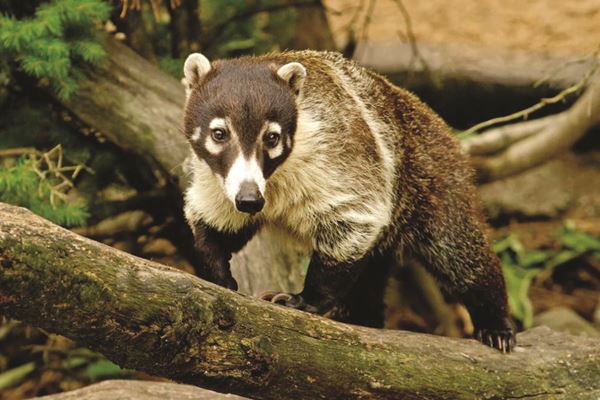
Costa Rica is home to the largest species of coati, Nasua narica, known as the white-nosed coati. They are very fun to watch and are the clowns of the forest.
These animals can grow to 120 cm long, their large, bushy tail making up half that length. Coati use their tails for balance while moving about in the trees, where they spend much of their time foraging for insects, fruits, small mammals, reptiles and amphibians.
White-nosed coati can grow to a weight of 11 to 20 pounds and have a top speed of 15 mph when running. Coati are normally active during the day, sleeping at night.
Female coati live in groups of several animals known as bands, oftentimes include immature males. Adult males live a solitary life, only joining bands for breeding. Breeding usually coincides with the start of the rainy season. Females give birth three months later, the number of offspring ranging from two to seven. Beforehand, pregnant females build a crude nest in a tree or on a high ledge, to protect the young from predators.
 Coati have many predators in the wild. Jaguars, ocelots, foxes, large snakes, birds of prey, humans and domesticated dogs are all known to hunt these docile and highly intelligent creatures.
Coati have the unique ability to descend trees headfirst by reversing their ankles. They are often observed eating their food while hanging upside down from a tree limb by their hind feet.
Coati are also known as coatimundi, hog-nosed coon, moncun, pizote or cusumbo. They belong to the same family as the raccoon and are similar in appearance and behavior.JTNDaWZyYW1lJTIwc3JjJTNEJTIyaHR0cHMlM0ElMkYlMkZ3d3cuamlnc2F3cGxhbmV0LmNvbSUyRiUzRnJjJTNEcGxheSUyNmFtcCUzQnBpZCUzRDNkZWJiNDI1MmY1MyUyNmFtcCUzQnZpZXclM0RpZnJhbWUlMjIlMjBzdHlsZSUzRCUyMndpZHRoJTNBMTAwJTI1JTNCaGVpZ2h0JTNBNDAwcHglMjIlMjBmcmFtZWJvcmRlciUzRDAlMjBhbGxvd2Z1bGxzY3JlZW4lM0UlM0MlMkZpZnJhbWUlM0U=