
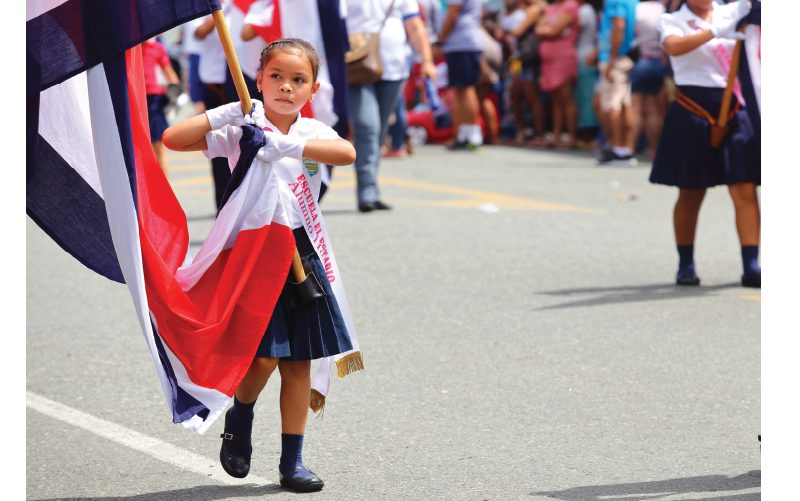
Costa Rica’s Flag: Proudly Waved, Carried and Worn. There is nothing more symbolic of a country’s heritage than its national flag. The flag represents a cultural identity that unites all the people and values it stands for. Costa Rica’s flag is an important element of civic events as well as cultural ones. It is the pride of athletes who wave it after winning international sporting events, and its colors are worn every four years by Tico soccer fans everywhere on earth during the World Cup.
The Costa Rican flag embodies the ideology of the people and the land that holds them. It also represents the establishment of a sovereign and peaceful nation.
Throughout the country’s history, Costa Rica has adopted eight flag designs reflecting different stages of independence. Initially, it was the Spanish flag and after independence, a Mexican flag. From 1823 to 1848, there were variations of a flag with two sky blue bands and a white band.
The country’s geographic, cultural, economic
and political vibrancy shines through
in the coat of arms imagery.
Doña Pacífica Fernández Oreamuno, the wife of Costa Rica’s first president, designed the flag we know today. She was a great admirer of France’s liberal ideas, revolutionary principles and inspiration for independent countries. Depicting the beauty of Costa Rica’s people and land, each color has its significance. Blue is for the skies of Costa Rica, white represents the reigning national peace and red stands for life — the spilling of blood for liberty and the Tico’s generosity of heart.
Symbolic imagery
As an important component of Costa Rica’s flag, the shield, or coat of arms, in the center has also changed over time, from stars and symbols to the current design with water, stars and land. The country’s geographic, cultural, economic and political vibrancy shines through in the coat of arms imagery. At its center are the three most important volcanoes in Costa Rica: Arenal, Poás and Irazú. In front and behind are two vessels portraying the commercial and cultural exchange with the rest of the world, while the blue ocean represents the Caribbean and Pacific ports. Silver stars above correspond to the seven provinces; San José, Alajuela, Cartago, Heredia, Guanacaste, Puntarenas and Limón. To the left, a rising sun on the horizon symbolizes modern Costa Rica’s free and prosperous republic. The green valley depicts the Central Valley as a hub of population and economic vitality. Lastly is the gold frame representing coffee production, since Costa Rica was the Latin American pioneer in establishing this industry.
Some distinct laws pertaining to the Costa Rican flag are interesting. It cannot be flown permanently outside a home, although houses can be adorned with flags, colors and coats of arms during civic festivities. The flag is not allowed to be used in advertising representing a product or political parties. It is flown outside all public buildings and outside the president’s house, and is allowed to be placed on licence plates and cars of particular public officials.
Both the flag and coat of arms are significant Costa Rican symbols. They reflect a common history and are a reminder of the importance of independence and sovereignty, something Ticos are very proud of.
Like this flag? Click: