

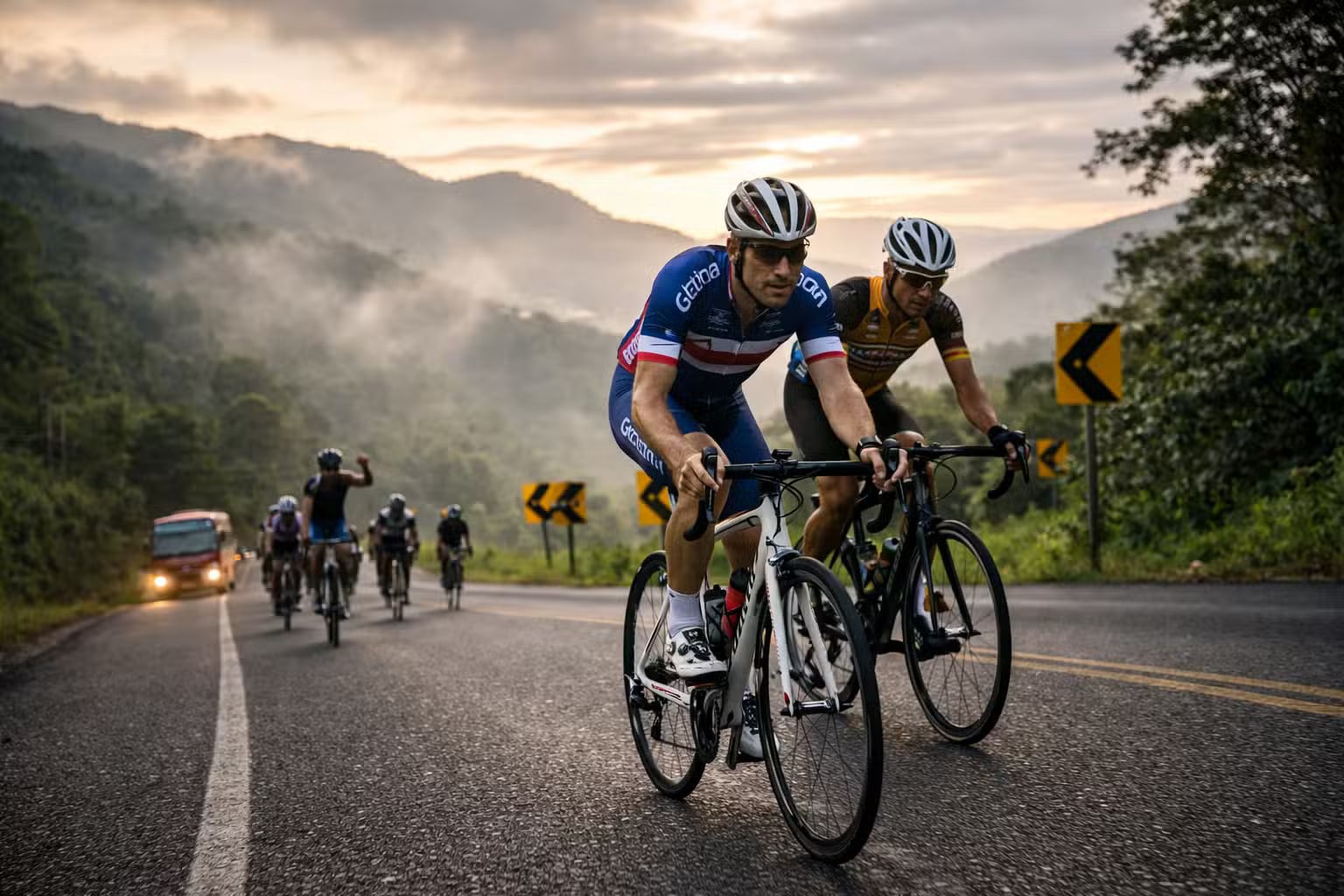
Before sunrise, long before beach towns fill with surfboards and coffee shops start their first pour, Costa Rica’s roads already belong to cyclists. You see them in tight pacelines outside San José, climbing toward the mountains above Heredia, or grinding through heat and crosswinds on Guanacaste highways. Costa Rica’s obsession with Road Bicycling is not a niche curiosity. It is woven into the country’s geography, community life, and athletic identity.
For visitors, this can come as a surprise. Costa Rica is often introduced through rainforest, wildlife, waterfalls, and waves. Yet road cycling has earned a place just as serious, just as beloved, and in many communities, just as visible. To understand why, you have to look beyond the bike itself and into the particular mix of terrain, climate, national pride, and daily discipline that makes the sport feel almost inevitable here.
Why Costa Rica’s obsession with road bicycling feels so natural
Costa Rica is a country built on elevation changes. In a single ride, a cyclist can move from warm lowlands into cool mountain air, pass dairy farms and cloud forest edges, and finish with a descent that feels cinematic. That geography creates natural training grounds few countries can match. Climbs are long, gradients can be punishing, and the rewards are immediate – wide valley views, crisp air, and roads that seem designed to test both lungs and legs.
This terrain has helped shape a culture that respects endurance. Road cycling in Costa Rica is not only about recreation. It carries a strong athletic tradition, especially in the Central Valley, where many serious riders train year-round. The country’s conditions encourage toughness. Even relatively short routes can become demanding because of steep elevation gain, sudden weather shifts, or traffic patterns that require total focus.
Climate plays its role, too. Costa Rica does not have the long winter shutdown that limits riders in much of North America and Europe. That means consistency. Cyclists can train through most of the year, adjusting for rainy-season realities rather than packing the bike away for months. For competitive riders, that matters. For everyday enthusiasts, it keeps the habit alive.
A sport tied to community, not just fitness
One reason road bicycling stands out in Costa Rica is that it often feels communal rather than solitary. Weekend group rides are part training session, part social ritual. Cyclists meet early, compare routes, push each other on climbs, and share recovery stories afterward over coffee or breakfast. There is real camaraderie in the suffering, and Costa Rican riders tend to carry that with a mix of seriousness and warmth.
That social fabric matters because sports culture here is still deeply local. Town pride, regional races, and community support all feed the cycling scene. For many riders, the road is not an escape from daily life. It is an extension of it. Families know the race calendar. Friends follow local results. Young riders grow up seeing cycling as something attainable, not distant.
This is where the country’s smaller scale becomes an advantage. Costa Rica can feel intimate in the best sense. Sporting communities intersect. A strong amateur rider may be known not only within a club but across neighboring towns. That visibility gives the sport energy. It also gives younger athletes role models close to home.
The influence of Costa Rican cycling heroes
No conversation about road cycling in Costa Rica is complete without recognizing the power of national icons. Riders such as Andrey Amador helped put Costa Rica on the global cycling map, showing that a cyclist from this small Central American nation could compete at the highest levels of the sport. That kind of representation matters immensely.
It changes perception. It tells young athletes that elite racing is not something that happens only in Europe or on television. It can begin on the roads they know, on the same mountain routes they ride on weekends. Success stories create ambition, but they also validate the effort that local riders already invest.
At the same time, the true backbone of cycling culture is not celebrity alone. It is the countless local racers, coaches, clubs, mechanics, and dedicated amateurs who keep the ecosystem alive. In Costa Rica, road bicycling thrives because there is admiration at the top and commitment at the ground level.
The roads are beautiful, but they are not easy
For international readers, this is the part worth understanding clearly. Costa Rica can be a spectacular place to ride, but it is not automatically a relaxed cycling paradise. The same roads that deliver jaw-dropping scenery also present real challenges.
Shoulders can be inconsistent. Traffic can be intense near urban centers. Rural roads may be narrow, broken, or wet depending on the season. Climbs that look manageable on a map can feel much harder in tropical humidity. Dogs, buses, potholes, and abrupt weather changes are all part of the landscape. So is the need for strong situational awareness.
That tension is part of what defines the sport here. Riders learn resilience early. They adapt. They start before dawn to avoid traffic and heat. They choose routes carefully. They understand that beauty and difficulty come together in Costa Rica, often on the same stretch of road.
For newcomers, that means road cycling here rewards preparation more than bravado. A good ride starts with route knowledge, weather awareness, visible gear, hydration, and respect for local road realities. The country offers unforgettable cycling, but it asks something in return.
Where the obsession is strongest
The Central Valley remains the heart of Costa Rica’s road cycling culture. This is where population density, mountain access, and long-established riding communities come together. Routes around Escazú, Santa Ana, Heredia, Cartago, and the hills above San José are well known among local cyclists for good reason. They offer serious climbing, cooler temperatures at elevation, and a concentration of riders that keeps the culture visible.
Cartago in particular holds a strong cycling identity. Its surrounding roads provide altitude, challenge, and scenery in equal measure. Climbing toward higher elevations from this part of the country can feel like entering a different Costa Rica – less coastal postcard, more athletic proving ground.
That said, the obsession is not confined to one region. In Guanacaste, riders face sun, wind, and longer open stretches that test a different kind of endurance. In the southern zone, more remote roads can deliver extraordinary scenery and equally serious demands. Across the country, the specifics change, but the attraction remains the same: every ride feels earned.
Why it resonates with visitors and future residents
For travelers and prospective expats, Costa Rica’s road cycling culture offers something deeper than a vacation activity. It reveals a version of the country that is disciplined, local, and deeply connected to the landscape. Riding here strips away the distance between observer and place. You feel the grade of every mountain, the shift in air temperature, the smell of wet earth after morning rain, the rhythm of towns waking up.
That experience can be especially appealing to readers who see Costa Rica not just as a place to visit, but as a place to build a lifestyle. A strong cycling culture signals more than sport. It points to wellness, outdoor community, and a national comfort with active living. For many people considering relocation, that matters as much as beaches and sunsets.
It also reflects a broader truth about Costa Rica. This is a country that celebrates movement through nature. Surfing gets the international glamour. Hiking gets the family appeal. Road cycling occupies a different space – demanding, disciplined, and often humbling. But that is exactly why people fall in love with it.
Costa Rica’s obsession with road bicycling says something bigger
At its core, this passion is about more than bicycles. It is about how Costa Ricans interact with challenge, terrain, and one another. The sport asks for grit, patience, and respect – qualities that resonate strongly in a country where the landscape is generous but never passive.
There are trade-offs, of course. Infrastructure is still uneven, and safety remains a serious consideration. Not every road is rider-friendly. Not every route should be tackled without local insight. But the sport’s persistence, despite those limitations, says a great deal. It speaks to commitment. It speaks to joy found through effort. And it speaks to a national relationship with the land that is active rather than simply admiring.
For anyone trying to understand modern Costa Rica, pay attention to the cyclists before dawn. They tell a story the postcards do not. They reveal a country that does not just admire its mountains – it rides straight into them.
FAQs
Why is road cycling so popular in Costa Rica?
Road cycling is popular in Costa Rica because of its mountainous terrain, year-round riding climate, and strong community culture that supports both amateur and professional cyclists.
What makes Costa Rica good for road cycling?
Costa Rica offers steep climbs, varied elevations, and scenic routes through mountains and valleys, creating ideal conditions for endurance training and challenging rides.
Where is the best place for road cycling in Costa Rica?
The Central Valley, including areas like Cartago, Heredia, and Escazú, is considered the best region due to its elevation, established cycling culture, and access to diverse routes.
Is road cycling in Costa Rica safe?
Road cycling can be safe with proper preparation, but riders must be cautious of traffic, road conditions, weather changes, and limited shoulders in some areas.
Who are the famous cyclists from Costa Rica?
Andrey Amador is one of Costa Rica’s most well-known professional cyclists, inspiring local riders and helping elevate the sport nationally.
What challenges do cyclists face in Costa Rica?
Cyclists face steep climbs, tropical heat, unpredictable weather, narrow roads, and traffic, making rides physically and mentally demanding.