


By Manfred Peters, GM Attorneys at Law
Costa Rica is preparing to implement an important administrative change that will affect newly created companies across the country. While the modification may seem technical at first glance, it is relevant for foreign investors, property buyers, and developers who frequently establish corporations as part of their real estate transactions. Understanding this change in advance can help ensure smooth processes when forming new legal entities in the coming years.
The National Registry has announced that once the current numerical sequence used for corporate identification numbers reaches its maximum capacity, new companies will begin receiving an alphanumeric identification number instead of the traditional numeric format. This change is expected to take effect at the beginning of the fourth quarter of 2026, although the exact implementation date will be formally announced closer to that time.
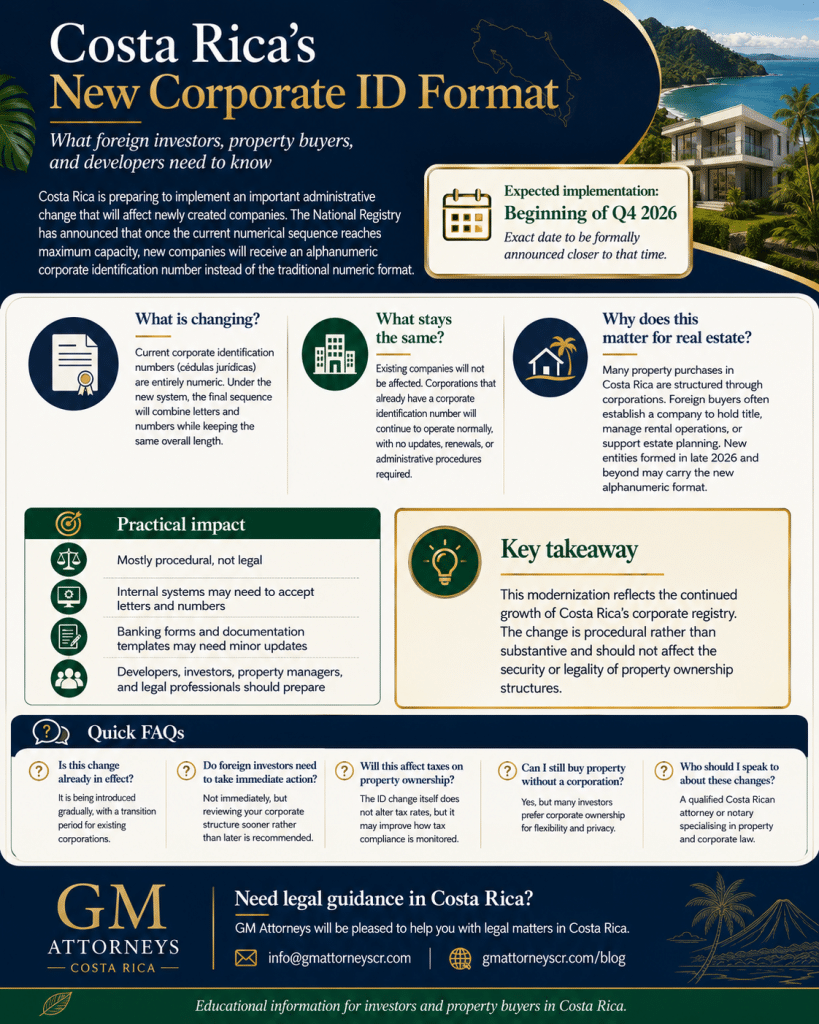
Under the current system, corporate identification numbers — commonly known as cédulas jurídicas — consist entirely of numbers. In the new system, the final sequence will combine letters and numbers while maintaining the same overall length. For example, instead of a number ending in digits only, future companies may receive an identification number that includes a letter followed by numbers in the final segment.
For existing companies, the good news is simple: nothing will change. Corporations that already have a corporate identification number will continue to operate normally, and no updates, renewals, or administrative procedures will be required. The new alphanumeric format will apply only to companies created after the new system becomes effective.
From a real estate perspective, this update is particularly relevant because many property purchases in Costa Rica are structured through corporations. Foreign buyers often establish a company to hold title to property, manage rental operations, or facilitate estate planning. As a result, developers, investors, real estate agents, and legal professionals involved in property transactions should be aware that new entities formed in late 2026 and beyond may carry a different type of identification number.
In practical terms, the change is not expected to create legal complications. However, it may require minor adjustments in administrative systems, documentation templates, banking procedures, and digital platforms that currently assume corporate identification numbers contain only digits. Businesses that frequently create new companies — such as developers, real estate professionals, and property management firms — should ensure their internal systems are flexible enough to accommodate alphanumeric formats.
Overall, this modernization reflects the continued growth of Costa Rica’s corporate registry and the increasing number of legal entities being created each year, particularly in the real estate and investment sectors. For buyers and investors, the key takeaway is straightforward: the change is procedural rather than substantive, and with proper awareness, it should not affect the security or legality of property ownership structures.
Frequently Asked Questions
Is this change already in effect?
It is being introduced gradually, with a transition period for existing corporations.
Do foreign investors need to take immediate action?
Not immediately, but reviewing your corporate structure sooner rather than later is recommended.
Will this affect taxes on property ownership?
The ID change itself does not alter tax rates, but it may improve how tax compliance is monitored.
Can I still buy property without a corporation?
Yes, but many investors prefer corporate ownership for flexibility and privacy.
Who should I speak to about these changes?
A qualified Costa Rican attorney or notary who specialises in property and corporate law.
Frequently Asked Questions
Is this change already in effect?
It is being introduced gradually, with a transition period for existing corporations.
Do foreign investors need to take immediate action?
Not immediately, but reviewing your corporate structure sooner rather than later is recommended.
Will this affect taxes on property ownership?
The ID change itself does not alter tax rates, but it may improve how tax compliance is monitored.
Can I still buy property without a corporation?
Yes, but many investors prefer corporate ownership for flexibility and privacy.
Who should I speak to about these changes?
A qualified Costa Rican attorney or notary who specialises in property and corporate law.
We at GM Attorneys will be pleased to help you with legal matters in Costa Rica! You can contact us at info@gmattorneyscr.com or visit our website and blog section at https://gmattorneyscr.com/blog/




https://gmattorneyscr.com/