
Discover a few interesting facts about Costa Rica Independence Day and rejoice with the country for its years of freedom on September 15!
You’ll notice businesses, homes and vehicles are proudly displaying blue, white and red Costa Rican flags, banners and decorations.
On September 15, 1821, a crucial Central American congress signed “The Act of Independence” asserting that Guatemala, El Salvador, Honduras, Nicaragua and Costa Rica were free and unbiased of the Spanish Empire.
Even though September 15 is the day the independence was declared, it wasn’t until October 13 that the news reached Costa Rica. The messenger had to travel by horseback from Guatemala with the official declaration.
There was no fight required for independence in Central America. With its resources depleted by the battle with Napoleon Bonaparte, and a few Latin American wars, Spain really supported independence because the area had ended up as a burden.
Costa Rica ultimately became a totally independent country in 1838, when it separated from the Central American Republic.
September 15 is a countrywide holiday, with agencies, banks and other establishments closed.
Each year, a symbolic independence torch travels from Guatemala to Costa Rica’s colonial capital of Cartago, east of San José, arriving on Sept. 14. Like the Olympic torch, the independence torch is carried throughout the critical American countries in a relay by using runners.
On the evening of September 14, Costa Rica starts its large party in every town throughout the country with a traditional midnight lantern parade (Desfile de Faroles) by schoolchildren. Children convey colorful homemade paper and wooden “lanterns” (in recent times with LED lighting fixtures) in the shape of homes and other gadgets in a reenactment of the 19th-century journey that delivered the message of independence to Costa Rica.
The Central America map 200 years ago
School marching bands, color guards and folkloric dancers parade through almost every town on the morning of Sept. 15. Schoolchildren practice for several months in preparation.
Traditional food and souvenir are typically sold through street vendors.
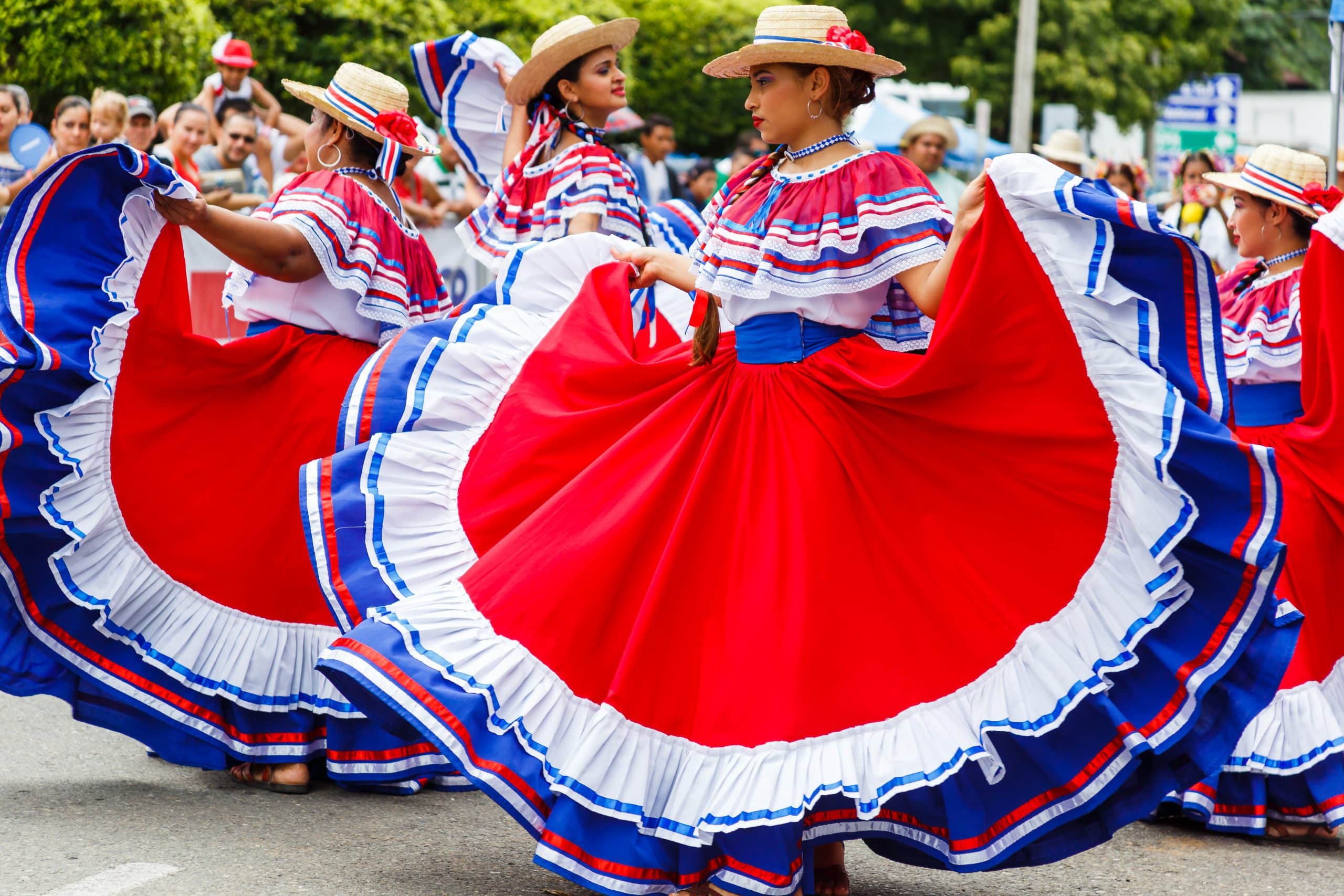
Costa Rica conventional clothing for men is normally white cotton pants and a white button-up shirt with a red sash belt, a red handkerchief tied at the neck, and a straw hat. Ladies put on lengthy, flowing, bright multi-colored skirts in layers, with a white, ruffled, sleeveless blouse (normally embroidered with ribbons), a choker band necklace, and their hair pulled up in complex braids or a bun and adorned with a big flower.
Costa Rica’s national anthem was created in 1853, with the music composed by Manuel María Gutiérrez, but it wasn’t till 1900 that the current lyrics were introduced by José María Zeledón Brenes.
Costa Rica is a democratic and peaceful country and has not had an army since 1948.
Costa Rica’s countrywide flag is striped blue, white, red, white and blue. The color blue signifies the sky, white is for peace, and red is for the warmth and courage of the Costa Rican people. The current flag has been in place since 1964.
The National Seal of Costa Rica features three green volcanoes representing the nation’s three principal mountain ranges, a distinct Central Valley, the two oceans of the Pacific and Caribbean that border the nation, and merchant ships that symbolize commerce and the country’s maritime history. A rising sun represents Costa Rica’s prosperity, and the seven stars in the sky are for the country’s seven provinces. Two myrtle branches, above the words “Republica de Costa Rica,” symbolize Costa Rica’s peaceful nature. The seal is framed in gold with small circles that represent coffee, known in Costa Rica as “golden beans.”
Complete the online puzzle, click the lower right rectangle icon
JTNDaWZyYW1lJTIwc3JjJTNEJTIyaHR0cHMlM0ElMkYlMkZ3d3cuamlnc2F3cGxhbmV0LmNvbSUyRiUzRnJjJTNEcGxheSUyNmFtcCUzQnBpZCUzRDFhNzE5ZGJiNTNiYyUyNmFtcCUzQnZpZXclM0RpZnJhbWUlMjIlMjBzdHlsZSUzRCUyMndpZHRoJTNBMTAwJTI1JTNCaGVpZ2h0JTNBNjAwcHglMjIlMjBmcmFtZWJvcmRlciUzRCUyMjAlMjIlMjBhbGxvd2Z1bGxzY3JlZW4lM0UlM0MlMkZpZnJhbWUlM0U=