You notice it first in the small gestures. A warm greeting before business. Coffee offered before conversation gets serious. Music drifting into a town square before a festival officially begins. When people search for costa rica cultural traditions explained, they are usually asking a bigger question: what makes life here feel so distinct, so grounded, and so welcoming at the same time?
The answer is not one custom, one holiday, or one phrase. Costa Rican culture is a living blend of Indigenous roots, Spanish colonial influence, Afro-Caribbean heritage, rural farming traditions, Catholic observances, and a modern national identity shaped by education, democracy, and a close relationship with nature. For visitors, future residents, and anyone considering deeper ties to the country, understanding those traditions adds context that no resort itinerary can provide.
Costa Rica cultural traditions explained through everyday life
One reason Costa Rica feels different from other destinations is that its culture often reveals itself in ordinary routines rather than staged performances. A lot of what matters here happens around the table, in the plaza, at school events, during patron saint celebrations, and within families that stay closely connected across generations.
That is where the famous phrase pura vida belongs. Visitors often hear it translated as a slogan, but locals use it more flexibly. It can mean hello, goodbye, no problem, all good, or simply a way of acknowledging life as it is. It reflects optimism, but not naivete. In practice, pura vida suggests appreciation, patience, and perspective. It does not mean Costa Rica is free of stress or social challenges. It means there is cultural value placed on enjoying what is good, staying human with one another, and not letting urgency define every interaction.
That attitude shows up in social etiquette. Greetings matter. Rushing into a request without some personal warmth can feel abrupt. Time can also be interpreted differently depending on the setting. In business, things may be more structured, especially in urban centers. In community life, there is often more elasticity. For newcomers, this is less about being late and more about understanding that relationships still carry real weight.
Family, community, and respect
Costa Rican society has long placed strong emphasis on family ties. Grandparents, cousins, siblings, and in-laws often play active roles in daily life, childcare, celebrations, and decision-making. Even as urbanization and global work patterns change routines, the family remains a central unit of support.
Respect is part of that structure. Children are often taught to greet elders properly, use polite language, and show consideration in shared spaces. For foreigners, this is useful to understand because many social settings in Costa Rica still run on courtesy before efficiency. If you are relocating, that matters in neighborhoods, schools, and local offices just as much as it does at dinner.
Community identity is also strong. Small towns, beach communities, and city neighborhoods often organize around local festivals, sports events, church activities, and school functions. It is one reason people who move to Costa Rica sometimes feel welcomed quickly, but also why integration takes more than admiration. Showing up, participating, and learning local rhythms counts.
Festivals are not just for tourists
If you want costa rica cultural traditions explained in the most vivid way, spend time around a local festival. Costa Rica’s calendar is filled with civic holidays, religious observances, and regional celebrations that mix devotion, food, music, horses, dancing, and collective pride.
One of the most beloved traditions is the pilgrimage to the Basilica of Our Lady of the Angels in Cartago on August 2, honoring La Negrita, the country’s patron saint. For many Costa Ricans, this is a deeply spiritual act, not a spectacle. Thousands walk long distances in fulfillment of promises, prayers, or gratitude. Even for nonreligious observers, it reveals how faith and national identity still intersect.
Then there are the town fiestas, where the atmosphere turns more playful and communal. Depending on the region, you may find parades, traditional music, carnival rides, rodeo-style events, and food stalls serving local favorites. These celebrations can feel relaxed and family-oriented, but they also carry regional flavor. What happens in Guanacaste may feel very different from what you experience on the Caribbean coast or in the Central Valley.
That variety matters. Costa Rica is often marketed as a single tropical identity, but culturally it is more layered than that. Regional traditions are part of the story.
Guanacaste, Limón, and the country’s many cultural currents
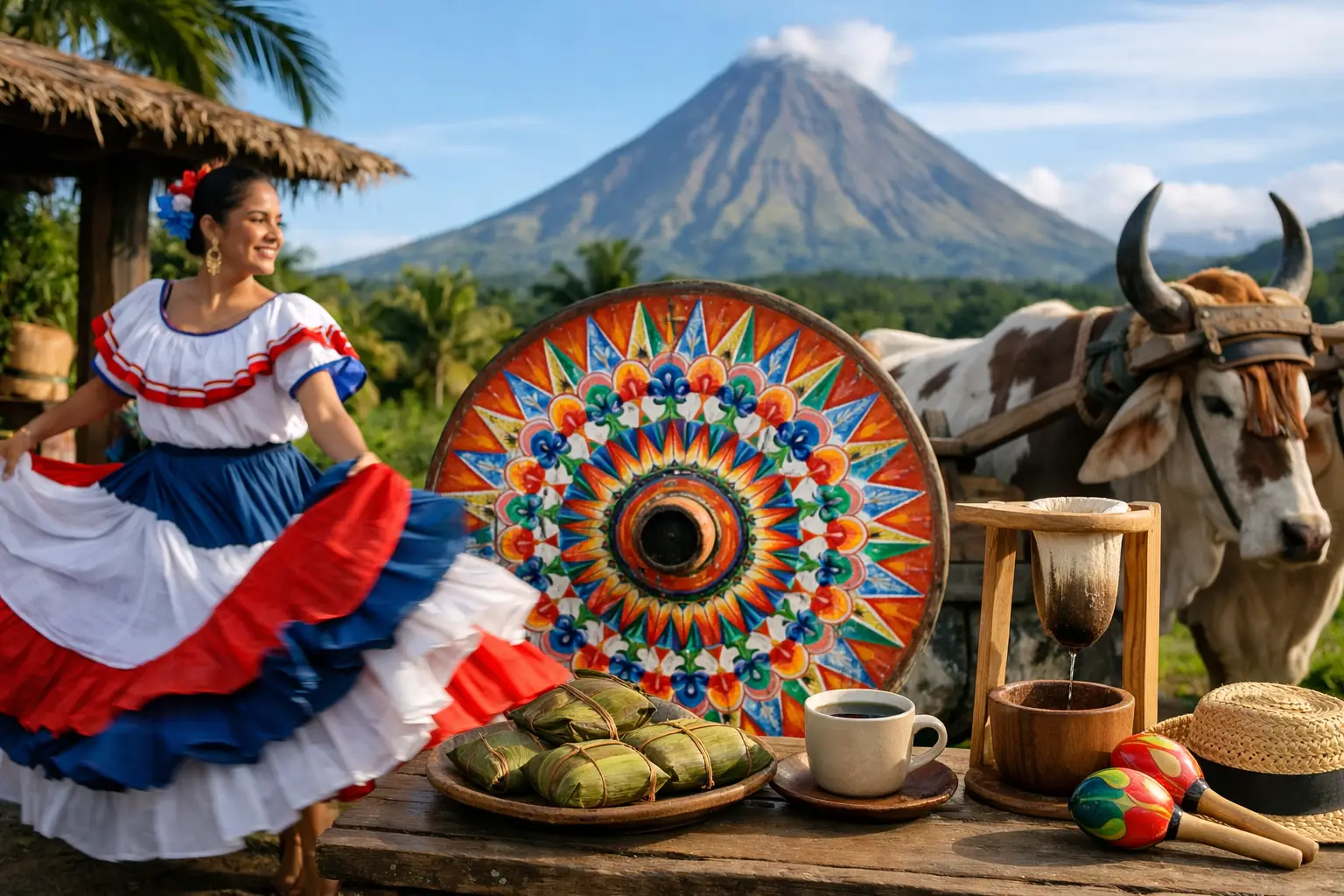
Guanacaste is often associated with some of Costa Rica’s most recognized folkloric traditions. Marimba music, bomba dances, traditional dress, sabanero or cowboy culture, and foods made from corn all connect to the province’s ranching history and ties to Mesoamerican heritage. Annexation Day on July 25 is especially meaningful there, commemorating Guanacaste’s voluntary incorporation into Costa Rica in 1824.
On the Caribbean side, Limón brings a different cultural pulse shaped by Afro-Caribbean history, migration, language, cuisine, and music. Calypso is one of the clearest examples. It is not an imported novelty but part of a living cultural expression with local legends and deep roots. Rice and beans cooked in coconut milk, patí, plantains, and Caribbean spices tell their own story of identity and resilience.
The Central Valley, home to major cities and much of the country’s political and economic life, often reflects a more mixed and contemporary version of tradition. You will still see religious processions, family-centered holidays, and classic foods, but often alongside global lifestyles, modern commerce, and fast-changing urban habits.
This is one of the healthiest ways to understand Costa Rica: not as a museum of folklore, but as a country where multiple cultural currents continue to evolve.
Food traditions say more than menus do
Costa Rican food is often described as simple, and in some ways that is true. It tends to favor fresh ingredients, balanced plates, and familiar staples over heavy seasoning or elaborate presentation. But simple does not mean generic.
Gallo pinto is more than a breakfast dish. It is a national habit, a comfort food, and a marker of home. Tamales become especially significant around Christmas, when families gather to prepare them assembly-line style, wrapping seasoned masa and fillings in banana leaves. Olla de carne, chorreadas, arroz con pollo, casados, and coffee all carry social meaning beyond taste.
Meals in Costa Rica are often tied to hospitality. Being offered coffee, juice, or something to eat is a common expression of welcome. Turning every meal into a foodie trend misses the point. The tradition is not performance. It is generosity, continuity, and the pleasure of feeding people well.
Music, dance, and the sound of place
Traditional culture in Costa Rica is not silent, and it is not limited to formal stages. Music shows up at civic events, family gatherings, religious celebrations, school performances, and local festivals. Folk dancing is often taught to children as part of cultural education, helping preserve regional costumes, rhythms, and stories.
The marimba remains one of the most iconic traditional instruments, especially in Guanacaste. On the Caribbean coast, calypso carries a different emotional texture, with humor, memory, and social commentary woven into song. Elsewhere, cumbia, salsa, reggaeton, and global pop are fully part of modern life.
That mix is worth paying attention to. Traditions endure in Costa Rica not because the country resists change, but because old and new are constantly negotiating space.
Nature is cultural, not just scenic
International audiences often approach Costa Rica through rainforest, wildlife, surfing, and wellness. All of that matters, but there is a mistake in treating nature as separate from culture. For many Costa Ricans, the land is tied to family livelihood, national pride, recreation, and identity.
Agricultural traditions still shape many communities, whether through coffee, sugarcane, cattle, bananas, or small-scale farming. Conservation, too, has become part of the modern national story. That does not mean every development debate is settled or every environmental choice is simple. Costa Rica faces real pressure around growth, infrastructure, and land use. Still, there is a widely shared belief that the natural environment is not disposable. That belief has cultural force.
For travelers and expats, this distinction matters. Appreciating Costa Rica means more than enjoying the view. It means understanding why beaches, forests, rivers, and farmland carry emotional and economic meaning for the people who live with them every day.
What visitors and new residents often get wrong
The most common misunderstanding is reducing Costa Rican culture to friendliness. Yes, Costa Ricans are often warm and approachable. But warmth is not the whole story. There are social codes, regional differences, class realities, political opinions, and local expectations that deserve respect.
Another mistake is assuming tradition means old-fashioned. Costa Rica is modern, digitally connected, and internationally engaged. Its culture includes start-up founders, surfers, farmers, artists, retirees, activists, and multigenerational families navigating rapid change. Tradition here is not frozen in time. It is part of how people adapt.
If you want a more authentic experience, curiosity works better than certainty. Attend the town event. Try the homemade tamal. Listen before comparing everything to home. Learn why a holiday matters to locals before photographing it. That is where a destination starts becoming a place.
Costa Rica’s traditions are best understood not as attractions to consume, but as invitations to pay closer attention. The more you notice the values beneath the festivals, food, and familiar phrase of pura vida, the more the country reveals itself.