
In the ancient days, when the gods still spoke through fire and tide, two
destinies never meant to cross were born. Lovers condemned to be parted. Since
then, with every dusk, the world remembers that wound. It was not fortune that
brought them together, but the very instant when day surrenders its kingdom to
the night. There, where everything ends and everything begins, this story also
began.
It was in a summer of ancestral heat —one of those summers in which the
earth seems to remember its origin of fire— when the Chorotega tribe celebrated,
amid songs and the ritual smoke, the birth of the one who would become their
next Cacique. They called him Nicoa, which in the language of dreams means “with
water on both sides”, or else, “he who arrives as one who has already been”. He was born at
the day`s decline, on that threshold the priests did not dare to name directly —for
to name it was, they believed, to interrupt it— when the sky dressed itself in
blazing oranges and solemn purples, as though the firmament were performing a
farewell it had been rehearsing since the beginning of the world. And it came to
pass that in that same instant, measured not by humans but by the secret pulse that
holds the stars in their place, another tribe, in a parallel distance, was also
celebrating a birth. The Nahua named their princess Nosara. Silent as the moon’s
first appearance over waters that still did not know they were liquid. Thus they
came into the world, not by chance —for chance is only the name ignorance gives
to design— but as an answer. He, beneath the ardent inheritance the sun bestows
upon the day; she, beneath the moon’s serene custody through the nights. Children
of contrary lights and yet united in the twilight, that impossible point where time
bends back upon itself and where destinies, like rivers, already know the sea they
are bound to reach, even though they have never seen it.
With the years, Nosara became a keeper of the secrets that heal —though
she herself doubted whether she healed bodies or simply reminded them how to
die with grace—. She was not merely a student of herbs; she knew the green pulse
of every root and the grammar of every leaf as one knows the script of a language
older than words. Above all, she was an interpreter of an older science: the volcano
itself. That library of fire, which humans mistake for a threat because they do not
know how to read. She would say, with the quiet certainty of one who does not need
to convince anyone, that in the burning depths of the mountain the god Numu and
the goddess Yu’yú —Sun and Moon— met for an eternal instant, lovers
condemned to touch only at the edges of the world; in the steam, in the blade
between lava and stone. And in every crack of fire, in every column of smoke that
rose like a message without a recipient, she believed she could read the traces of an
embrace that never ends because it never quite begins.
Nicoa, for his part, grew the way lightning is born: in tension, in prior
silence, in destiny. He became a warrior under the rigor of dawn, training each day
until his body forgot exhaustion and remembered only will. The elders said that in
his gaze lived the edge of the sun —that light which illuminates and blinds at
once— and that his steps were already those of one who does not fear the end,
because he suspects that the end and the origin are the same thing seen from
opposite sides of time.
There came then the two hundredth feast in honor of Numu and Yu’yú,
when the Chorotega and the Nahua laid down their weapons to offer prayers to the
earth. It was a suspended time, a parenthesis in history, where discord dissolved
into dances and drums that imitated the primordial heartbeat of the world. No one
knew whether the peace held because the gods sustained it, or because men had
simply stopped remembering that they were enemies. In the midst of that ritual,
Nosara slipped away in silence, like one who obeys a voice that is not heard but
inhabited. She walked toward the beach, where the sand —so white it held the light
rather than reflecting it— seemed to contain the memory of every dusk that had
ever fallen upon it.There, in the solitude she had chosen, within the eternal sighing
of the sea, she found Nicoa.
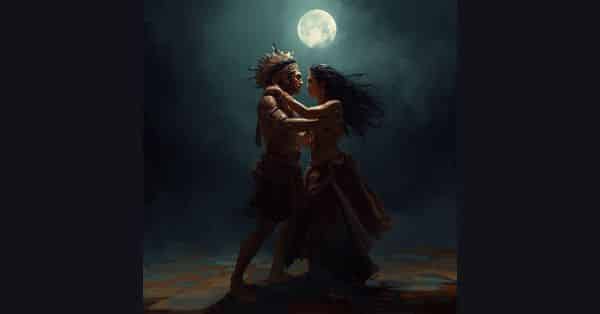
They looked at each other.
It was not an encounter, but a recognition. The instant in which two forms
remember that they were once a single thing, before the world learned to make
distinctions. The evening sky opened like a wound, spilling colors that no name
could contain: pinks that seemed like memories of something that never happened,
oranges that floated like questions forgotten by the centuries, blues that neither
arrived nor left, and a purple so deep that to look at it too long was to feel one’s
memory gently erased. The sky itself seemed to hesitate between saying farewell
and staying, between being the sky and becoming something else.
Then their breaths met —and the wise men would debate for generations
whether it was an instant or an eternity, never understanding that both words point
to the same thing—. A gust, a flash that blinded even the horizon, which is the
place where light goes to die and always survives. And the world, for that moment
without duration, rewrote itself.
When they opened their eyes, the sea was no longer entirely sea: across its
surface a living constellation had bloomed, as though the sky had descended to
gaze at itself in a mirror that did not know it was one. The waters, lit by an
ancestral bioluminescence that the wise men would later call the memory of the original
fire, traced paths of light —the same routes the stars have drawn in silence since
before there were eyes to see them—. And so, between the sky that descended and
the sea that rose, the paths opened. As though the universe were remembering its
promise. A mutual recognition: the universe remembering that they existed, and
they remembering that the universe had foreseen them.
That night, neither spoke. There were no words for what had occurred, and
both knew it with the same silent certainty with which one knows the sun will
return tomorrow without anyone asking it to. They parted before dawn, each
toward their tribe, their name, the destiny others had written for them. But
something had shifted in the shape of the world. As though two rivers, having
touched their waters for an instant, could no longer pretend they were flowing
toward different seas. And so began what had no permitted name.
For two years, Nicoa and Nosara sought each other in secret. Always on the
same white beach of star ash that seemed never to have been touched by time.
Always at the same uncertain hour of dusk, where day and night grow confused
and where both of them, as though they belonged there, could exist without guilt
or name. They met not as children of enemy tribes, but as the two halves of an
ancient, forgotten word. But the world of humans does not forgive what the
cosmos consents to.
It was a forbidden love. The tribes, united only in truce, were built on
memory and rancor. Nicoa’s father, Cacique of the Chorotegas, would never have
permitted it. And Nosara, already promised, carried upon herself a sealed destiny.
She was to be joined to Nambí, future Cacique of the Nahua, a man of immoderate
strength and somber spirit, in whom violence and jealousy were not vice but
nature. Nambí had executed three men for looking at her. He was the kind of man
who does not threaten but acts, and then forgets, because for him there is no
difference between a decision and a sentence. Nosara knew this. And she knew too
that if Nambí came to suspect, there would be no twilight and no god capable of
standing in his way. Thus, their love was not merely secret. It was a sentence written
in advance.
It was said —and the wise men confirmed it in low voices, as one reveals a
secret— that their convergence was not by chance. That Nicoa was not merely a
warrior, but the embodiment of the power of the god Numu; and that Nosara, in
her gift of healing and understanding the hidden, carried the essence of the
goddess Yu’yú. They were, in flesh and time, the repetition of an ancient design:
that of two forces destined to seek each other without ever being permitted to
remain united. The curse did not reside in the hatred of the tribes, but in
something older and more sacred. Both had been born mere instants apart, one
beneath the declining sun, the other beneath the rising moon. Between them lay
not distance, but destiny. And so, like day and night, they could touch only in
transit —in that brief trembling of the world where everything seems possible…
But nothing can stay.
Then destiny, which until that moment had been no more than a whisper
among the gods, took shape upon the earth and became violence. Nambí —already
Cacique-elect of the Nahua, already shadow before man, learned of the love that
betrayed him. He did not deliberate. He did not summon his warriors or wait for
the counsel of the elders. He descended to the beach where the world stood still
for them, in the silence before dawn, when the birds have not yet yielded their turn
to the crickets and the world still belongs to what has no name. He found her
there, with Nicoa, as he had feared. As he had known, in truth, all along.
There were no words. In men like Nambí, words are a luxury reserved for
afterward —for when the act is already done and only regret remains. He
advanced with the knife in hand, with that terrible calm of one who has decided
and no longer doubts. Nicoa turned barely in time. The blade grazed his side like a
warning from destiny, or perhaps its first signature. Nosara did not cry out. Those
who have learned to read the volcano do not fear fire; they know there are
moments when the only possible response is simply the one that occurs, like steam
that rises, like the tide that asks no permission. She drew the bow with the same
certainty with which she had drawn her whole life —that of one who acts not out
of rage, but out of understanding. The arrow parted the air before thought could
stop it, and found Nambí’s chest with the quiet precision of the inevitable. He fell
upon the sand. And the sand —white, nearly untouched, silent witness to all that
had passed between them— received that blood slowly, the way one receives a
memory one did not ask for but will keep forever. Gradually, the red spread
through it. Turned it rose-colored. And so, they say, the pink beach was born: not
from love, but from its price.
There was no victory in that act, only understanding. The same cold, clear
understanding that arrives when the world finally shows its true face. Nicoa and
Nosara looked at each other over the fallen body, and in that silence, they knew
what could no longer be undone. She had killed her own Cacique. He was the cause
of a war that would not end with his own death, but would survive for generations,
as all wounds survive that no one knows how to forget. They did not speak. Words
belong to the world of the living who still believe they can change something, and
they had already crossed that threshold.
They walked inward, into the jungle. They left behind the beach and its
memories, and the forest received them as it receives everyone: without judgment,
without haste, with that generous indifference that belongs to ancient things. The
guanacaste trees closed their branches above them like the vaults of a cathedral that
nature had raised in silence, and the earth —dark and damp— pulsed beneath their
feet, alive with roots that intertwined as though dreaming together, and with
insects murmuring an ancient melody; it softened their steps, as though the
ground, in a gesture of modesty, refused to hear its own farewell.
They crossed nameless blue rivers, waterfalls born in the deepest folds of
the world, where time had not yet learned to count itself, and which left in the air,
as they passed, a scent of mineral and centuries. Scarlet macaws crossed the sky like
flashes from another reality —red as the fire that awaited them, blue as the
impossibility of love— and howler monkeys called from the heights with that voice
that sounds like mourning, and perhaps it was. They understood, with the lucidity
of the condemned, that their destiny was never to be together upon the earth, but
to long for each other within it. They climbed while the night finished being born
and the sky, as on the day of their origin, as on every day they had ever met—
hesitated between two lights: the one departing and the one arriving, neither quite
deciding. Like the sun and the moon. Without words, they took the same path that
Nosara had learned to read in the smoke and the stone. The path of the volcano.
As though their whole lives had been the road toward this point where fire and
stone grow indistinguishable and the world admits, at last, what it cannot sustain
upon its surface. They gave themselves to the fire. And the fire, which does not
forget because it has no memory but only is, transformed them.
Since then, say the ancients, Nicoa dwells in the burning core of the volcano,
as pulse and force, as contained fury; and Nosara in its vapors and exhalations, in
the living memory of what heals and burns at once. They are not together —for
not even sacrifice breaks entirely the law that separates them— but neither are they
entirely apart. Because at dusk, in that instant which belongs neither to day nor to
night, the volcano glows with a different light. There are places where time does
not advance, but waits. A beach, a volcano, an hour, a convergence. These are
enough for destiny to repeat itself. And those who look carefully say they can see,
in that radiance, two presences seeking each other. There, where the world wavers,
where time cannot decide, Nicoa and Nosara meet again. Not in the land of
humans, but in the only place where their love was possible from the very
beginning: the instant.
—————————–
The elders say that night the stars changed place. They also say that they did not change at all. Both things are, as tends to happen with truth, equally true.