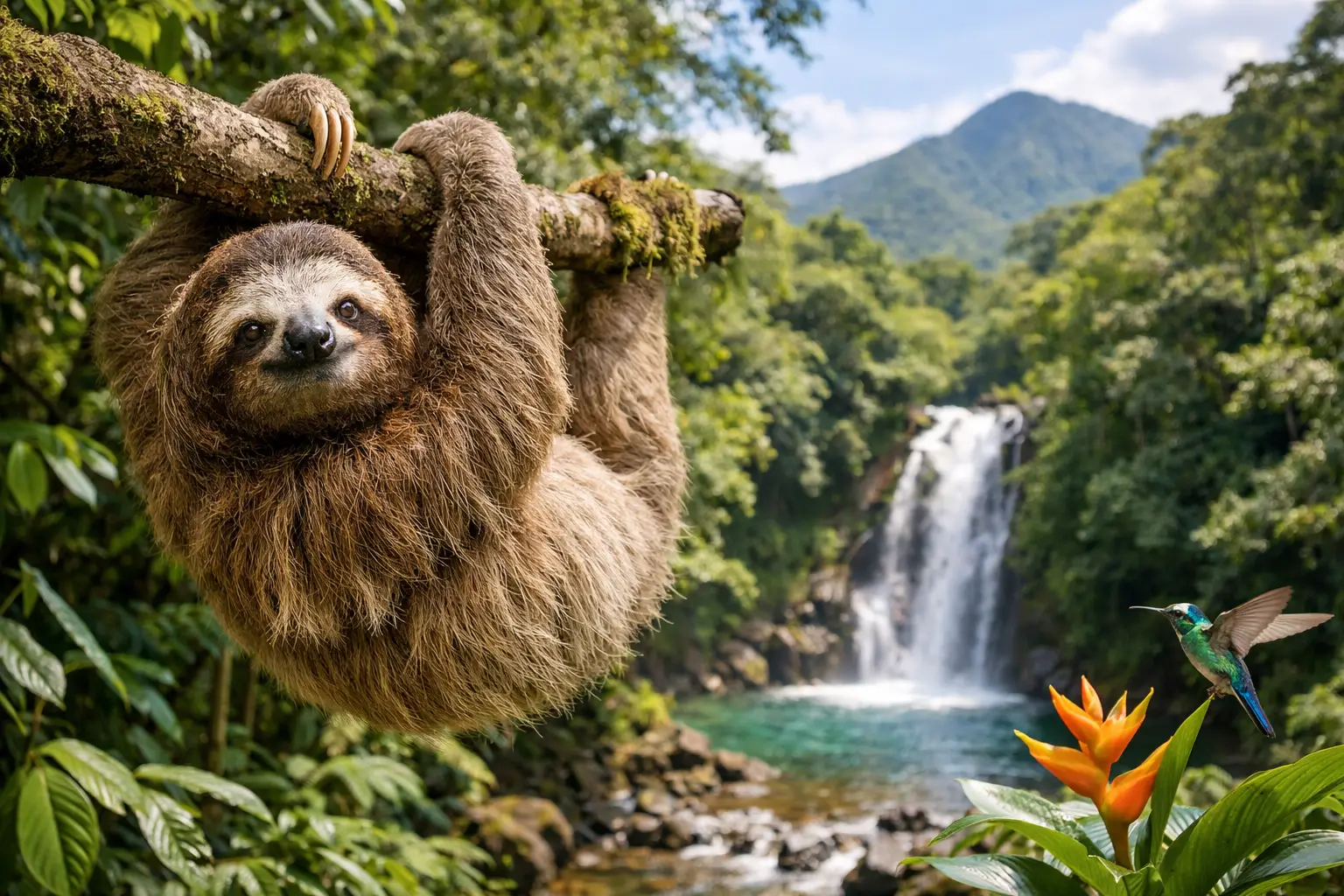
You can be driving a dusty back road near the beach, thinking about lunch or the next waterfall, when someone in the car suddenly shouts, “Stop!” Everyone piles out, stares into a tangle of cecropia branches, and there it is – a fuzzy face, a hooked arm, and a smile that looks almost borrowed from a dream. Sloths do that in Costa Rica. They turn ordinary moments into stories you tell for years.
For many visitors, seeing one feels like a lucky bonus. For those who live here, sloths are part of the emotional landscape of the country, as iconic as scarlet macaws, howler monkeys, and late-afternoon rain rolling over green hills. They are adored, photographed, painted on murals, and printed on souvenirs. But behind the charm is an animal with a highly specialized life, and that life depends on forests that still function.
Why sloths fascinate us
Part of the appeal is obvious. Sloths seem to reject the frantic pace most of us have accepted as normal. They move slowly, rest often, and appear completely uninterested in urgency. In a country celebrated for natural beauty and a more balanced way of living, that image lands especially well.
But sloths are not lazy cartoon mascots. They are masters of energy conservation, shaped by evolution to survive on a low-calorie diet of leaves. Their bodies are built for hanging, gripping, and making the most of very little. What looks like a leisurely lifestyle is really a precise biological strategy.
That is what makes them so compelling. They are cute, yes, but also a little mysterious. Their movements are deliberate. Their expressions seem thoughtful. They live above us in plain sight, yet many people walk right past them.
The two kinds of sloths you may see
Costa Rica is home to two species: the two-toed sloth and the three-toed sloth. If you are visiting for a week and hoping for a sighting, the distinction may not matter at first. You will probably just be thrilled to spot one curled in a tree. Still, knowing a bit more makes the encounter richer.
Three-toed sloths
The three-toed sloth is often the one people imagine first. It has a smaller, rounder face and a gentler, almost permanently amused expression. It tends to be active during the day, which improves your odds of seeing one on a walk, roadside stop, or hotel grounds with mature trees.
Its diet is highly selective, and it often favors cecropia trees, the lanky, fast-growing trees that show up in disturbed areas and forest edges. If a guide points at a cecropia and asks everyone to scan carefully, pay attention. That is classic sloth real estate.
Two-toed sloths
The two-toed sloth is usually larger, with a shaggier look and a face that can appear more pronounced around the nose and eyes. It is more nocturnal and often harder to observe clearly unless you are out in the evening or happen to catch one resting in a visible spot.
It also has a somewhat broader diet and behavior pattern. To the casual observer, both species look equally enchanting. To naturalists, the differences are part of Costa Rica’s constant reminder that even the most familiar wildlife is more complex than it first appears.
Where to see sloths in Costa Rica
Sloths can be found in many parts of the country, especially where forest cover remains connected and food trees are available. The Caribbean side has a strong reputation for sightings, and for good reason. Lush vegetation, humidity, and abundant wildlife make places like Puerto Viejo and the southern Caribbean especially rewarding.
That said, the Pacific side offers plenty of opportunities too. Manuel Antonio, the South Pacific, parts of Guanacaste with healthy forest corridors, and inland regions with river habitat and protected land can all produce memorable encounters. Sometimes the best sloth sighting happens not in a national park, but in a boutique hotel garden, a roadside almond tree, or a quiet residential area with mature canopy.
This is where Costa Rica shines. Wildlife is not always locked behind gates. In many communities, nature still overlaps with daily life.
Sloths and the Costa Rican landscape
Sloths thrive when the landscape works as a network, not as isolated green patches. A single tree in a parking lot may look lovely, but it is not enough. These animals need connected habitat to move, feed, find mates, and avoid danger.
That matters because development pressure is real. Roads, power lines, land clearing, and fragmented construction can turn a healthy habitat into a risky obstacle course. One of the hardest truths behind the country’s favorite wildlife photos is that many rescued sloths arrive at sanctuaries because they were injured crossing roads, electrocuted on wires, or displaced by habitat loss.
Costa Rica deserves credit for protecting significant areas of forest and for building a global identity around conservation. Still, success is never permanent. It depends on policy, enforcement, local stewardship, and practical planning. Wildlife corridors, responsible infrastructure, and tree retention are not abstract environmental ideals. For sloths, they are the difference between survival and decline.
How to watch sloths without harming them
Seeing a sloth in the wild is special partly because it is on the animal’s terms. That is the whole point. The best encounters are patient, quiet, and respectful.
Keep your distance, especially if a sloth is moving low to the ground. Never ask a guide to make it “come closer” for a photo, and never support businesses that offer direct handling for social media moments. A sloth clinging to a person may look calm, but stress in wildlife is not always obvious to untrained eyes.
Good wildlife viewing also means managing expectations. Sloths are famous, but they are not performers. Sometimes you will see little more than a back, a paw, or a sleepy face tucked into leaves. That still counts as a wonderful sighting. In fact, it usually means the animal is simply living its life.
If you want the best experience, go with a knowledgeable naturalist guide. They can spot what most people miss and help interpret behavior, habitat, and species differences. The story becomes much bigger than a checklist photo.
Why sloths became symbols of Costa Rica
There is something fitting about the way sloths have become ambassadors for the country. Costa Rica has long attracted people searching for beauty, biodiversity, and a different relationship with time. Sloths embody that fantasy, but they also anchor it in reality.
They remind us that this country’s magic is ecological before it is commercial. Visitors may arrive for beaches, surfing, real estate tours, wellness retreats, or retirement scouting, but what often stays with them is the feeling of being in a place where wild creatures still shape the mood of a day.
That is no small asset. It supports tourism, education, and national identity. Yet it also creates responsibility. When an animal becomes a symbol, the risk is turning it into branding while neglecting the living habitat behind the image. Costa Rica is at its best when admiration leads to protection.
What sloths teach the rest of us
It is tempting to turn sloths into life coaches with fur. Slow down. Rest more. Stress less. There is a grain of truth there, even if the animal itself is simply following biology.
What sloths really offer is perspective. They show how much life can happen above eye level, beyond our schedules and screens. They invite attention. They reward patience. In a place as visually generous as Costa Rica, that matters. The country is full of spectacular scenes, but sloths ask for a quieter kind of seeing.
And maybe that is why people love them so much. Not because they are rare celebrities, though they can feel that way, but because they change the tempo of the moment. You stop. You look longer. You notice the shape of leaves, the architecture of branches, the fact that an entire small life was there all along.
That is a pretty good way to travel, and an even better way to care for a place. The next time a car pulls over and someone points into the trees, take your time before asking where to look. With sloths, the best sightings usually begin when you finally slow down enough to see the forest the way they do.
FAQ About Sloths in Costa Rica
Are sloths easy to see in Costa Rica?
Sloths can be easy to see in the right habitat, but sightings are never guaranteed. A guide greatly improves your chances because sloths blend into the canopy.
What is the best side of Costa Rica for seeing sloths?
The Caribbean side is especially well known for sloth sightings, but the Pacific side also has excellent areas, including Manuel Antonio and the South Pacific.
Are sloths dangerous?
Sloths are not aggressive toward people when left alone, but they are wild animals and should never be touched or handled.
Why do sloths move so slowly?
Sloths move slowly to conserve energy. Their leaf-based diet provides limited calories, so their bodies are adapted for careful, efficient movement.
Can I hold a sloth in Costa Rica?
No, ethical wildlife viewing does not include holding sloths. Responsible sanctuaries and guides do not allow direct handling for tourist photos.
What trees do sloths like?
Sloths often use cecropia trees, but they depend on a variety of forest trees for food, shelter, and movement.