
Stand on a misty ridge in Monteverde at sunrise, then head down to the Pacific by afternoon, and you feel the answer before anyone says a word. In a country smaller than West Virginia, the air changes, the trees change, the birds change, and even the smell of the forest shifts. If you have ever asked why Costa Rica is so biodiverse, the short answer is that nature had an extraordinary head start here – and Costa Rica, for the most part, chose not to squander it.
That richness is not just a tourism slogan. It is visible in the scarlet macaws flying over coastal almond trees, in the poison dart frogs tucked into Caribbean leaf litter, and in the orchids clinging to cloud forest branches high above the valleys. Costa Rica holds a staggering share of the world’s species for its size, and the reasons go far beyond simple tropical luck.
Why is Costa Rica so biodiverse? Start with geography
Costa Rica sits in one of the most biologically strategic spots in the Americas. It forms part of the land bridge between North and South America, and that matters more than it may seem on a map. When species from both continents began moving across this narrow connection over geological time, Costa Rica became a crossroads. Animals and plants from two great biological realms met, mixed, competed, adapted, and in many cases stayed.
That position alone would make the country interesting. But Costa Rica is not a flat corridor. It is wrinkled with mountain ranges, split by valleys, edged by two very different coastlines, and broken into countless microhabitats. A toucan, a tapir, and a humpback whale can all be part of the same national story because the country compresses so much ecological variation into such a small space.
The Pacific side and the Caribbean side do not behave like mirror images. Rainfall patterns differ. Winds differ. Dry forest, wet forest, mangroves, estuaries, páramo, cloud forest, and coral-rich marine zones all fit into a relatively compact area. In practical terms, that means species can specialize. Once they specialize, biodiversity multiplies.
Mountains make the magic more complicated
Costa Rica’s mountain chains do more than offer dramatic views. They shape the weather in ways that create ecological layers almost stacked on top of one another. Moist air rises, cools, and condenses. One slope may be drenched while another lies in a comparative rain shadow. Temperature drops with elevation. Soil changes. Water availability changes. Sun exposure changes.
This is why a drive of a few hours can feel like crossing countries. Down low in Guanacaste, tropical dry forest evolves to survive months with little rain. In the central highlands, cooler conditions favor very different plant communities. Up in the cloud forest, epiphytes, mosses, ferns, and orchids thrive in near-constant moisture. Those variations create niches, and niches are the building blocks of biodiversity.
Isolation also plays a role. Populations separated by mountains or valleys often adapt to local conditions over long periods. Sometimes that leads to endemism, with species found nowhere else. Costa Rica may be famous for abundance, but part of its ecological charm is specificity. Some creatures belong to very particular places, elevations, and habitat types.
Climate is generous, but not uniform
A common misconception is that biodiversity simply means heat and rain. Costa Rica certainly has both, but what makes the country exceptional is the variation within its tropical climate. It has seasonal dry forests in the northwest, humid Caribbean lowlands, cool mountaintops, and rainforest systems that receive astonishing annual rainfall.
That climatic diversity lets many kinds of life coexist across short distances. Species adapted to wet heat can flourish near species adapted to cooler, cloud-wrapped elevations. Marine life benefits too. The Pacific coast, with its gulfs, rocky shores, mangroves, and offshore islands, differs sharply from the Caribbean’s reefs and calmer coastal ecosystems.
Then there is water. Rivers run from mountain to sea, feeding wetlands and forests along the way. Mangroves act as nurseries for fish and buffers for coastlines. Seasonal rhythms shape flowering, fruiting, migration, and breeding. Biodiversity here is not random abundance. It is a choreography tied to climate patterns that vary by region and elevation.
A violent geological past helped create a living present
Costa Rica’s beauty can look serene, but its origins were anything but. Volcanoes, tectonic uplift, erosion, and shifting seas helped build the terrain that now supports so many forms of life. Volcanic soils in many areas are fertile, supporting lush plant growth that feeds complex food webs.
Over deep time, disturbance has also been part of the story. Forests recover, species adapt, landscapes shift. That dynamic history can encourage diversification, especially in places where terrain and climate keep changing over evolutionary timescales. Nature rarely produces richness from stability alone. Often it comes from pressure, separation, adaptation, and return.
Why conservation matters to the answer
If you ask why Costa Rica is so biodiverse, geography and climate explain the opportunity. Conservation explains why so much of that natural wealth still exists.
Costa Rica did not preserve everything perfectly. The country experienced significant deforestation in the twentieth century, especially as cattle ranching and agriculture expanded. That history matters because it reminds us that biodiversity is never guaranteed. It can be lost quickly.
What changed the trajectory was a national commitment to protect land and restore forests before the damage became irreversible. National parks, biological reserves, wildlife refuges, reforestation efforts, and payment-for-ecosystem-services programs all helped shift the equation. Today, a large portion of the country is under some form of protection, and forest cover has rebounded remarkably.
That is one reason Costa Rica is so often held up as a model. Not because it escaped environmental pressure, but because it responded with unusual seriousness. Conservation became part of national identity, economic strategy, and global reputation. Ecotourism played a role, yes, but so did policy, education, science, and local stewardship.
There are trade-offs, of course. Success brings visitors, development, roads, and real estate pressure. Some regions feel that tension more sharply than others. Habitat fragmentation, water stress, and coastal overbuilding remain real concerns. The country’s biodiversity is resilient, not invincible.
The human factor is part of the ecosystem now
Costa Rica’s biodiversity story is not just about wild places far from people. It also includes farms with forest corridors, private reserves, community conservation, regenerative tourism, and citizens who understand that clean rivers and intact forests are not abstract ideals. They are assets tied to health, livelihoods, and national character.
This is especially important for readers considering travel, relocation, or investment. The same natural capital that makes a destination spectacular also raises the stakes for how development is done. Building near mangroves, clearing too much hillside, or ignoring water realities is not simply a bad look. It can damage the very systems that make a place valuable in the first place.
In that sense, biodiversity in Costa Rica is both a wonder and a responsibility. The country benefits from an extraordinary ecological inheritance, but keeping that inheritance intact requires constant attention.
What visitors notice first – and what they often miss
Most visitors fall in love with the obvious stars: sloths, monkeys, sea turtles, whales, and brightly colored birds. Fair enough. Those species are unforgettable. But the deeper answer to why Costa Rica is so biodiverse lies in the supporting cast.
It is in the pollinators working the forest edge, the fungi breaking down fallen wood, the bats dispersing seeds at night, the mangrove roots sheltering juvenile fish, and the insects that feed the birds everyone photographs at breakfast. Biodiversity is not a collection of charismatic animals. It is a web of relationships.
That web is also why protected areas matter beyond their borders. Forests create rainfall patterns, stabilize slopes, cool local temperatures, and support watersheds used by surrounding communities. The ecological value is practical, not just scenic.
For a country with global appeal, that may be the most impressive part of the story. Costa Rica did not become extraordinary by accident alone. It had the right location, the right topography, the right climate contrasts, and the right geological drama. But it also made decisions that allowed those gifts to remain visible, vibrant, and alive.
If you spend any time here, the question starts to change. It becomes less about why Costa Rica is so biodiverse and more about how a place this rich can stay that way. That is the question worth carrying home, whether you came for a week of surfing, a scouting trip for a future move, or simply the thrill of hearing howler monkeys announce the morning from the trees.
FAQ
Why is Costa Rica so biodiverse in simple terms?
Costa Rica is so biodiverse because it combines a tropical location, two coastlines, mountain ranges, varied climates, volcanic soils, and strong conservation.
Is Costa Rica one of the most biodiverse countries in the world?
Yes, Costa Rica is considered one of the world’s most biodiverse countries, especially when measured against its small size.
What animals is Costa Rica famous for?
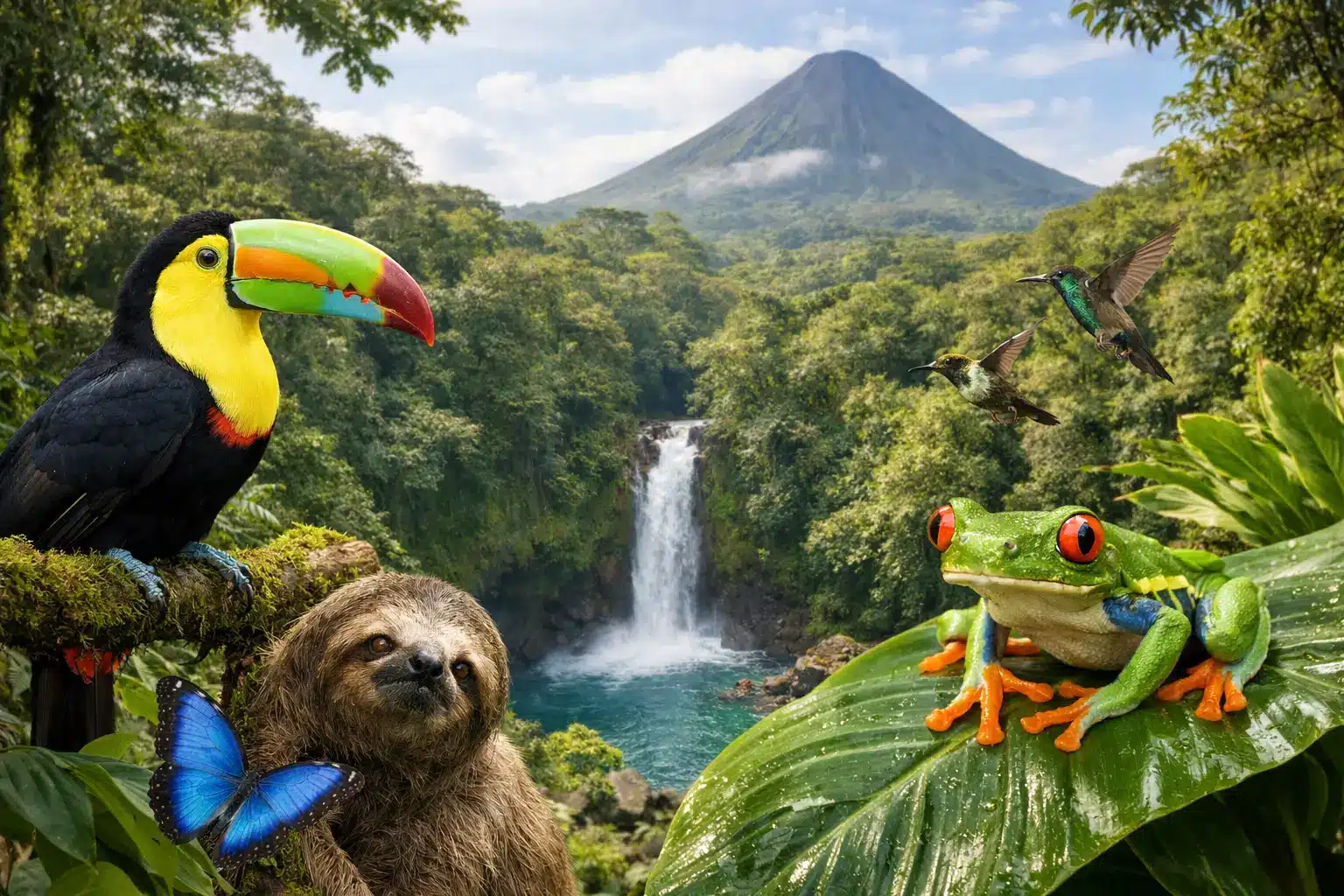
Costa Rica is famous for sloths, howler monkeys, capuchin monkeys, scarlet macaws, toucans, sea turtles, poison dart frogs, tapirs, jaguars, whales, and hummingbirds.
Why are Costa Rica’s cloud forests important?
Costa Rica’s cloud forests are important because they support rare plants, birds, amphibians, insects, mosses, orchids, and water systems that depend on constant mist and cool mountain conditions.
How does conservation help Costa Rica?
Conservation helps Costa Rica by protecting forests, wildlife corridors, watersheds, tourism income, local communities, and the natural beauty that makes the country globally admired.
Can tourists help protect Costa Rica’s biodiversity?
Yes, tourists can help by choosing responsible tours, staying on trails, avoiding wildlife selfies, supporting local conservation projects, reducing plastic use, and respecting protected areas.