Stand on a forest trail in Costa Rica for ten quiet minutes and the numbers stop feeling abstract. A hummingbird flickers past at eye level, leafcutter ants cross the path like a moving zipper, and somewhere overhead a troop of monkeys turns the canopy into a stage. That is why costa rica biodiversity facts are more than trivia. They help explain why this small country has become one of the world’s most admired models for living with extraordinary natural wealth.
For travelers, nature lovers, future residents, and investors alike, biodiversity in Costa Rica is not a side story. It shapes the country’s tourism economy, land-use debates, real estate value, conservation policy, and everyday experience of place. The headline numbers are impressive, but the deeper story is even better.
Costa Rica biodiversity facts start with scale
One of the most quoted facts is also one of the most revealing: Costa Rica occupies only about 0.03 percent of the planet’s landmass, yet it contains roughly 5 percent of the world’s biodiversity. The exact count shifts as species are reclassified and newly recorded, but the central point holds. This is an outsized concentration of life in a relatively compact country.
That density comes from geography as much as luck. Costa Rica sits on a biological bridge between North and South America, which means species from both continents overlap here. Add two coastlines, mountain ranges, cloud forests, dry forests, wetlands, rivers, mangroves, and coral environments, and you get a remarkable variety of habitats packed into a country smaller than West Virginia.
This is one reason visitors can watch sea turtles nest on one trip and then, a few hours later, walk through cool mist in the highlands looking for quetzals. In Costa Rica, ecological variety is not spread across a continent. It is compressed into a manageable distance.
12 Costa Rica biodiversity facts worth knowing
1. The country has more than 500,000 species
That figure is an estimate, not a final inventory, which is part of the fascination. Scientists have identified many species, but countless insects, fungi, marine organisms, and microorganisms remain understudied. In practical terms, biodiversity here is still being discovered, not just protected.
2. Insects do much of the heavy lifting
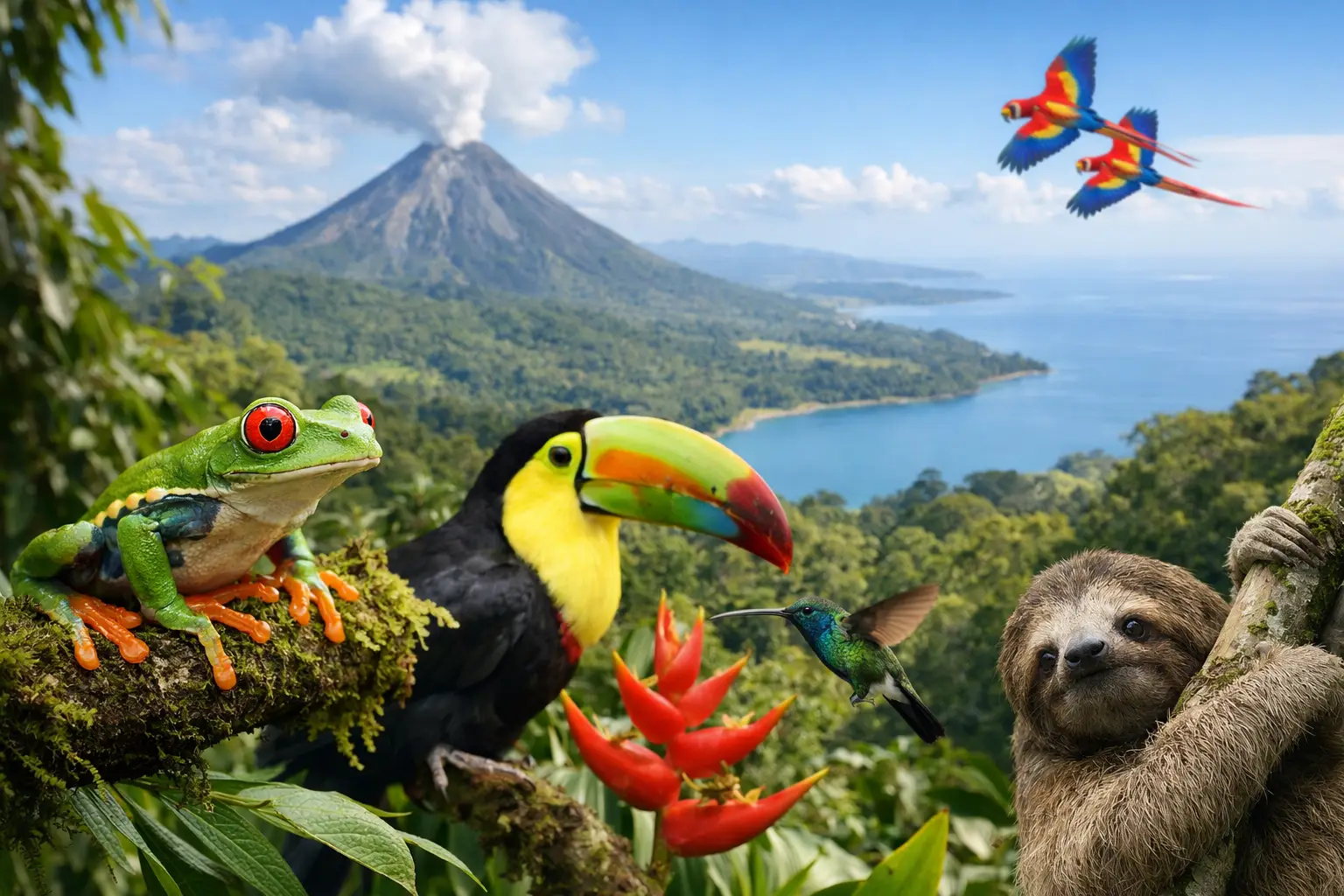
When people think of Costa Rican wildlife, they picture sloths, scarlet macaws, and toucans. Yet insects make up the overwhelming share of species richness. Beetles, butterflies, moths, ants, bees, and wasps are essential to pollination, decomposition, and food webs. The glamorous species get the photographs, but the small creatures keep the system functioning.
3. Costa Rica has more bird species than the continental US and Canada combined
For birders, this fact is almost unfair. More than 900 bird species have been recorded in Costa Rica, which helps explain why serious birdwatchers return again and again. But even non-birders notice the difference. The soundscape alone can feel richer, from the rough call of toucans to the metallic trill of wrens and the distant cry of hawks riding thermals over the hills.
4. Amphibians are both a treasure and a warning sign
Costa Rica’s frogs and salamanders are beautiful, diverse, and highly vulnerable. Because amphibians are sensitive to changes in temperature, moisture, and water quality, they often serve as biological alarm bells. Their declines can signal broader environmental stress from disease, habitat loss, or climate shifts.
5. Cloud forests punch above their size
Cloud forests occupy a relatively small area, but they are among the country’s most distinctive ecosystems. These high-elevation forests trap moisture from passing clouds, feeding rivers and supporting species adapted to cool, wet conditions. They also remind us that biodiversity is not only about coastlines and tropical heat. Some of Costa Rica’s most delicate ecological balances happen in the mist.
6. Marine biodiversity is part of the picture too
Costa Rica’s biodiversity story does not end at the shoreline. The country protects important marine areas in both the Pacific and Caribbean. Whale migrations, coral communities, reef fish, sharks, rays, dolphins, and nesting turtles all contribute to the national ecological identity. This matters because many people still think of conservation here as a forest issue alone. It is also a sea issue.
7. National parks and protected areas cover more than a quarter of the country
Costa Rica is widely recognized for putting land under protection at a scale many nations still struggle to achieve. National parks, reserves, wildlife refuges, and other protected categories cover more than 25 percent of the territory. That does not mean every protected area is free from pressure, but it does show a long-term policy choice that set Costa Rica apart.
8. Forest cover has rebounded dramatically
This is one of the country’s most encouraging environmental stories. After significant deforestation in the mid-20th century, Costa Rica reversed course through policy reform, protected areas, and payment-for-ecosystem-services programs. Forest cover, once severely reduced, recovered over time. It is a genuine conservation success, though not a reason for complacency.
9. Biodiversity supports the economy, not just the scenery
Wildlife and intact landscapes are major economic assets. Tourism, especially nature-based travel, depends on healthy ecosystems. So do agriculture, water supply, research, and local livelihoods. This creates an interesting tension. The same natural beauty that attracts visitors, development, and investment can also put pressure on the habitats that make the country special in the first place.
10. Endemism matters, even if the total number is lower than on larger islands
Costa Rica has endemic species found nowhere else on Earth, though its role as a continental bridge means it also shares many species with neighboring countries. That mix is part of its ecological character. It is both a meeting ground and a home for uniquely adapted life forms.
11. Elevation changes create biodiversity fast
Drive from sea level into the mountains and you move through multiple climate zones in a single day. Temperature, rainfall, and vegetation shift quickly with altitude. That steep ecological gradient allows very different communities of plants and animals to exist close together, which helps explain the country’s species density.
12. Conservation here is impressive, but it is not automatic
Costa Rica has earned global respect for environmental leadership, and rightly so. Still, biodiversity remains under pressure from illegal logging, poorly planned development, water stress, pollution, climate variability, and tourism overload in some areas. The country’s environmental reputation is real, but it requires constant work.
Why these Costa Rica biodiversity facts matter beyond the jungle
For many readers, the appeal begins with beauty. Scarlet macaws over a beach cove, a green sea turtle surfacing offshore, orchids clinging to a mountain branch – these images are part of Costa Rica’s magnetism. But biodiversity also affects decisions that seem far removed from wildlife.
If you are planning a move, buying property, or investing in hospitality, ecological context matters. A parcel near a wildlife corridor may come with stricter development considerations. A tourism business built around wildlife viewing depends on habitat health, seasonal patterns, and legal compliance. Even water access and land stability can connect back to ecosystem integrity.
That is where Costa Rica often stands apart from destinations that market nature as a backdrop while treating it as expendable. Here, the conversation is more mature. Conservation is not a decorative value. It is tied to public policy, national branding, business reality, and community identity.
The real trade-off behind the numbers
Celebrating biodiversity is easy. Managing it is harder.
Costa Rica continues to wrestle with a challenge familiar to many desirable destinations: how to welcome growth without eroding the very assets that drive that growth. Tourism can finance conservation and create strong incentives to protect landscapes. It can also strain roads, water systems, coastlines, and fragile habitats if growth outruns planning.
The same goes for real estate and infrastructure. Thoughtful development can coexist with ecological responsibility, especially when projects respect zoning, wildlife corridors, wastewater standards, and carrying capacity. Poorly executed development can fragment habitat quickly. In a country this biologically dense, small changes can have large effects.
This is why the best biodiversity stories in Costa Rica are rarely simplistic. They are about balance, enforcement, education, and long-term thinking. They are also about people – park rangers, scientists, local communities, landowners, business operators, and policymakers making daily decisions that shape what remains possible.
A country that feels alive
The strongest biodiversity fact may be the one hardest to measure. Costa Rica feels alive in a way that many places no longer do. Dawn starts loudly. Trees move with hidden animals. Night carries insect calls so layered they seem electronic. Even in developed areas, nature often stays close enough to interrupt your plans in the best way.
That living richness is one of the country’s great privileges and one of its great responsibilities. Admiring it is easy. Respecting what it takes to protect it is the part that matters most.
The next time you hear a statistic about Costa Rica’s biodiversity, read past the wow factor. Behind every number is a landscape still working, still adapting, and still worth defending.