
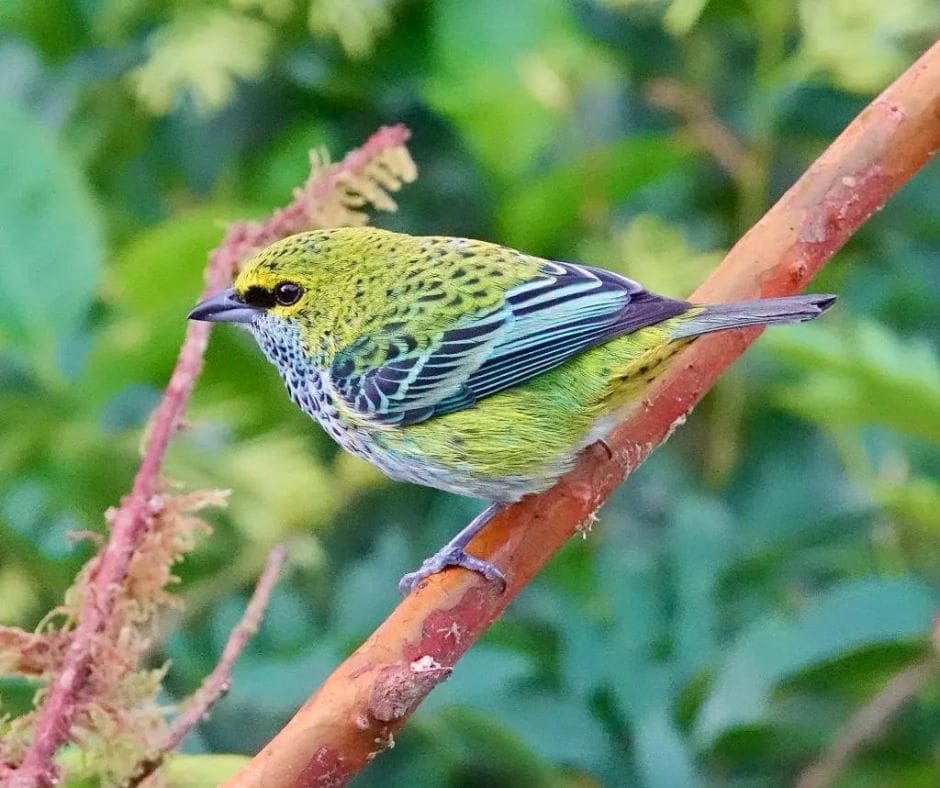
The Speckled Tanager, scientifically known as *Ixothraupis guttata*, is a captivating bird species found in the lush landscapes of Central and South America. Its vivid plumage and intriguing behaviors make it a subject of interest not only for birdwatchers but for anyone fascinated by the rich biodiversity of these regions.
Description of the Speckled Tanager
The Speckled Tanager is a small bird, typically measuring about 12 to 13.5 centimeters in length. It boasts a striking appearance that varies slightly between males and females, which is relatively uncommon in the tanager family where sexual dimorphism is often more pronounced.
Male Coloring
The male Speckled Tanager displays a vibrant green body speckled with black, giving it its common name. The speckles are more concentrated around the chest and back area. Its head is a brighter green compared to the rest of the body, and during certain light conditions, it can appear almost turquoise. The wings and tail are slightly darker with light yellowish-green edging.
Female Coloring
Females share the same speckled pattern but tend to have a duller green coloration overall. Their speckles are less defined and more scattered, which helps in camouflage among the dense foliage. Both sexes have a sharp, pointed beak that is typical for tanagers, aiding in their foraging habits.
Habitat and Migration
Speckled Tanagers are primarily residents throughout their range, which extends from Honduras in Central America down through Colombia, Venezuela, and parts of the Andes in Ecuador, Peru, and Bolivia. They inhabit humid lowland and montane forests, especially areas of thick secondary growth and the edges of clearings. They are rarely seen above 1,400 meters.
Though mostly sedentary, some movement is observed, possibly in response to the availability of food or habitat changes rather than traditional migration. This movement is more localized and does not fit the typical long-range migration patterns seen in many other bird species.
Role in the Ecosystem
Speckled Tanagers play a crucial role in their habitats as part of the bio-universe. They are primarily frugivores, feeding on a variety of berries and small fruits. Through their diet, they help in seed dispersal, which is vital for the regeneration of their forest habitats. Additionally, they consume insects, including beetles and caterpillars, helping control pest populations and maintaining the ecological balance.
Where to See Them
For enthusiasts eager to observe these colorful birds in their natural setting, the best places include national parks and bird sanctuaries throughout their range. In Costa Rica, areas like the Braulio Carrillo National Park, the Monteverde Cloud Forest Reserve, and various protected areas along the Caribbean slope offer good chances of sightings. The birds’ preference for secondary growth and forest edges makes them more accessible to birdwatchers compared to species that dwell deeper in the forest.
Interesting Facts
- Social Behavior: Speckled Tanagers are often seen in mixed-species flocks, particularly outside the breeding season. They join groups of other tanager species, honeycreepers, and warblers, which increases the efficiency of foraging and reduces the risk from predators.
- Breeding: Their nesting habits are less studied, but they are known to build cup-shaped nests where the female lays 2 to 3 pale blue eggs.
- Vocalizations: They have a range of subtle calls and are not known for loud or melodious songs, which contrasts with their visually striking appearance.
The Speckled Tanager, with its ecological importance and stunning appearance, is a brilliant example of the vibrant biodiversity found in Central and South America. Observing these birds offers a glimpse into the complex interdependencies and the beauty of tropical ecosystems.