
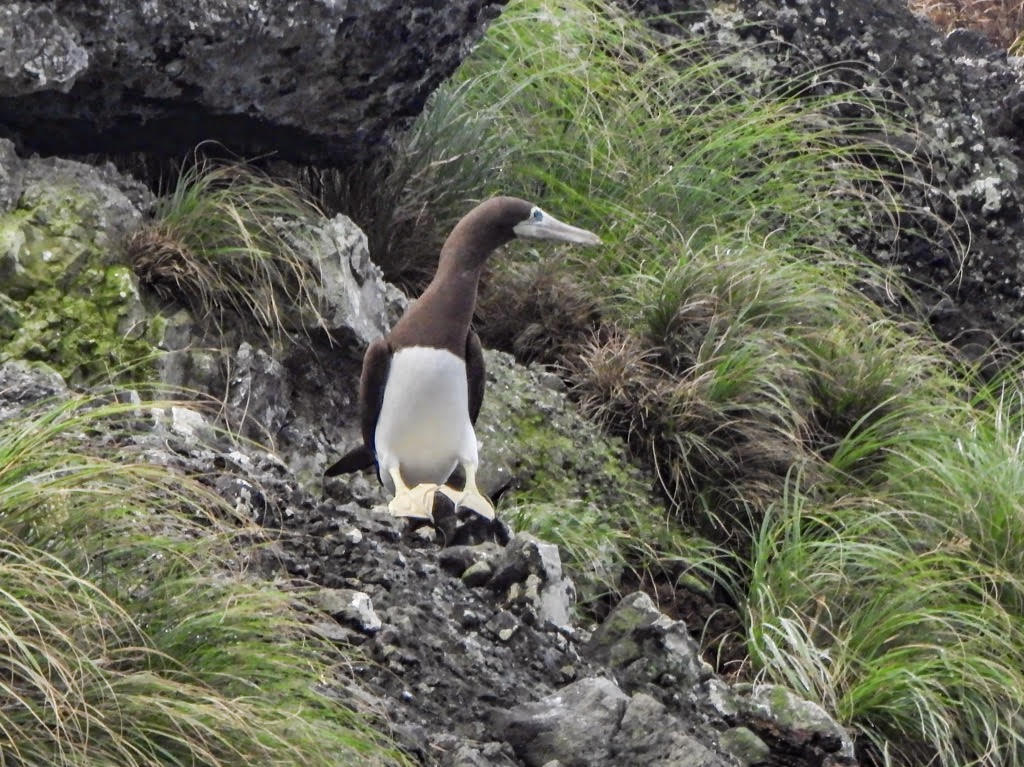
Okay, stop giggling. The Booby family is one of my favorite pelagic birds. Pelagic means they spend most of their time at sea. Boobies spend most of their time just offshore, not very far out at sea, and nest on land. Beautiful to watch in flight, and always good for a laugh when they are on land due to their silly walks, at least silly to us.
Brown-footed booby
Their name does not derive from where those of you still chuckling like Bevis and Butthead think it does. Their name is actually Spanish- bobo. Bobo is Spanish for a fool or silly person, and since they are very clumsy and have a silly walk on land, they started being called Bobos. The name got anglicized to the plural of boobies. Here in Costa Rica we also use bobo for the Motmots, but that is because that is how the motmot call sounds – an onomatopoeic name.
In the world, there are a total of only 6 species of boobies, and most people think of the Galapagos as the place to go see them, and they are correct. There are many to see there, and you are able to get close to them, especially the famous Blue-footed Booby, known for its incredible mating dances. But, there are only 3 of the six species to be seen there: the Red and Blue-footed and the Nazca.
Do you know where you can actually see all six species? Costa Rica.
Bobbies are mostly seen in the tropical Pacific, and we are lucky that we have several resident species, and the seasonal winds and storms sometimes bring in the others. We are one of only a handful of countries where you can see all six of them.
Blue-footed Booby
Where can you see Boobies in Costa Rica?
The most common booby here is the Brown Booby. Easily recognized because of their color, they have colonies on several islands off the Pacific coast from Nicoya to Uvita. You’ll see them on any whale-watching trip out of Uvita, and other Central Pacific places.
The second most common is the Nazca booby. Named for the area of Peru and more importantly the Nazca tectonic plate where they mostly live above. They are one of the Galapagos boobies. You can see them here at certain times of the year if you travel right off the Pacific coast or even from the ferry as you cross from Puntarenas to Tambor.
The third is the famous Blue-footed Booby, which can be seen off shore, or on the Guayabo Islands Preserve. They are the small rocky islands of twisted and contorted rock beds you can see near Isla San Lucas as you cross on the ferry. This year there are probably more than 50 of them just hanging out there.
The next two are harder to find here, but you can if you travel to the farthest reaches of Costa Rica: Isla del
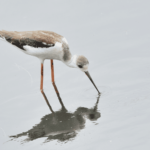
Long-Legged Booby
Coco. On the 36-hour trip out you may see in addition to the first three, the Masked and the Red-footed Booby. Masked and Nazca used to be considered the same species, but they have been separated. They are fairly difficult to tell apart, with a yellow versus an orange bill. The Red-footed and Masked Nazca all nest on Cocos Island – it being closer to the Galapagos than the mainland of Costa Rica. Masked Boobies can also be seen off the Caribbean coast.
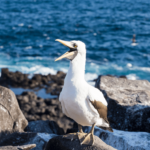
Galapagos booby
The final is the rarest, and is considered a rare vagrant here: The Peruvian Booby. Found mostly off the central and southern coast of Peru, they have recently been spotted ( 3 of them) on the Guayabo islands, standing around with the Blue-footed ones. The belief is the El Nino temps and winds have driven them up here. It has become an official birding ‘twitch’, the term birders use when a rare bird is spotted and everyone races out to see them. We joined the watch and had a small boat take 10 of us out to photograph them.
So the next time you are on the beach, look out and look up, you may see some Boobies.