

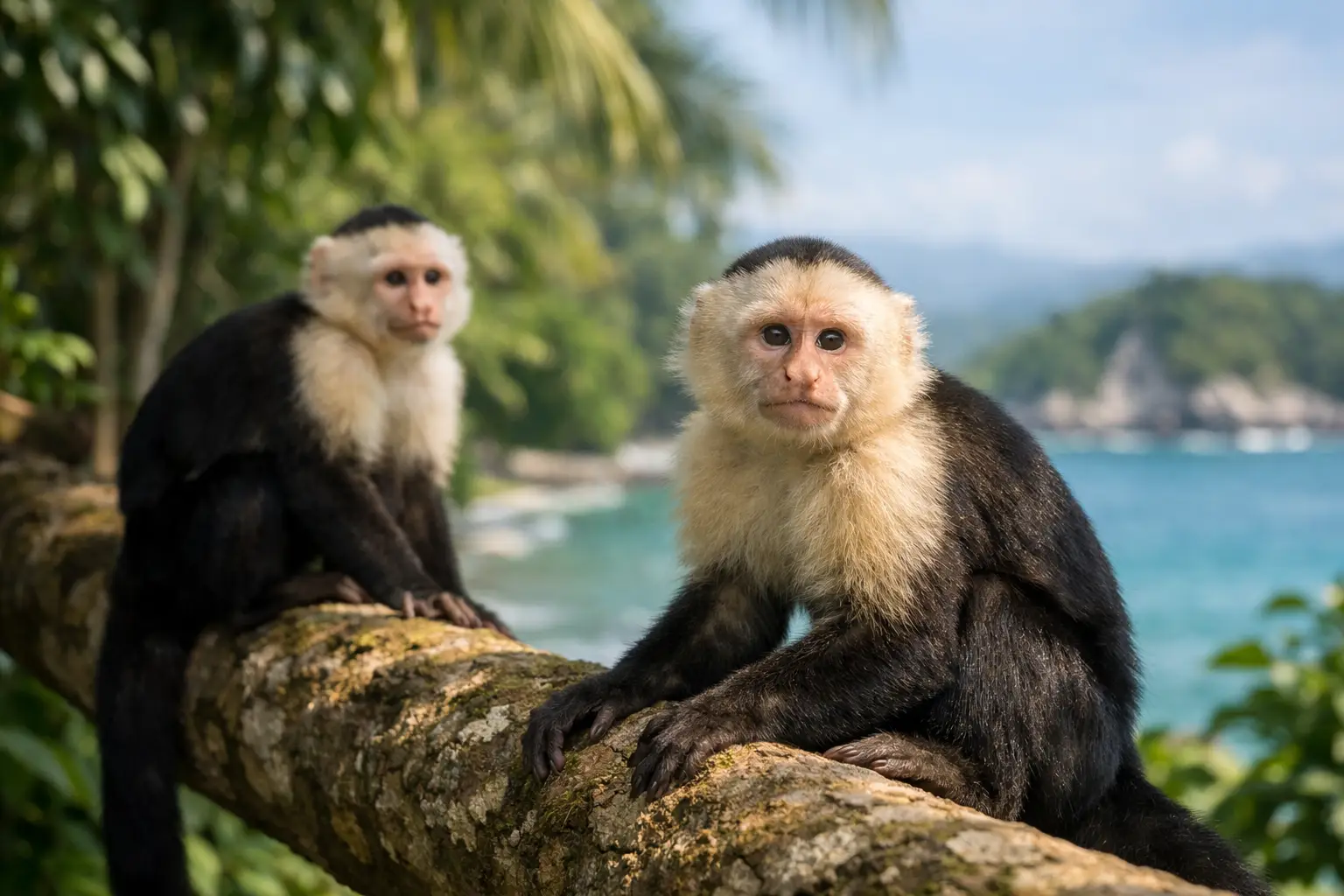
You usually hear them before you see them. A rustle high in the canopy, a sudden shower of leaves, then a pale face peering down with an expression that seems almost too knowing. White face capuchin monkeys are one of Costa Rica’s great wildlife encounters, not just because they are photogenic, but because they feel startlingly present. They watch back.
For travelers, newcomers, and anyone building a life around Costa Rica’s natural richness, capuchins often become a favorite memory fast. They are clever, social, noisy when they want to be, and deeply woven into the experience of the country’s forests, beaches, and protected areas. But they are also a species that reminds us of a larger truth about Costa Rica. Wild beauty stays wild only when people give it room.
Why white face capuchin monkeys stand out
Among Costa Rica’s four monkey species, white face capuchin monkeys tend to steal the scene. Mantled howlers have the voice, squirrel monkeys have the speed, and spider monkeys seem built from pure motion. Capuchins bring personality.
They move through the trees in tightly connected groups, often with an alert, purposeful energy that makes the forest feel animated. Their creamy white faces and dark bodies are easy to recognize, and their behavior is even easier to remember. They inspect branches, search for insects and fruit, test objects with their hands, and seem constantly engaged with one another and their surroundings.
That intelligence is not your imagination. Capuchins are considered among the most cognitively advanced New World monkeys. They solve problems, learn socially, and adapt well to changing environments. In the wild, that can mean everything from using technique to pry food from hard surfaces to navigating territories that overlap with roads, lodges, farms, and beach towns.
For visitors, this can create the illusion that they are friendly or tame. They are neither. They are wild animals that have become highly skilled at reading human habits.
Where you might see white face capuchin monkeys in Costa Rica
White face capuchin monkeys are found in many parts of Costa Rica, especially in lowland and dry forest regions along the Pacific side, as well as in some transitional forest areas. If you spend time in places like Manuel Antonio, Santa Rosa, parts of the Nicoya Peninsula, or forested coastal zones in Guanacaste and the Central Pacific, your odds are good.
That said, wildlife does not work on a schedule. One morning you may spot a whole troop moving like acrobats above a trail. The next day, in the same place, there may be nothing but iguanas and birdsong. Season, weather, fruit availability, and daily movement patterns all shape what you see.
The best sightings often happen when people slow down. Sit quietly near the forest edge at first light. Pause on a trail instead of marching through it. Look up when you hear branches shake in quick succession. In many parts of Costa Rica, capuchins announce themselves through motion more than sound.
What they eat and how they live
Capuchins are omnivores, and that flexible diet helps explain their success. They eat fruit, seeds, flowers, insects, eggs, and small animals when the opportunity is there. They are curious foragers, using their hands with remarkable precision, turning over bark, probing crevices, and investigating almost anything that might hold a meal.
Their social lives are just as dynamic. Troops can include multiple adults and juveniles, and life inside the group involves cooperation, competition, grooming, play, and constant awareness. Young capuchins learn by watching older members, which is one reason human-fed groups can develop problematic behavior quickly. Once one monkey figures out that a backpack might contain chips or fruit, others learn fast.
This matters more than many visitors realize. Feeding monkeys changes their movement patterns, increases aggression, and can pull them away from natural foods. It also puts them at risk near roads, parking lots, and buildings. What seems like a funny vacation moment can ripple through a troop for years.
The capuchin problem humans create
There is a reason park staff, guides, and longtime residents repeat the same advice. Do not feed the monkeys. Not once. Not for a photo. Not to get them closer.
White face capuchin monkeys are bold enough without encouragement. In heavily visited areas, they may snatch food, unzip bags, raid open vehicles, or leap onto outdoor tables. People often describe this as mischievous, and sure, it can look comical from a distance. But the backstory is usually human behavior.
When wildlife becomes habituated to snacks, everyone loses. Monkeys can become dependent, nutritionally stressed, and more likely to interact aggressively with people. Visitors get bitten or scratched. Property owners end up dealing with damaged roofs, torn screens, and frequent raids. Park rangers must manage an issue that should never have started.
Costa Rica’s success as a nature destination comes with this tension. The more people who come to admire wildlife, the more discipline is required to protect it. Admiration without boundaries becomes pressure.
Watching white face capuchin monkeys the right way
The best wildlife encounters are often the least intrusive. If you see white face capuchin monkeys, keep your food packed away, give them space, and resist the urge to call, whistle, or toss something for attention. A monkey that continues its natural behavior in your presence is a far better sighting than one that approaches because it expects a handout.
A local guide can make a huge difference. Not because capuchins are impossible to find, but because an experienced guide reads the forest in layers. They notice fresh movement in the canopy, distinguish monkey activity from coatis or squirrels, and explain social behaviors you would otherwise miss. Suddenly, a quick sighting turns into a story about territory, parenting, feeding, and adaptation.
Timing also helps. Early morning and late afternoon are often productive, especially in warmer coastal areas where midday heat can slow animal activity. Still, there are no guarantees. That unpredictability is part of the charm.
Why conservation still matters, even for a smart survivor
Capuchins are adaptable, but adaptable does not mean invulnerable. Habitat fragmentation remains a serious issue in many parts of Costa Rica. Roads cut through forest corridors. Power lines create dangerous crossings. Development can isolate troops in patches of habitat that look green on a map but function like islands on the ground.
One of Costa Rica’s ongoing conservation challenges is making sure wildlife can move safely between those patches. For monkeys, that may mean preserving canopy connections, installing wildlife bridges, and planning development with actual ecological continuity in mind instead of decorative landscaping.
This is where Costa Rica’s environmental reputation deserves both praise and realism. The country has done extraordinary work in reforestation, national parks, and biodiversity protection. At the same time, local communities, conservationists, and policymakers still face real pressure from growth, tourism demand, and infrastructure needs. White face capuchin monkeys thrive best where the forest is not just protected on paper, but connected in practice.
A more memorable sighting
There is a particular kind of morning in Costa Rica when the light comes in low and gold, the air still holds a little coolness, and the forest seems to wake up in sections. Birds first. Then insects. Then the movement overhead. A capuchin pauses on a branch, tail balanced, scanning below with absolute confidence. Another follows, carrying a youngster close behind. The troop passes through and the trees settle again.
That moment lands because it feels earned. Not staged, not fed, not interrupted. Just a glimpse into a living system that still works.
For readers who come to Costa Rica looking for beauty, white-faced capuchin monkeys offer something better than a postcard scene. They offer a relationship between forest and coastline, tourism and responsibility, curiosity and restraint. They are entertaining, yes, but they also represent the kind of country Costa Rica has fought to remain: biologically rich, visibly alive, and worth treating with care.
If you are lucky enough to meet their gaze from below, let that be enough. Pack up your snacks, keep your distance, and leave the canopy to its rightful residents. The best travel memories are not the ones you control. They are the ones you are invited to witness.
FAQ
Are white-faced capuchin monkeys dangerous?
White-faced capuchin monkeys are not naturally looking for trouble, but they can bite or scratch if people get too close or offer food. Respect their space and keep your belongings secure.
Can I feed capuchin monkeys fruit?
No, you should not feed capuchin monkeys fruit or any other food. Even natural-looking food can change their behaviour and encourage dangerous interactions with people.
What is the best time of day to see capuchins?
Early morning and late afternoon are often the best times to see capuchins, especially in warmer coastal areas. Midday heat can make animals less active.
Are capuchins found near beaches in Costa Rica?
Yes, capuchins are often seen near forested beach areas, especially where coastal habitats connect with protected forest. Manuel Antonio is one of the best-known examples.
Why do capuchins steal food?
Capuchins steal food because they are intelligent, opportunistic, and quick learners. In tourist areas, repeated human feeding teaches them that bags, tables, and vehicles may contain easy snacks.
Do capuchins live in groups?
Yes, capuchins live in social troops with adults, juveniles, and young monkeys. Their group life includes grooming, play, competition, learning, and cooperation.
What should I do if a capuchin comes close?
Stay calm, secure your food, avoid eye contact that feels confrontational, and do not reach out. Give the monkey room to move away.