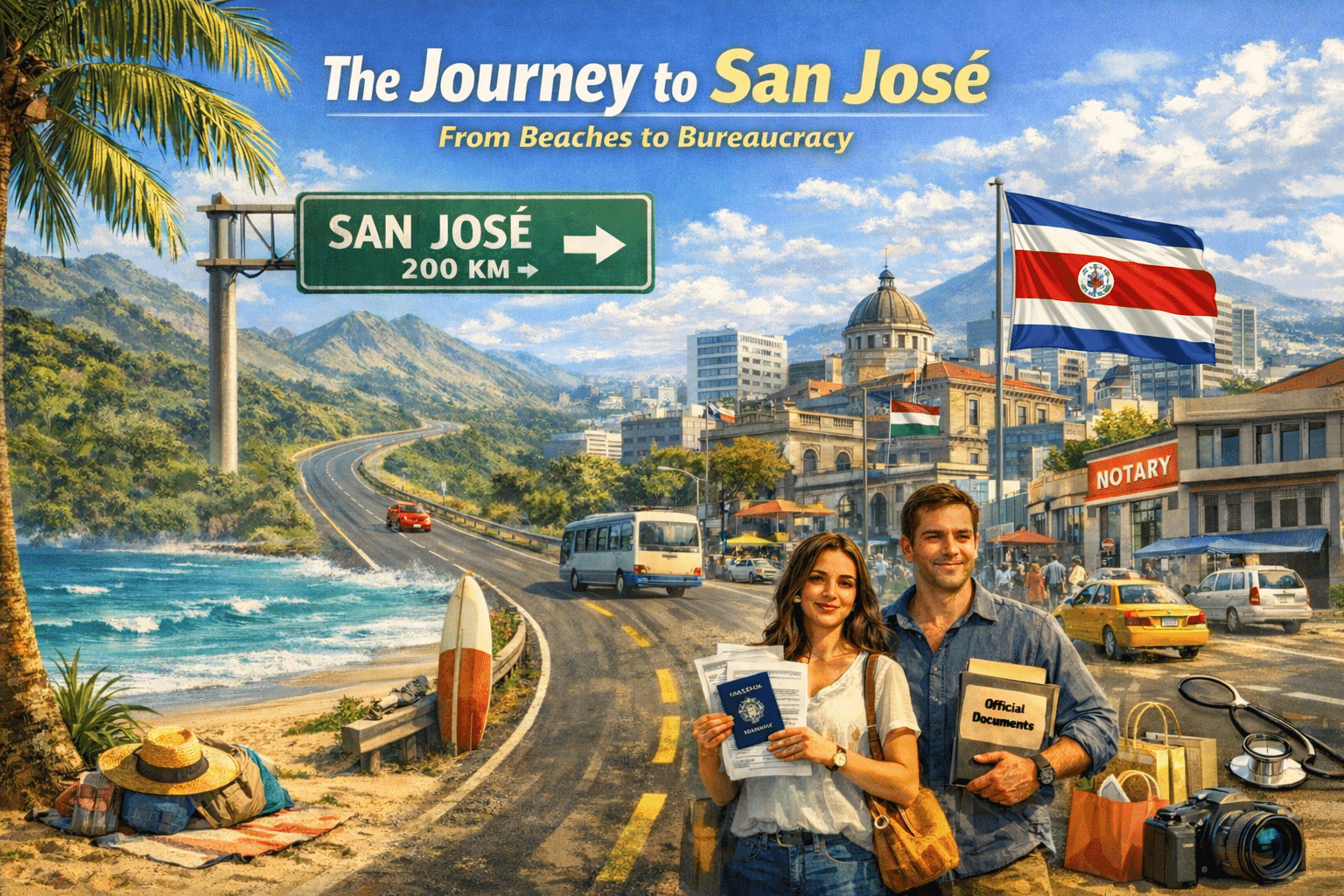
If you settle in Guanacaste long enough, there comes a day when paradise and practicality collide. You need something you simply cannot get in Tamarindo, Flamingo or Playas del Coco – a proper garden hose that actually sprays, a fridge that doesn’t smell like burned toast, a special document, fingerprinting, or a quick dash to the embassy. That is the moment you accept an unspoken truth: sooner or later, you’re going to San José.
Do you really need to go to San José if you live in Guanacaste?
Yes, at some point you almost certainly will need to go to San José.
Costa Rica’s capital city is where the serious bureaucracy lives: embassies, major banks, specialist clinics, government offices, visa and residency services, and the sort of shops that sell things in more than two models and one odd colour. It is also where you find:
- Specialist shopping – electronics that last, proper tools, decent bedding, unusual ingredients
- Official paperwork – fingerprints, legalisations, translations, notaries
- Emergency help – consular services, higher-level hospitals and labs
It might feel like an annoying interruption to your beach life, but it quickly turns into a rhythm: a day or two in the cooler Central Valley, tick off the to-do list, eat something wonderful, then head back down to the heat and the waves.
How long does it take to drive from Guanacaste to San José?
The drive from coastal Guanacaste to San José typically takes about four to five hours.
From the Tamarindo area, most people plan on roughly four and a half hours, allowing for roadworks, coffee stops and that one lorry that chooses to overtake on a blind bend. Some claim to do it in three; those are the same people who think indicators are optional and that double yellow lines are a suggestion, not a rule.
You now have two main choices:
- The coastal toll road – faster, straighter, and usually less stressful. You pay several tolls in colones, but you gain time and a few extra years of life expectancy.
- The old mountain road – more scenic, more bends, and shared with enormous trucks piloted by drivers whose licences may still smell of fresh ink.
Either way, you climb up from the shimmering heat of the lowlands into fresher air, coffee country and a different Costa Rica altogether.
What is it actually like to drive to San José?
Driving to San José is a strangely entertaining mix of beauty, chaos and dark humour.
You pass fields, volcano silhouettes and small towns, then suddenly the road chokes with shiny new Hyundais, Toyotas and the occasional BMW, all trying to occupy the same bit of tarmac that was originally designed for coffee mule carts. Lanes appear and disappear without warning. Indicators are used creatively. Motorbikes slide past in gaps that do not technically exist.
The trick is to:
- Leave early so you arrive just after morning rush hour
- Avoid entering or leaving the city in peak “hora pico” (rush hour)
- Accept that the journey is part of the story, not a problem to be solved
Once you view the drive as a rolling lesson in patience with mountain views as your reward, it becomes less ordeal and more ritual.
How do locals handle traffic and moving around San José?
Locals time their driving carefully and switch to buses or taxis when traffic turns feral.
A common strategy is to arrive in the city mid-morning, use your car until mid-afternoon, then park it and let someone else fight the traffic. Public buses are cheap and surprisingly efficient; taxis give you the same journey for several times the price but with air-conditioning and fewer elbows.
Roughly speaking:
- Taxi: quicker, around the equivalent of a few dollars for most central hops
- Bus: slower but very cheap, and an excellent crash course in everyday Costa Rican life
Once you stop trying to drive absolutely everywhere, San José becomes far easier to manage – and your blood pressure will thank you.
What can you actually enjoy in San José after your errands?
San José may not be on many tourists’ bucket lists, but it is a surprisingly good city for eating, wandering and people-watching.
After a day of embassies, lawyers and appliances, Guanacaste residents often reward themselves with a good meal. Around the centre and the older neighbourhoods you’ll find Peruvian restaurants with Pisco Sours that creep up on you, Lebanese spots with sofa seating and fusion cocktails, and modern Costa Rican kitchens where almost everything shares plate space with black beans and rice. That mix of Latin flavours, Middle Eastern mezze and local comfort food is very much the capital’s personality.
If you stay overnight, you can:
- Stroll past historic buildings that finally started appearing in the late 19th century
- Visit museums and galleries that remind you there is more to Costa Rica than beaches
- Enjoy the cool evening air – often a good ten degrees Celsius gentler than Guanacaste’s coastal furnace
By the time you wake up next morning, you might even be slightly reluctant to leave.
How should new residents think about San José trips?
New residents should treat trips to San José as part of the Costa Rican lifestyle, not a punishment.
The capital was built on a high plateau because the early colonists quickly realised it was healthier and more pleasant than mosquito-ridden lowlands. That logic still holds. When Guanacaste feels like an oven and you need paperwork, repairs or a serious shopping run, San José becomes a cool-air reset button.
See it as:
- A monthly or seasonal city break wrapped around essential errands
- A chance to experience another side of the country – the busy, working Costa Rica that keeps the rest of it moving
- An opportunity to return to Tamarindo with stories, a working washing machine and perhaps a new appreciation for your quiet beach road
If you are planning to live here long term, embrace the capital as a slightly chaotic but necessary partner to your coastal dream. Enjoy its restaurants, use its services, and then head home to Guanacaste in one piece, windows down, ready for the sea breeze again.
FAQ: Living in Guanacaste and Going to San José
Do I need a car to get from Guanacaste to San José?
No, you can also go by public bus or shared shuttle, but having a car gives you flexibility with stops, timing and shopping.
Is it safe to drive to San José?
Yes, thousands do it daily, but you need to drive defensively, respect the weather and avoid overtaking on blind bends.
Can I do San José as a day trip from the coast?
You can, but it is exhausting; many residents prefer one overnight, errands by day, dinner at night, and return the following morning.
Is San José worth visiting if I am not doing paperwork?
Yes, especially for food, culture, museums and a break from the heat; it shows you a completely different Costa Rican rhythm.
What should I bring back from San José?
Apart from paperwork and spare parts, people return with proper kitchen gear, decent linens, treats from international supermarkets and usually a new favourite restaurant recommendation.