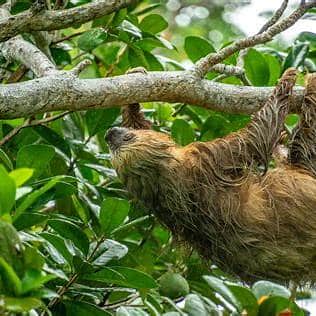
There’s a moment in Costa Rica when the jungle goes quiet enough that you notice the small things: a leaf trembles, a branch creaks, and a ball of moss you swore was just… moss… slowly turns its face towards you and looks mildly pleased with itself. That’s the sloth experience in a nutshell—equal parts wildlife safari and wholesome comedy.
Sloths aren’t “lazy”. They’re specialists: masters of energy-saving, camouflage, and moving so slowly that even time gets bored and walks off. Costa Rica is one of the easiest places on Earth to meet them in the wild, and it’s also a brilliant base for understanding where sloths live across the wider Americas.
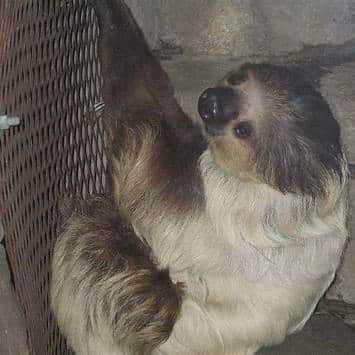
What kinds of sloths live in Costa Rica?
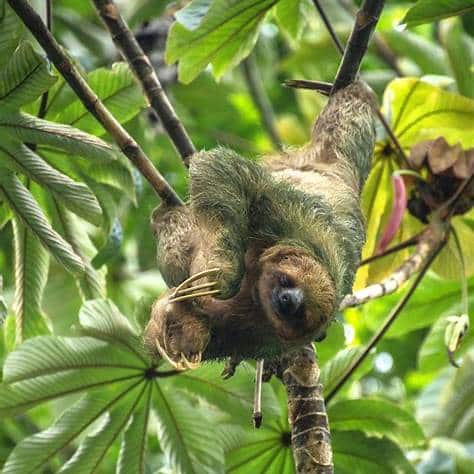
Costa Rica is home to two sloth species: the brown-throated three-toed sloth and Hoffmann’s two-toed sloth. (MytanFeet)
Here’s the quick, traveller-friendly difference:
- Three-toed sloth (brown-throated): often spotted in daylight, “smilier” face, tends to look like a comfy cushion wedged in a tree fork.
- Two-toed sloth (Hoffmann’s): more nocturnal, often harder to spot, with a slightly longer snout and a fluffier, denser look.
Tiny ID tip that actually works in the field:
- If it’s out in the day and you can see it clearly, it’s more likely the three-toed.
- If it’s dusk/night, or it’s a shaggy blur that seems to be awake while the forest is on night mode, it might be the two-toed. (MytanFeet)
Where do sloths live around the world?
Sloths live only in the Americas, mainly in the tropical forests of Central and South America. (WWF)
There are six living sloth species, split into two-toed and three-toed groups. (World Wildlife Fund)
Highlights worth knowing (and dropping casually into conversation like you’re the sloth correspondent of your friend group):
- Costa Rica & Panama sit at the northern end of sloth country for some species. (IFAW)
- Brazil is a major stronghold, including the maned sloth, which is tied to the Atlantic Forest. (World Wildlife Fund)
- The pygmy three-toed sloth is a famous rarity: it’s endemic to Isla Escudo de Veraguas, Panama, basically a sloth living on “hard mode” with a tiny range. (PLOS)
If you want the “where else can I see sloths?” shortlist:
- Panama (Caribbean side)
- Colombia
- Ecuador
- Peru
- Bolivia
- Venezuela
- Brazil
- parts of the Guianas
…and pockets of Central America depending on species and habitat. (IFAW)
Why are sloths so slow—and why does that work?
Sloths are slow because they run on an ultra-low-energy strategy that lets them survive on a leaf-heavy diet. (Smithsonian Institution Archives)
Leaves aren’t exactly an energy drink. So sloths do the smartest thing possible: they spend less. Less movement, fewer risks, and fewer calories burned. It also means they can sit so still that a predator’s brain often files them under “tree furniture” and moves on.
A fun side effect: stillness plus tropical humidity encourages algae growth in the fur, which adds camouflage. (Smithsonian Institution Archives)
What’s going on in a sloth’s fur?
A sloth’s coat is a miniature ecosystem where algae, moths, and microbes interact in genuinely weird ways. (Smithsonian Tropical Research Institute)
One of the most famous sloth mysteries is the risky habit of descending to the ground to poop (yes, we’re talking about it, because sloths made it science). Research has linked this behaviour to a three-way relationship: sloths, moths, and algae. Moths lay eggs in sloth droppings, and more moths can mean more nutrients for algae in the fur—algae that sloths may then consume during grooming. (Smithsonian Tropical Research Institute)
In other words: sloths might be slow, but their fur is running a whole side-hustle operation.
Are sloths really good swimmers?
Yes—sloths are surprisingly capable swimmers, and they can move more confidently in water than they can on land. (WWF)
They use their long arms like paddles, and they’re often observed swimming across rivers in their native range. (National Geographic)
When is the best time of day to see sloths in Costa Rica?
Morning and late afternoon are great for spotting resting sloths, and guided walks can help you find them at any time.
In practical terms:
- Three-toed sloths are often easier in daylight because they’re frequently visible while dozing in exposed forks. (Two Weeks in Costa Rica)
- Two-toed sloths are more likely to be active later in the day or at night, so a night walk in the right habitat can be a game-changer. (MytanFeet)
Voice-search friendly tip: “Do I need a guide to see sloths?”
If you want reliable sightings fast, yes—a good guide will spot a sloth you’d walk past five times. (They’re basically human wildlife radar.)
Where are the best places to see sloths in Costa Rica?
Your best odds are in Costa Rica’s lush lowlands on both coasts, plus a few wildlife-rich corridors where forest meets town life.
Here are strong, real-world options around the country:
- Caribbean Coast: Cahuita & Puerto Viejo / Manzanillo area
Coastal forest and leafy neighbourhood trees can be excellent, and the region is famous for relaxed wildlife watching. (Also: snacks.) - Tortuguero (Caribbean north-east)
Boat trips through forested waterways give you a different angle for spotting canopy wildlife, sloths included. (Enter Costa Rica) - Sarapiquí (north lowlands)
A classic “green tunnel” zone where rainforest habitats boost your chances. (Enter Costa Rica) - La Fortuna / Arenal region
Great for pairing volcano drama with slow-motion mammals; there are also educational wildlife visits in the area. (institutoasis.com) - Manuel Antonio (Central Pacific)
One of the most consistent places for visitors to spot sloths, especially with a guide who knows the usual trees and angles. (Two Weeks in Costa Rica) - Dominical / Uvita (South Pacific)
This stretch can be excellent for wildlife in general, and sloths do show up in the right forest edges and reserves. (MytanFeet) - Osa Peninsula region (wild Pacific south)
For travellers chasing maximum biodiversity, this is where Costa Rica turns the volume up—expect effort, humidity, and bragging rights.
Quick “spot the sloth” checklist
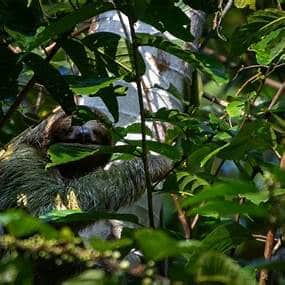
- Scan tree forks first: they love that comfy wedge.
- Look for a perfectly round “nest” shape that seems too tidy to be random.
- Check Cecropia trees (they’re common in many areas and are often associated with sloth feeding).
- Let your eyes relax; sloths are found more by pattern recognition than by searching for movement.
What’s the most ethical way to see sloths up close?
The ethical way is simple: observe from a respectful distance and avoid any experience that involves handling, baiting, or forced interaction.
Good sanctuaries and educational tours often make their welfare rules very clear—for example, some explicitly prohibit direct contact for the animal’s wellbeing (and yours). (Tripadvisor)
Rescue-and-rehab organisations also emphasise education and responsible visits. (Toucan Rescue Ranch)
Ethical sloth rules you can follow anywhere
- No touching (even if someone says “it’s fine”).
- No feeding.
- Keep voices low; think library energy, not football match.
- Skip flash photography.
- Let them choose the distance—if they move away, that’s the answer.
FAQ: Sloths in Costa Rica
Are sloths dangerous?
Sloths aren’t aggressive, but they can defend themselves, and their claws are built for gripping—so admire from a distance.
What’s easier to see in Costa Rica: two-toed or three-toed sloths?
Three-toed sloths are often easier for daytime visitors because they’re frequently spotted resting in the open. (Two Weeks in Costa Rica)
Can I see sloths without going to a national park?
Yes, especially in wildlife-rich regions where forest and towns overlap, but your odds rise sharply in protected habitats and with a guide.
Do sloths really come down to poop?
Yes, and it’s one of the most studied “why would you do that?” behaviours in rainforest mammals. (Smithsonian Magazine)
Where else in the world can I see wild sloths?
In the Americas—especially parts of Central America and much of northern South America, with a famous tiny-range exception in Panama (pygmy three-toed sloth). (IFAW)