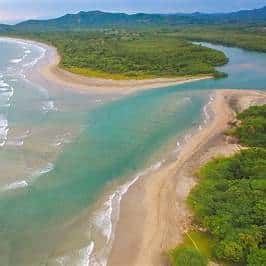
A beach with a river mouth (or estuary/“estero”) is two places at once: calm holiday postcard on the sand, and moving machinery in the water. In April, that machinery tends to get a fresh set of gears. A few early rains upstream, a slightly different tide cycle, a pulse of swell, and the whole set-up can flip—sandbars shift, channels deepen, and the “easy paddle” becomes a sneaky conveyor belt.
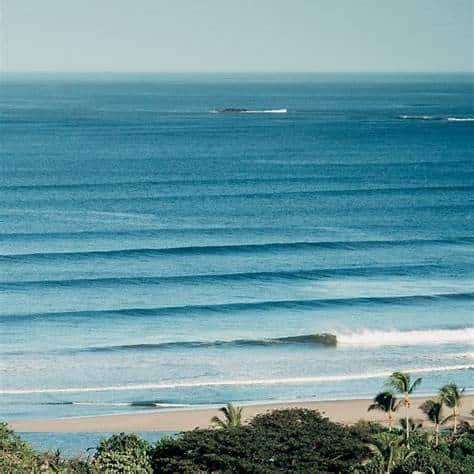
This isn’t here to scare you off. River mouths can deliver brilliant peaks and playful sandbar waves. The goal is to help you spot the mood quickly, position yourself smartly, and keep your session fun instead of frantic.
Suggested lead photo: a high, slightly angled aerial shot where tea-coloured river water meets turquoise sea, with the sandbar clearly visible and a clean channel cutting seaward.
What is the “river mouth factor”?
It’s the way river outflow reshapes sandbars and currents, making the water movement faster, more changeable, and less obvious than a normal beachbreak.
Rivers don’t just “arrive” at the ocean—they push, pull, and rearrange the nearshore like a slow bulldozer. Where the river exits, it often scours a deeper path (a channel), while waves pile sand into banks on either side. That contrast—deep channel next to shallow bar—is a classic recipe for strong, focused currents.
Why does April change the rules at river mouths?
April is a transition month where early rains and shifting flow can rework sandbars quickly, even if the beach looked “the same” last week. (vacationscostarica.com)
In Costa Rica, April often sits on the dry-to-green-season hinge. The first showers may be occasional, but they can still send a noticeable pulse down smaller watersheds. (Two Weeks in Costa Rica) That pulse can:
- deepen the river channel at the exit
- cut a fresh notch through a sandbar
- speed up the longshore “sideways” drift
- change visibility (murky water makes hazards harder to read)
How do changing flows create the “conveyor belt” paddle?
When waves push water towards the beach and a river channel offers a deep escape route back out, the ocean often funnels into that channel and pulls like a moving walkway. (Frontiers)
Here’s the bit people feel as “doom”: you paddle out, you sit up, you look back… and you’re 30 metres down the beach without noticing. That’s usually longshore drift feeding into (or alongside) the river-mouth channel. The current isn’t always roaring. It’s just persistent—like someone gently but continuously tugging your ankle.
How can you read a river mouth in 30 seconds before you paddle out?
Watch for pattern breaks—river-mouth currents announce themselves by making the water look “wrong” compared with the surrounding ocean.
Look for:
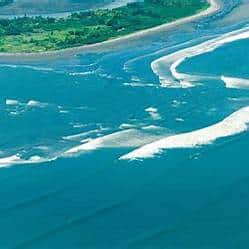
- A gap in breaking waves: a darker, smoother-looking stripe where waves don’t crest as much (often the deeper channel).
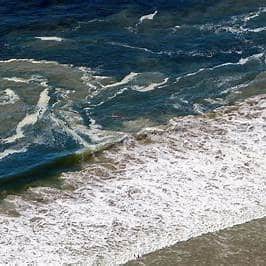
- Foam and bubbles moving sideways: instant proof of longshore drift.
- A colour seam: brown/green river water meeting blue ocean water in a sharp line.
- Choppy, crossed-up texture: river flow and incoming swell colliding can make the surface look confused.
- A “V” shape offshore: two lines of foam converging and streaming seaward.
If you can, get slightly higher—walk to a dune, steps, rocks, or a lookout—because currents are much easier to spot from above.
Where’s the safest place to paddle out near a river mouth?
The safest paddle-out is usually away from the outflow and up-current of where you plan to sit, so any drift moves you into position rather than past it.
Try this simple positioning routine:
- Pick two landmarks on shore (a tree and a roofline, for example).
- Do a 60-second drift check in knee-to-waist depth: stand still and see which way you’re sliding.
- Start your paddle slightly up-current of the peak you want.
- Aim for the shoulder first, then slide into the take-off zone once you’ve confirmed you’re not being marched along the beach.
Using a channel can be smart, but only if you know the exit:
- A channel can make paddling out easier (less whitewater),
- but it can also deposit you exactly where you don’t want to be—too far outside, too far down the beach, or right where waves are lurching over a shallow bar.
What should swimmers and waders do differently at river mouths?
Give river mouths extra space, because the current can be stronger than it looks and can change quickly with tides and pulses of flow.
Practical rules that save holidays:
- Don’t swim across the mouth if you can see obvious flow.
- Avoid the smooth dark channel where waves aren’t breaking—deep water plus current is a bad combo for casual swimming.
- Choose beaches with lifeguards whenever possible, and ask what the river mouth is doing that day. (Ocean Today)
- Treat “calm-looking” water as a warning, not an invitation—rips and channels often look calmer precisely because waves aren’t breaking there.
What if you get caught in the pull—what’s the best move?
Don’t fight straight against it; stay calm, float if needed, signal for help, and move across the current until you’re out of the main flow. (Ocean Today)
For swimmers:
- Float and breathe first (panic burns energy fast).
- Wave and call for help early.
- Swim parallel to shore to escape the narrow current, then angle in with the waves. (Ocean Today)
For surfers:
- Keep your board (it’s flotation and visibility).
- Paddle parallel across the flow rather than trying to “win” straight back to where you started.
- Use the drift: sometimes the safest play is to let it carry you to a calmer exit point and walk back.
What small habits cut risk massively in April?
Treat April river mouths as “dynamic features” and do quick checks every session, because yesterday’s safe sandbar can be today’s weird channel.
A simple checklist:
- Scan for 2–3 minutes before entering.
- Ask a local surf school, lifeguard, or fisherman what the mouth is doing right now.
- Time your session: mid-tide changes can shift currents fast, especially near estuaries.
- Have an exit plan: know where you’ll come in if you drift.
- If it feels wrong, move beaches: Costa Rica has plenty of options.
FAQ
Is river water “pulling you under”?
No—river-mouth rips and channels pull you out and along, not down, but the exhaustion risk is real if you fight them. (Ocean Today)
Are river mouths always dangerous?
No—some days they’re mellow, and they can create excellent sandbar waves, but they’re less predictable than ordinary beaches.
What’s the easiest sign of a rip or channel?
A darker, smoother-looking lane with fewer breaking waves is one of the quickest visual tells. (National Ocean Service)
Does April automatically mean stronger currents?
Not automatically, but April’s transition conditions can change flow and sandbars faster than you expect. (vacationscostarica.com)
Should beginners surf river mouths?
Beginners should choose lifeguarded beaches and sandier, simpler peaks; if a river mouth is involved, go with a reputable local instructor.
If I’m drifting down the beach, should I panic?
No—drift is information, not judgement: paddle across it, reset up-current, and choose an easier zone.