
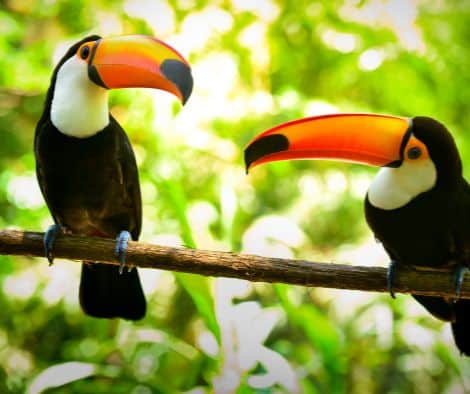
Probably one of the first things you hear from a new visitor is, “Where can I see the ‘Fruit Loops’ Bird”? Toucans are the quintessential bird of the tropics: big, bold, colorful and always a treat to see. Not surprisingly, they are known for their unmistakable beaks, which can be as much as 30% of the total size of the bird. After wondering for years why toucans had such huge beaks, researchers finally determined that they act as huge radiators for the birds, with a system of blood vessels in them for cooling. Toucans are omnivores, meaning they will eat anything, and while you may see them at fruit feeders, they are as comfortable eating baby birds out of nests. Nature is harsh.
There is no single location in Costa Rica to see all six species of the toucan family that live here, but no matter where you are, you can see at least one of them. Of the six birds in the family, two are called toucans, two smaller species are called aracari, and the two smallest are called toucanets.
The largest member, measuring almost 2 feet, or half a meter, is the yellow-throated toucan. You may know him as the black-mandibled or chestnut-mandibled. International bird organizations keep changing his name as they uncover more DNA studies, so now he is the yellow-throated toucan. These toucans are found on both the Caribbean and southern Pacific slopes of Costa Rica.
In some places you can find yellow-throated toucans living alongside the second largest and more colorful family member, the keel-billed toucan. This species is found in the northern part of the country, down through the Central Valley and commonly in the Nicoya Peninsula.
The two aracari bird species have no range overlap. In Nicoya or the north over to the Caribbean, you will see the collared aracari. In the central and southern Pacific slope areas you will find the fiery-billed aracari, special for being the only regional toucan endemic to Costa Rica. So if you want to see the fiery-billed aracari, you must go to the central and southern Pacific. Birders from around the world come here to add this toucan to their “life lists.”
The two smallest species, toucanets, live only in the mountains. The emerald toucanet has been renamed the blue-throated toucanet. The smallest family member, it can be seen fairly easily if you know where to look. I’ve found the Cinchona restaurant and its feeders near the La Paz waterfall to be a regular hangout for blue-throated toucanets. The lovely yellow-eared toucanet is the most difficult to find and even harder to photograph well. It lives only in a narrow band in the foothills of the Caribbean. Your best chance of seeing the yellow-eared toucanet is via Sky Adventures near Braulio Carrillo Park, where some of the birds appear to have nested and stayed.
Regardless of the size, species or location, a glimpse of a toucan flying by reinforces why I live here and love it so much. Enjoy a toucan today if you can!