

Which reptiles and amphibians are found only in Costa Rica?
Costa Rica has dozens of reptiles and amphibians found nowhere else on Earth, especially frogs, toads, salamanders, anoles and small forest snakes. These are called endemic species, meaning their wild home is limited to one country, one mountain range, one island, or sometimes a narrow band of forest.
Costa Rica is already famous for colourful frogs, boa constrictors, basilisk lizards and sea turtles, but many of those species also live in neighbouring countries. The true Costa Rica-only creatures are often quieter, smaller and more secretive. They hide in cloud forests, leaf litter, mountain streams, páramo grasslands and the damp green folds of the Talamanca range.
A modern Costa Rica field guide covers around 470 amphibian and reptile species in the country, including frogs, salamanders, crocodilians, turtles, lizards, snakes and caecilians. That number shows how rich the country is, but the endemic species are the real local signatures.
Why does Costa Rica have so many endemic frogs, toads, lizards and snakes?
Costa Rica has many endemic species because its mountains, volcanoes, rainforests and cloud forests create natural islands of habitat. A frog living beside a cold highland stream may be separated from another valley by ridges, weather, temperature and forest type.
Over time, those separations create animals that belong to very specific places.
Costa Rica’s endemics are shaped by:
- Misty cloud forests
- Isolated volcanic slopes
- Highland páramo habitats
- Wet Caribbean foothills
- Pacific rainforest pockets
- Cocos Island isolation
- Specialised breeding sites
- Tiny climate zones packed into short distances
That is why a creature can be “Costa Rican” in the deepest possible sense — not just living here, but written by the landscape itself.
Which endemic frogs and toads are found only in Costa Rica?
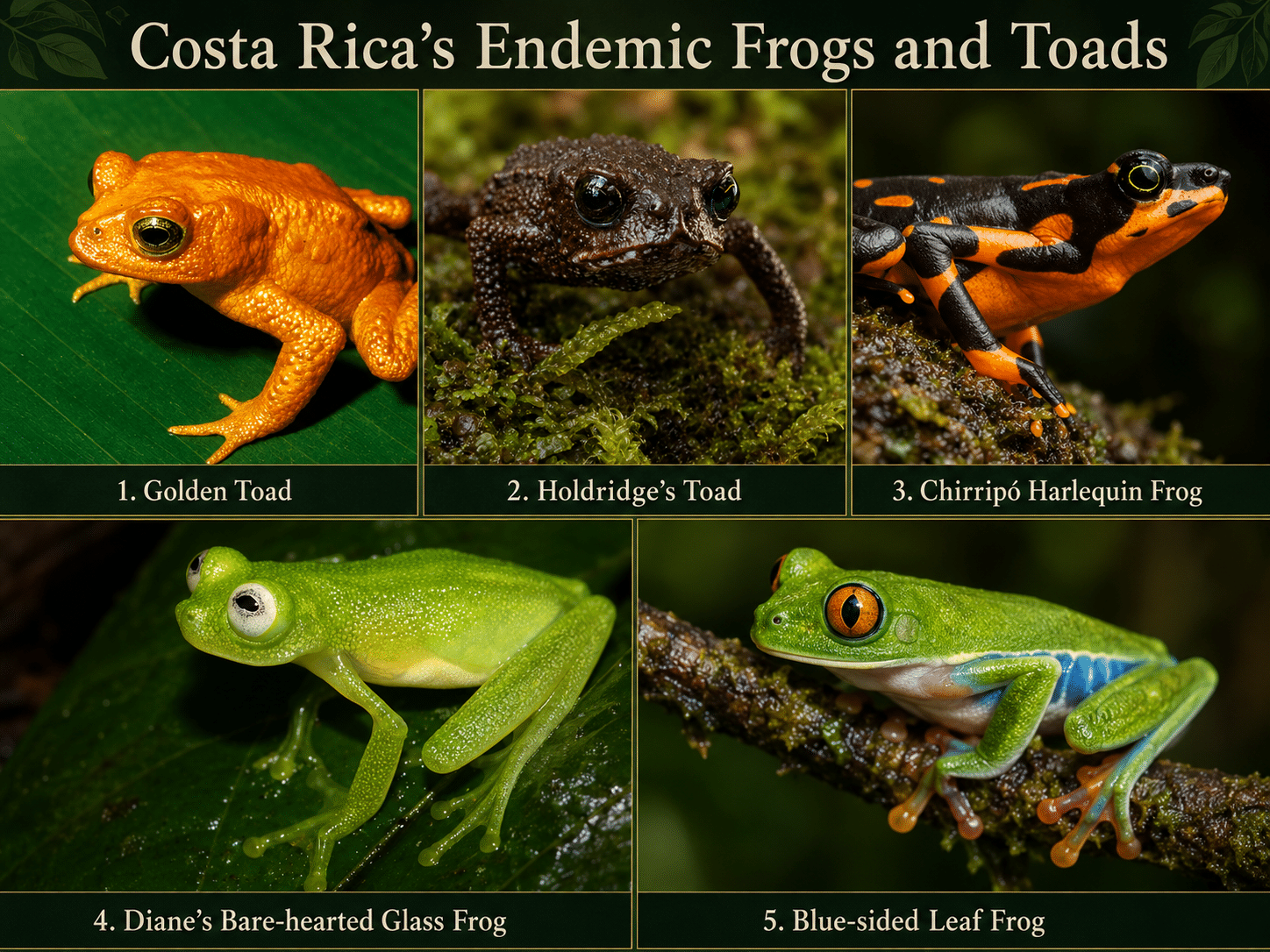
Costa Rica’s endemic frogs and toads include the Golden Toad, Holdridge’s Toad, Chirripó Harlequin Frog, Diane’s Bare-hearted Glass Frog, Blue-sided Leaf Frog and several rare rain frogs. A checklist based on AmphibiaWeb lists 70 endemic amphibian species for Costa Rica, including frogs, toads and salamanders.
Some remarkable examples include:
- Golden Toad (Incilius periglenes) — once famous from Monteverde, now considered extinct
- Holdridge’s Toad (Incilius holdridgei) — a rare highland toad from Costa Rica
- Chirripó Harlequin Frog (Atelopus chirripoensis) — linked to high mountain habitats
- Diane’s Bare-hearted Glass Frog (Hyalinobatrachium dianae) — a delicate glass frog described from Costa Rica
- Blue-sided Leaf Frog (Agalychnis annae) — a striking tree frog associated with Costa Rican highlands
- Golfo Dulce Poison Frog (Phyllobates vittatus) — a vivid Pacific-side poison frog
- Granular Poison Frog (Oophaga granulifera) — a tiny jewel of the forest floor
These animals are not just beautiful. They are warning lights for the health of forests and water. Amphibians breathe partly through their skin, so pollution, climate shifts and disease often reach them before we notice the wider damage.
Are there lizards found only in Costa Rica?
Yes, Costa Rica has several endemic lizards, especially anoles that live in specific mountain, island and forest habitats. Endemic reptile checklists list species such as the Talamanca Cloud Forest Anole, Monteverde Anole, Osa Anole, Arenal Anole and Cocos Anole.
Some Costa Rica-only lizards include:
- Talamanca Cloud Forest Anole (Anolis alocomyos)
- High Anole (Anolis altae)
- Santa Elena Anole (Anolis leditzigorum)
- Monteverde Anole (Anolis monteverde)
- Osa Anole (Anolis osa)
- Tenorio Anole (Anolis tenorioensis)
- Cocos Anole (Anolis townsendi)
- Arenal Anole (Anolis arenal)
Anoles are the forest’s little acrobats. They cling to leaves, trunks and branches, changing posture and colour as if arguing with the weather. Many are overlooked because they are small, fast and perfectly designed to vanish into green.
Are there snakes found only in Costa Rica?
Yes, Costa Rica has endemic snakes, including forest racers, earth snakes, litter snakes, ground snakes and pitvipers. These are not the celebrity snakes of travel posters; many live hidden under leaves, in soil, or in cool mountain forest.
Examples include:
- Talamanca Forest Racer (Dendrophidion crybelum)
- Savage’s Earth Snake (Geophis downsi)
- Ruthven’s Earth Snake (Geophis ruthveni)
- Zeledon’s Earth Snake (Geophis zeledoni)
- Striped Litter Snake (Rhadinella serperaster)
- Viquez’s Tropical Ground Snake (Trimetopon viquezi)
- Talamancan Palm Pitviper (Bothriechis nubestris)
- White-tailed Hog-nosed Pitviper (Porthidium porrasi)
The Talamancan Palm Pitviper is a good reminder that “rare” does not always mean harmless. Admire snakes from a distance, never handle them, and let guides do what guides do best: spot the almost invisible without turning the walk into a hospital visit.
Where can visitors look for these rare species?
Visitors can look for endemic reptiles and amphibians in Costa Rica’s cloud forests, highland parks, night-walk reserves and wet mountain regions. The best sightings often happen slowly, after sunset, with a guide who knows the difference between a leaf, a frog and a leaf pretending badly to be a frog.
Good regions to explore include:
- Monteverde and Santa Elena
- Talamanca highlands
- Cerro de la Muerte
- Chirripó National Park region
- Tapantí and nearby wet forests
- Osa Peninsula
- Tenorio and Arenal areas
- Cocos Island for specialised island reptiles
For voice search, people might ask: “What frogs are only found in Costa Rica?” or “Where can I see endemic reptiles in Costa Rica?” The honest answer is: go with an expert, go at night, and look at the small things.
Why do endemic reptiles and amphibians matter?
Endemic reptiles and amphibians matter because they protect the balance of Costa Rica’s forests, streams and food chains. Frogs eat insects, snakes control small animals, lizards feed birds and mammals, and all of them help scientists read the health of the land.
They matter because they:
- Control insect populations
- Feed birds, mammals and larger reptiles
- Indicate clean water and healthy forests
- Support scientific research
- Strengthen Costa Rica’s ecotourism story
- Represent wildlife found nowhere else on the planet
Losing one of these species is not like misplacing a copy. There is no backup population in another country waiting politely in the wings.
What threatens Costa Rica’s endemic frogs, toads, lizards and snakes?
The main threats are habitat loss, climate change, disease, pollution and the shrinking of specialised mountain habitats. Amphibians are especially vulnerable because many depend on clean, cool, wet environments.
Common pressures include:
- Forest fragmentation
- Rising temperatures in cloud forests
- Fungal disease affecting amphibians
- Illegal collection
- Road expansion
- Pesticide runoff
- Loss of streamside vegetation
- Poorly managed tourism in sensitive areas
The Golden Toad remains the haunting symbol of what can happen when a species has a tiny range and the world around it changes too quickly. Costa Rica’s remaining endemics need protection before they become legends told in the past tense.
How can travellers help protect them?
Travellers can help by joining ethical night walks, staying on trails, never touching wildlife and supporting reserves that protect habitat. Curiosity is welcome; grabbing is not.
Smart ways to help include:
- Book certified naturalist guides
- Avoid flash-heavy photography at close range
- Never handle frogs, toads, snakes or lizards
- Stay on marked trails
- Choose lodges that protect forest
- Report wildlife trafficking
- Support local conservation projects
- Share accurate stories about lesser-known species
Costa Rica’s rarest cold-blooded creatures do not ask for much: clean streams, connected forest, quiet nights and humans with enough sense to keep their hands to themselves.
FAQ: Reptiles, Lizards, Snakes, Frogs and Toads Only Found in Costa Rica
Are red-eyed tree frogs only found in Costa Rica?
No, red-eyed tree frogs are not only found in Costa Rica. They also live in other parts of Central America, although they are one of the country’s most famous frog species.
Are poison dart frogs endemic to Costa Rica?
Some poison frogs are endemic to Costa Rica, but not all of them. The Golfo Dulce Poison Frog and Granular Poison Frog are examples listed among Costa Rica’s endemic amphibians.
Are there venomous snakes only found in Costa Rica?
Yes, Costa Rica has endemic venomous snakes, including the Talamancan Palm Pitviper and White-tailed Hog-nosed Pitviper. These species should only be observed from a safe distance.
Are Costa Rica’s sea turtles endemic?
No, Costa Rica’s sea turtles are not endemic. They nest on Costa Rican beaches, but their ocean ranges extend far beyond the country.
What is the most famous extinct endemic amphibian in Costa Rica?
The Golden Toad is the most famous extinct endemic amphibian associated with Costa Rica. It became an international symbol of amphibian decline and environmental change.
What is the best time to see frogs in Costa Rica?
The rainy season is often best for frog activity, especially at night. Many frogs call, breed and move more actively when forests and streams are wet.
Can tourists touch frogs in Costa Rica?
No, tourists should not touch frogs. Amphibians have sensitive skin, and oils, sunscreen, insect repellent or pathogens from human hands can harm them.