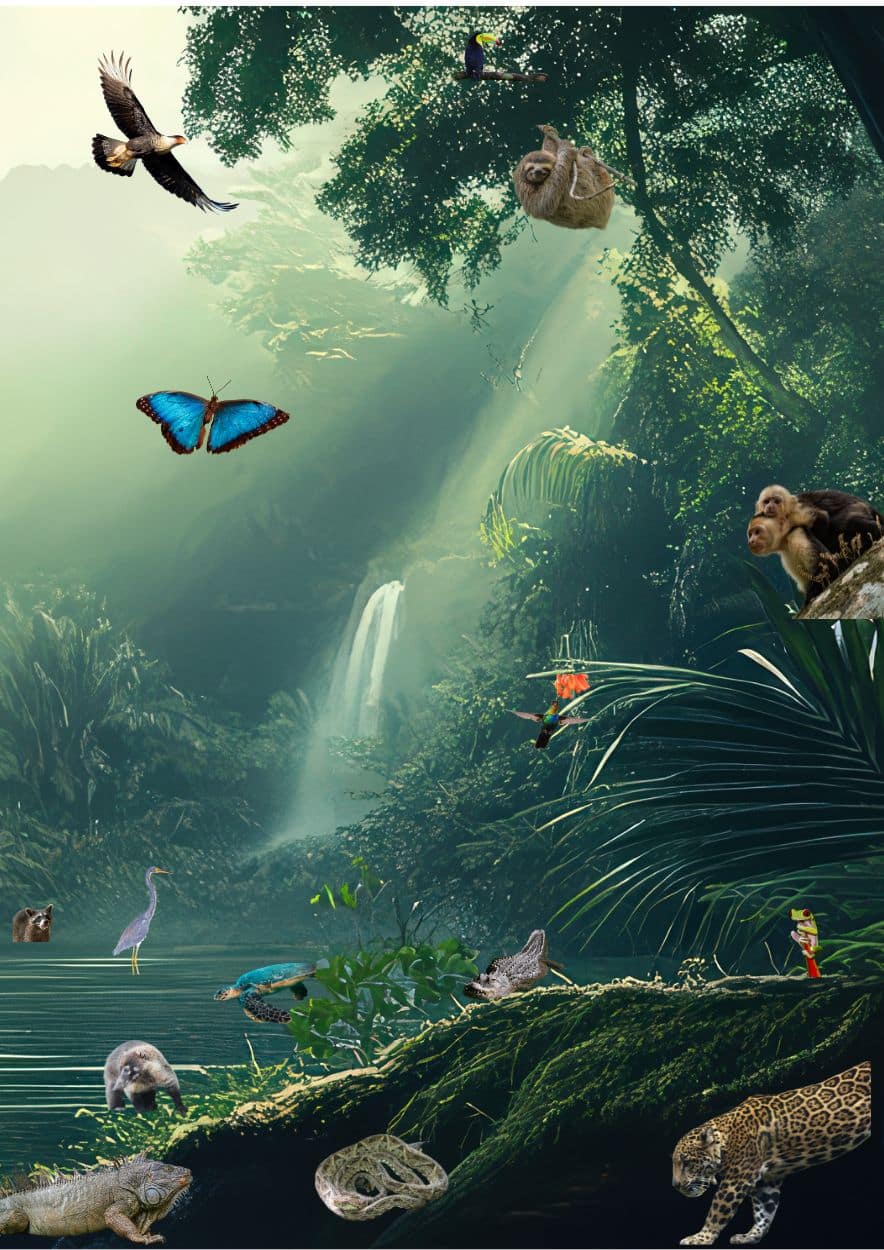
Costa Rica may be small on the map, but it is enormous when it comes to wildlife, packing in hundreds of mammals, reptiles, amphibians, birds, and marine species across rainforests, cloud forests, mangroves, and two very different coasts.(Costa Rica Experts)
Why is Costa Rica such a wildlife hotspot?
Costa Rica is one of the best places on Earth to see wildlife in the wild because a huge share of the country is protected and spans many different habitats. Over a quarter of the national territory is in parks and reserves, ranging from dripping lowland jungle and misty cloud forest to dry tropical woodland, mangroves, and coral-fringed beaches.
Those overlapping habitats allow everything from jaguars and tapirs to hummingbirds and sea turtles to share the same relatively compact country. For travellers, it means you can wake to howler monkeys in the trees and end the day watching humpback whales just offshore, without ever crossing a border.
Which mammals are the stars of Costa Rica’s forests?
Costa Rica’s forests are home to charismatic mammals, from noisy monkeys to shy, nocturnal cats. In most places, you will hear the wildlife before you see it: branches shaking with capuchins, the roar of howlers, the grunt of a distant tapir or the rustle of a coati troop rummaging through leaf litter.
Key mammals to look for include:
- Monkeys: howler, white-faced capuchin, squirrel, and spider monkeys, often seen in mixed groups in national parks.
- Jungle cats: jaguar, puma, ocelot, margay, oncilla, and the sleek jaguarundi, mostly active at night and extremely elusive.
- Large herbivores and oddballs: Baird’s tapir, coatimundi (ring-tailed coati), pacas, anteaters, and playful river otters.
Spotting a jaguar is rare even in places like Corcovado, but knowing it might be there changes the way the forest feels – suddenly every paw print in the mud is a story.
What monkeys can you see in Costa Rica?
You can see four species of monkey in Costa Rica: howler, white-faced capuchin, squirrel, and spider monkeys.(MytanFeet)
- Howler monkeys are the soundtrack of dawn, their booming calls carrying for kilometres.
- White-faced capuchins are bold, intelligent, and often seen near beaches and picnic spots.
- Squirrel monkeys are tiny, hyperactive, and now restricted mainly to the southern Pacific coast and Osa Peninsula.
- Spider monkeys are acrobats of the canopy, swinging with ease using their long limbs and prehensile tail.
The Osa Peninsula is the only region where all four species share the same forests, making it a dream area for primate lovers.(MytanFeet)
Which big cats and other nighttime hunters live here?
Costa Rica shelters six wild cat species, but you are far more likely to see their tracks than the cats themselves. The largest is the jaguar, followed by puma, ocelot, margay, oncilla, and the sleek jaguarundi.
- Jaguars and pumas roam remote parks such as Corcovado and the Guanacaste conservation area.
- Ocelots, margays, and oncillas are smaller spotted cats that hunt at night in dense forests.
- Jaguarundis are long, weasel-like cats sometimes glimpsed in daylight along forest edges.
Camera traps on remote beaches have even documented jaguars hunting nesting sea turtles, a dramatic meeting of forest and ocean predators and a reminder that these cats are still very much part of Costa Rica’s living landscape.
What birds should be on your Costa Rica checklist?
Costa Rica is a world-class birdwatching destination, with over 800 bird species recorded, from tiny hummingbirds to giant macaws.(MytanFeet)
Birds to listen to and look out for:
- Scarlet macaw: loud, colourful, and often seen in pairs wheeling over the Pacific coast and Osa Peninsula.
- Clay-coloured thrush (Yigüirro): the unassuming national bird whose rich song heralds the rainy season.
- Mangrove hummingbird: an endemic jewel found only in Pacific mangroves.
- Magnificent frigatebird: the pirate of the sky, effortlessly riding coastal thermals.
- Plus toucans, herons, kingfishers, and countless others, depending on where you travel.
Even casual visitors tend to come home with a surprising bird list simply by keeping their eyes on the treetops and carrying a pair of binoculars.
Which reptiles and amphibians define Costa Rica’s wild side?
Costa Rica’s reptiles and amphibians are some of its most photogenic and misunderstood residents. Green and black spiny-tailed iguanas bask on branches and walls, while delicate vine snakes hang motionless, disguised as twigs.
Famous species include:
- Red-eyed tree frog: perhaps the most iconic Costa Rican animal, with lime-green body, scarlet eyes, and blue-striped sides.
- Eyelash viper: a small but venomous pit viper that comes in astonishing colour forms, from mossy green to bright yellow.
- Boa constrictor: a powerful, non-venomous snake often seen near rivers.
- Golden toad: once found only in Monteverde’s cloud forest and now believed extinct, a sobering symbol of how fragile these ecosystems are.(MytanFeet)
Night walks with a naturalist guide are the best way to see many of these animals, particularly frogs, which really come to life after dark.
Which sea turtles, whales, and marine creatures visit Costa Rica?
Costa Rica’s coasts host several species of sea turtle and one of the longest humpback whale seasons in the world.(MytanFeet)
On the turtle side, you can encounter:
- Leatherback, green, hawksbill, and loggerhead sea turtles nest on both Caribbean and Pacific beaches at different times of year.
- Olive ridley turtles, famous for mass arribadas at Ostional and Nancite, when tens of thousands come ashore to nest.
Offshore, three distinct populations of humpback whales migrate through Costa Rican waters at different times, joined by dolphins and other occasional whale species.(stayonda.com)
Guided night walks during nesting season or responsible boat trips with licensed operators give you a good chance of witnessing these animals without disturbing them.
Where are the best places to see wildlife in Costa Rica?
The best places to see Costa Rican wildlife are its national parks and reserves, where habitats are protected and animals are used to people passing quietly along trails. Corcovado, Tortuguero, Manuel Antonio, Carara, and Monteverde all stand out for different reasons.
- Corcovado National Park: remote, wild, and famous for jaguars, tapirs, all four monkey species, and scarlet macaws.
- Tortuguero National Park: canals full of caimans, otters, and birds, plus world-class sea turtle nesting.
- Manuel Antonio and Carara: easier access, excellent for monkeys, sloths, iguanas, and macaws.
- Monteverde Cloud Forest: cooler, misty forest with hummingbirds, quetzals, and unique amphibians.
Even smaller reserves and private farms can be outstanding, especially when local guides know exactly where resident sloths, owls or frog ponds are hidden.
How can you watch Costa Rican wildlife responsibly?
You can enjoy Costa Rica’s wildlife responsibly by keeping a respectful distance and following park rules. Small choices add up and help ensure that animals stay wild rather than becoming stressed or dependent on humans.
Simple guidelines include:
- Book certified guides and small-group tours.
- Never feed animals or try to touch them.
- Keep noise low and avoid sudden movements.
- Use red light or no flash around turtles and nocturnal wildlife.
- Stick to marked trails and respect nesting or denning areas.
Responsible watching gives you better sightings and photos, and it protects the very experiences visitors come for.
FAQ: Costa Rica Wildlife
What is the most famous animal in Costa Rica?
The most famous Costa Rican animals are probably the howler monkey, sloth, scarlet macaw, red-eyed tree frog and sea turtles. Each has become a symbol of the country’s wild side, appearing on souvenirs, logos and conservation campaigns.
When is the best time to see wildlife in Costa Rica?
The best time to see wildlife in Costa Rica is generally the green (rainy) season, when forests are lush and many animals are more active. Sea turtles and whales have specific peak months, but you can see monkeys and most birds all year round.(MytanFeet)
Is it easy to see a jaguar in Costa Rica?
It is very difficult to see a jaguar in Costa Rica, even in prime habitats like Corcovado or the Guanacaste conservation area. These big cats are naturally secretive, mostly nocturnal, and range over large territories, so spotting tracks or hearing a distant call is more realistic than expecting a clear sighting.
Are Costa Rica’s animals dangerous?
Most Costa Rican animals are not dangerous if you give them space and behave sensibly. Venomous snakes, crocodiles, and some insects need respect, but attacks on visitors are rare, especially if you stay on trails and follow local advice.(MytanFeet)Do I need a guide to see wildlife in Costa Rica?
You do not have to hire a guide, but a good naturalist guide will dramatically increase the number of animals you see. With a trained eye, a spotting scop,e and knowledge of calls and habits, guides turn “green blur” rainforest into a living, recognisable community of species.(MytanFeet)

Former Navy Journalist, published author and international speaker. Howler executive since 2019.