

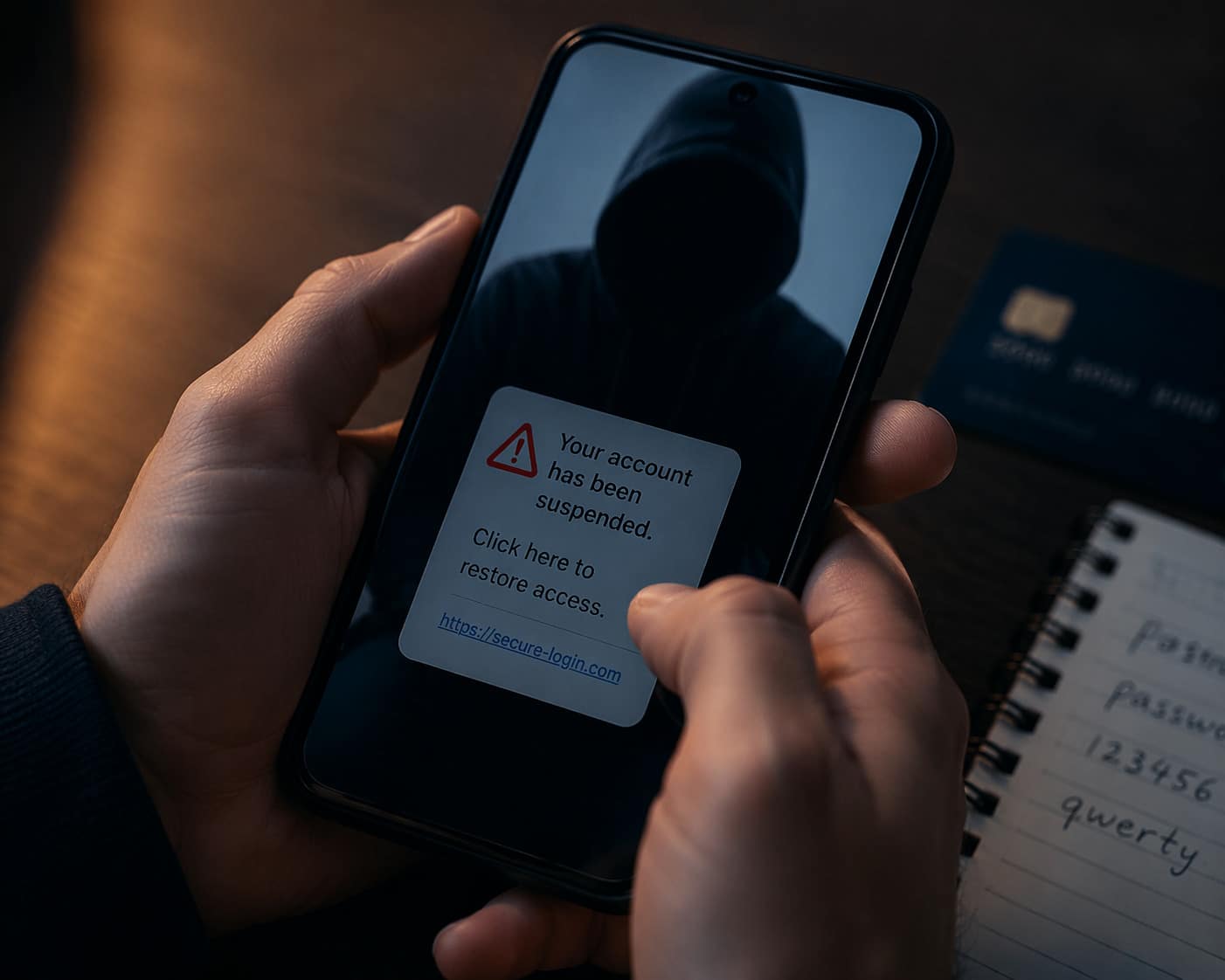
Why do scams and identity theft dominate cybercrime in Costa Rica?
They dominate because they exploit human behaviour rather than technical weaknesses.
Cybercriminals are increasingly targeting people instead of systems. Fraudulent emails, fake banking alerts, and impersonation schemes rely on urgency, fear, or trust to trick individuals into handing over sensitive information. These attacks are simple to execute, scalable, and often difficult to trace.
Common tactics include:
- Phishing emails posing as banks or government agencies
- Fake WhatsApp messages requesting urgent transfers
- Cloned websites designed to steal login credentials
- Social engineering calls impersonating trusted contacts
How widespread is cybercrime in Costa Rica?
Cybercrime has grown rapidly, with over 40,000 cases reported between 2018 and 2025.
According to data from the Judicial Investigation Agency (OIJ), 40,457 cybercrime reports were filed between January 2018 and August 2025. The upward trend is unmistakable, with recent years showing particularly sharp increases.
Key figures:
- 62.1% of cases involve online fraud
- 21.7% involve identity theft
- 10,598 cases reported in the first eight months of 2025 alone
- Nearly doubling of reports between 2023 and 2024
This surge reflects both increased criminal activity and greater awareness leading to more reporting.
Where are cybercrime cases most concentrated?
Most cases occur in urban areas, especially within the Greater Metropolitan Area (GAM).
Cybercrime tends to follow population density and digital activity. The GAM, Costa Rica’s economic and technological hub, accounts for 79% of reported incidents.
Breakdown by province:
- San José: 38.2%
- Alajuela: 19.2%
- Heredia: 11.4%
- Cartago: 10.4%
These regions host the highest concentration of businesses, financial institutions, and internet users—making them prime targets.
Who is most at risk of cybercrime?
Adults aged 18 to 64 are the most affected, with peak vulnerability in the 30–39 age group.
Contrary to the stereotype that older individuals are the primary victims, the data show that working-age adults are the most frequently targeted. This group is highly active online, managing finances, work communications, and digital services daily.
Notable insights:
- 86% of victims fall within the 18–64 age range
- Highest incidence among those aged 30–39
- Men and women are equally affected
Cybercrime does not discriminate—it follows opportunity.
Why is cybercrime increasing so quickly?
It is increasing due to digital dependence, inconsistent security practices, and evolving criminal strategies.
While Costa Rica has made strides in adopting cybersecurity tools, implementation remains uneven. Advanced systems may exist in some organisations, but basic protections—like strong passwords or multi-factor authentication—are still not universally applied.
Contributing factors:
- Rapid digitalisation of banking and services
- Limited public awareness of cyber risks
- Inconsistent use of security protocols
- Increasing sophistication of scam techniques
Is artificial intelligence helping fight cybercrime?
Yes, but adoption is still in its early stages.
Around 20% of institutions in Costa Rica are currently using or testing artificial intelligence to detect threats and monitor suspicious activity. AI can analyse patterns at speed, identify anomalies, and respond faster than traditional systems.
However, challenges remain:
- Limited number of specialised cybersecurity teams
- High cost of advanced AI tools
- Need for training and integration
AI is promising, but it is not yet widespread enough to counter the scale of the problem.
How can individuals protect themselves from cybercrime?
The best defence is awareness combined with simple, consistent security habits.
Practical steps include:
- Never clicking on suspicious links or attachments
- Verifying requests for money or personal information
- Using strong, unique passwords for each account
- Enabling two-factor authentication wherever possible
- Keeping devices and software updated
A moment of caution can prevent months of damage.
FAQ: Cybercrime in Costa Rica
What is the most common type of cybercrime in Costa Rica?
Online fraud is the most common, accounting for over 60% of reported cases.
Is identity theft a growing concern?
Yes, it represents over 21% of cases and continues to rise alongside digital activity.
Are tourists at risk of cybercrime in Costa Rica?
Yes, especially when using public Wi-Fi or unfamiliar payment systems.
Do banks in Costa Rica offer protection against fraud?
Most banks provide security measures, but users must also follow safe practices.
Can cybercrime be reported in Costa Rica?
Yes, incidents can be reported to the Judicial Investigation Agency (OIJ).
Is cybercrime expected to increase?
Yes, as digital adoption grows, so will opportunities for cybercriminals.




Howler Staff are John, Terry and whomever else we can get to write great articles.