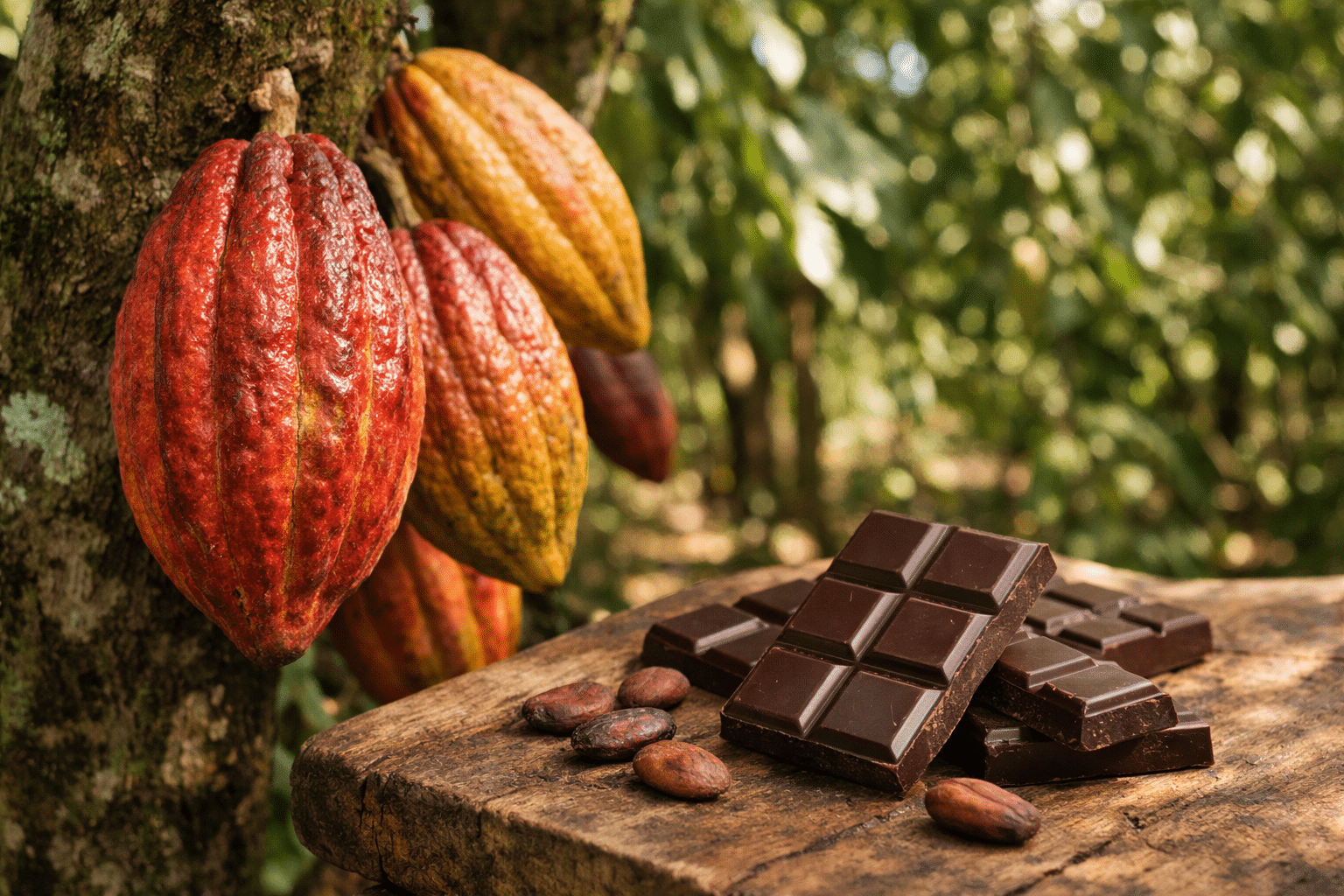
Cacao in Costa Rica isn’t just “the ingredient before chocolate” — it’s a living thread that runs through rainforest ecology, Indigenous heritage, smallholder livelihoods, and the modern obsession with seriously good dark chocolate.
If you’ve ever snapped a square of 70% dark chocolate and thought, How did something this luxurious start as a sticky pod in the jungle? — Costa Rica has answers. Not the over-polished, gift-shop version either, but the real one: disease setbacks, community comebacks, women-led traditions, and a growing movement toward quality and sustainability.
What makes cacao in Costa Rica special?
Costa Rican cacao stands out because it’s often grown by small producers in biodiverse, shaded systems where flavour and sustainability matter as much as yield. MAG+1
You’ll find cacao woven into “working landscapes” — farms where fruit trees, hardwoods, and cacao share the same space. That matters because it shapes both flavour and impact.
- Flavour first: Costa Rica positions itself around fine-quality cacao, not sheer volume. MAG
- Agroforestry culture: Research in Costa Rica (especially around Talamanca) has long explored cacao grown under shade as an ecological and economic strategy. repositorio.catie.ac.cr+1
- Strong local identity: In some regions, cacao is part of community memory — how families farm, share knowledge, and celebrate food.
Was cacao used in Costa Rica before Europeans arrived?
Yes — cacao was used in Costa Rica and wider Mesoamerica long before colonisation, valued as food and also as a form of currency and status symbol. MAG
That detail matters because it reframes cacao as more than a crop. It was social, ceremonial, and economic — something you’d offer, trade, and honour.
Here’s the shift that happened later:
- Pre-colonial cacao: Mostly consumed as a bitter drink in ritual and high-status contexts (the “original” chocolate experience was not a sweet one).
- Colonial reinterpretation: European tastes gradually pushed cacao toward sweetness, milk, and spice combinations — the beginnings of what most people now call “hot chocolate”.
When did cacao become a serious Costa Rican industry?
Cacao became a major economic crop in Costa Rica in the modern era, especially on the Caribbean side, where conditions suited large-scale production. si.cultura.cr+1
At one point, cacao was a meaningful generator of foreign exchange for the country — and then came the plot twist that every farmer remembers.
- The Caribbean region’s historic importance: Limón and surrounding areas played a major role in national production. si.cultura.cr
- A rise-and-fall pattern: Like many tropical crops, cacao boomed, then got hit by biological reality.
What happened to cacao production in Costa Rica — and why did it drop?
Cacao production dropped sharply after frosty pod rot arrived, a disease that devastated yields and forced many producers to abandon cacao for a time. cabidigitallibrary.org+2bsppjournals.onlinelibrary.wiley.com+2
This is where Costa Rica’s cacao story stops being romantic and starts being real.
- Frosty pod rot (Moniliophthora roreri) was detected in Costa Rica in 1978. cabidigitallibrary.org
- Studies describe steep production declines in the years following its arrival. bsppjournals.onlinelibrary.wiley.com
- The result: fewer cacao farms, less national output, and a period where cacao looked like a losing battle.
How did Costa Rica’s cacao make a comeback?
Costa Rica’s cacao comeback has been driven by smallholder organisations, organic and fair-trade pathways, improved post-harvest practices, and renewed demand for fine-flavour chocolate. edepot.wur.nl+2appta.org+2
A key name in the story is APPTA, a small producers’ association founded in 1987, with hundreds of member families and a strong Indigenous presence. appta.org+1
What “comeback” looks like on the ground:
- Better fermentation and drying (because flavour is built after harvest, not just on the tree). MAG
- Organic systems and certification routes that opened premium markets for small farmers. edepot.wur.nl
- A shift toward quality — where a farm’s care and processing can beat sheer scale.
What’s the Bribri connection to cacao in Costa Rica?
In Bribri culture (Talamanca), cacao is considered sacred, and traditional practice places women at the centre of preparing and serving the cacao drink. appta.org+2MytanFeet+2
This is one of the most striking parts of cacao culture in Costa Rica because it’s not a performance — it’s continuity.
- Cacao as a sacred food: It’s treated with respect, not just as a commodity. appta.org
- Women’s role: In many Bribri communities, women traditionally prepare the cacao drink. MytanFeet
- Cultural tourism with responsibility: Chocolate tours can be meaningful when they’re community-led and not extractive.
Where is cacao grown in Costa Rica today?
Cacao in Costa Rica is strongly associated with the Caribbean region and northern areas, with recognised territories including places such as Upala and Talamanca. srb.una.ac.cr+2TEC+2
If you’re mapping cacao by flavour, microclimate matters — rain patterns, shade density, soils, and even the way beans are fermented.
Common cacao “conversation zones” include:
- Talamanca / Caribbean side (often linked to Indigenous cacao and agroforestry) srb.una.ac.cr+1
- Huetar Norte (including Upala area), where cacao has been actively organised and supported through regional initiatives TEC
- Other origin-identity efforts that aim to connect place and quality (geographical indications). srb.una.ac.cr
Is dark chocolate actually good for you?
Yes — in modest amounts, dark chocolate can support heart and brain health because cacao contains flavanols that improve blood flow and help reduce oxidative stress. Cleveland Clinic+2Harvard Health+2
Let’s keep it sensible: dark chocolate isn’t a magic shield, but it does have evidence-backed upsides — especially compared with sugary milk chocolate.
What nutrients are in dark chocolate?
Dark chocolate contains flavanols plus minerals like iron, magnesium, copper, and manganese, with benefits depending heavily on cocoa percentage and added sugar. Cleveland Clinic
Look for:
- 70% cocoa or higher (a common threshold for “more cocoa, less sugar”) Cleveland Clinic
- Short ingredient lists (cocoa mass, cocoa butter, minimal added sugar)
- Portion realism (because it’s still calorie-dense) Harvard Health
What are the proven (or plausible) benefits of dark chocolate?
The best-supported benefits are modest improvements in blood pressure and vascular function, with possible short-term cognitive perks. Harvard Health+2Cleveland Clinic+2
- Heart support: Flavanols are linked with improved blood flow and short-term blood pressure benefits. Harvard Health+1
- Brain boost: Better blood flow can support cognition, and cocoa contains small amounts of caffeine-like stimulants. Cleveland Clinic
- Mood lift: Many people feel a genuine mood effect — partly sensory, partly biochemical, partly “life is better with chocolate”.
How much dark chocolate should you eat?
A small daily portion (think a couple of squares) is the sweet spot if you want benefits without turning it into a sugar-and-calorie habit. Harvard Health+1
Try this approach:
- 2–3 squares after lunch instead of a larger dessert
- Pair it with fruit (banana, strawberries, mango) for a Costa Rica-meets-kitchen moment
- Use grated dark chocolate on yoghurt or oatmeal for flavour without overdoing it
How do you taste Costa Rica in a bar of dark chocolate?
You taste Costa Rica through fermentation choices, roast style, and the farm’s growing conditions — which can bring out notes like fruit, spice, nuts, and florals. MAG+1
If you want to sound like you know what you’re doing (without becoming unbearable at dinner), focus on three things:
- Origin (region): Caribbean vs northern zones can express differently
- Percentage: Higher cocoa often means more bitterness and clearer origin character
- Processing: Well-fermented beans taste clean and complex; poor fermentation tastes flat or harsh
What’s the easiest way to experience cacao culture in Costa Rica as a visitor?
The easiest way is to join a community-led cacao experience that shows the pod-to-bar process and explains why cacao matters locally. MytanFeet+1
What to look for (quick checklist):
- Small groups and transparent pricing
- Real farming context (trees, shade, compost, fermentation boxes)
- Respectful storytelling (especially in Indigenous territories)
- Tasting that compares styles (raw cacao drink, roasted nibs, finished chocolate)
FAQ: Costa Rica cacao and dark chocolate
How did cacao reach Europe from Central America?
Spanish colonisation carried cacao to Europe, where recipes shifted toward sweetened chocolate drinks that later evolved into modern chocolate styles.
What disease hit cacao farms in Costa Rica?
Frosty pod rot was a major blow, appearing in Costa Rica in 1978 and causing severe losses. cabidigitallibrary.org+1
Why is Talamanca so closely linked with cacao?
Talamanca is linked with cacao because it’s a centre of Indigenous cacao culture and long-running cacao agroforestry systems. repositorio.catie.ac.cr+1
Is dark chocolate healthier than milk chocolate?
Usually yes, because dark chocolate tends to have more cocoa and less sugar, especially at 70% cocoa and above. Cleveland Clinic
Can dark chocolate help blood pressure?
It may help modestly in some people because cocoa flavanols support blood vessel function, but it’s not a substitute for medical care. Harvard Health+1
What’s the best dark chocolate to buy?
Choose a reputable brand with 70%+ cocoa, low added sugar, and a clean ingredient list — then keep portions sensible. Cleveland Clinic+1