What is the green flash?
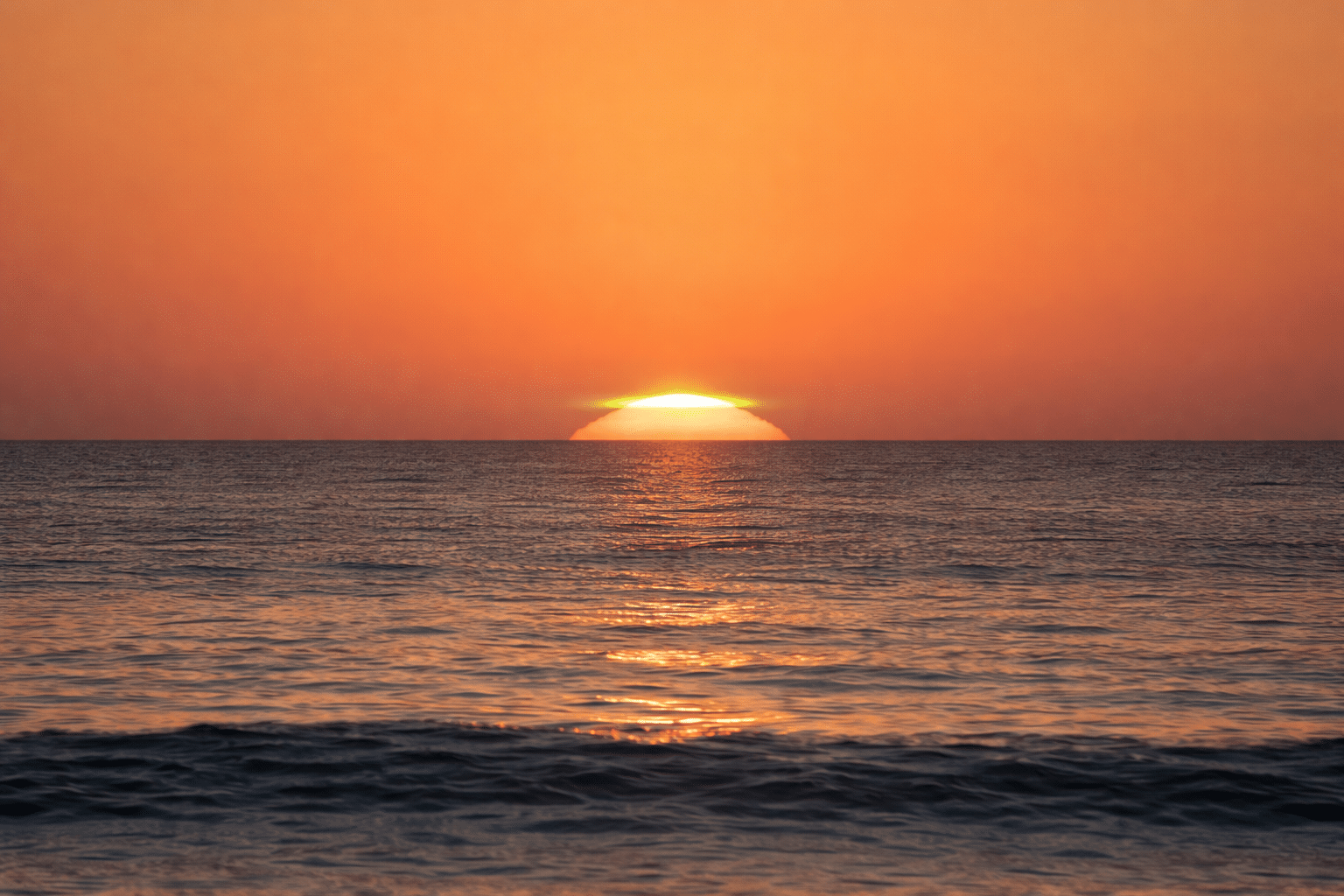
The green flash is a brief burst of green light that can appear on the very top edge of the sun for roughly one to three seconds as it meets the horizon. It’s most often spotted at sunset over the ocean, though it can happen at sunrise too.
People describe it in different ways: a neon-green “cap” on the sun, a quick emerald wink, or a tiny green flame that seems to flick up and vanish before your brain has fully caught up with what your eyes just saw.
Is the green flash real, or just sea story folklore?
It’s real, and it’s been observed and explained by atmospheric science—yet it still feels like magic when you finally see it. Mariners have talked about it for centuries, and plenty of listeners have rolled their eyes because it sounds like a sailor’s embellishment.
Pop culture helped cement the mythic vibe, too. A famous 19th-century French novel built an entire romantic quest around the “green ray,” and modern films have turned it into a spooky omen. But the phenomenon itself doesn’t need a ghost story to be extraordinary; the physics are already dramatic enough.
Why does the sun turn green at the horizon?
The green flash happens because Earth’s atmosphere bends sunlight like a prism and filters colours differently as the sun sits low on the horizon. When the sun is high, its light travels through less atmosphere, so the colours stay more blended. Near the horizon, sunlight passes through a much thicker slice of air.
That extra atmosphere:
-
Refracts (bends) the light, separating colours slightly
-
Scatters colours unevenly (blue tends to scatter strongly)
-
Leaves a narrow window where green wavelengths can briefly dominate the topmost edge of the sun
The result is a tiny, fleeting green highlight that only appears when the “stack” of atmosphere between you and the sun is just right.
What does the green flash actually look like in real life?
Most green flashes are subtle and fast, and they usually appear as a thin green line or small green segment at the sun’s upper rim. You’re not typically going to see a giant green explosion. It’s more like the sun blinks green—then the moment is gone.
Common real-world looks include:
-
A thin green rim on the sun’s top edge
-
A small green “bead” that forms briefly as the sun slips behind the horizon
-
A quick emerald flicker that appears and disappears in a heartbeat
When are the odds best in Costa Rica?
Your best chances are on clear dry-season evenings when the western sky is clean and the horizon is sharp. Costa Rica can serve up unforgettable sunsets, but clouds are the biggest spoiler for green-flash hunting.
You’ll improve your odds if you aim for:
-
Dry season clarity (when evenings are more likely to be cloud-free)
-
Low haze and low humidity near the horizon
-
Minimal smoke or dust in the distance
-
A perfectly defined horizon line (ocean horizons are ideal)
Where should you watch for the green flash in Costa Rica?
The best locations are west-facing Pacific viewpoints with an unobstructed horizon—especially along the Nicoya Peninsula and Guanacaste. You want the sun to drop straight into open water with nothing interrupting the sightline.
Strong Costa Rica options include:
-
Nicoya Peninsula beaches (Santa Teresa, Mal País, Montezuma area viewpoints, Sámara, Nosara/Guariones region)
-
Guanacaste’s west-facing coastline (Papagayo area viewpoints, Playa Hermosa (Guanacaste), Flamingo/Potrero outlooks)
-
Cliffside or headland lookouts where you can see a clean ocean horizon without beach trees or buildings
Quick rule: if you can see a perfectly straight ocean horizon and the sunset is cloud-free right where the sun will touch down, you’re in the right place.
What conditions ruin the green flash, even on a beautiful sunset?
Anything that blurs the horizon or interrupts the last sliver of sun can wipe out your chances. The most frustrating part is that the sunset can look stunning… and still not deliver the flash.
Common deal-breakers:
-
A low cloud bank sitting right on the horizon
-
Haze or heavy humidity that smears the sun’s edge
-
Sea spray or wind-driven mist in the wrong direction
-
Distant smoke (sometimes seasonal) that dulls contrast
-
Obstructions like palms, headlands, boats, or buildings cutting across the last moment
How do you watch safely without wrecking your eyes?
Watch the horizon and the final edge of the sun without staring hard or using unsafe magnification. A sunset is less intense than midday sun, but it can still be damaging if you fixate or use optics carelessly.
Safer viewing tips:
-
Don’t stare continuously at the sun—watch casually, blink, look away, return
-
Never use binoculars or a telescope to look at the sun unless you have proper solar filters and know exactly what you’re doing
-
If using a camera, use the screen view rather than pressing your eye to an optical viewfinder for extended periods
-
Consider watching the moment just before the sun touches the horizon, then focusing on the very last sliver
Can you photograph the green flash on purpose?
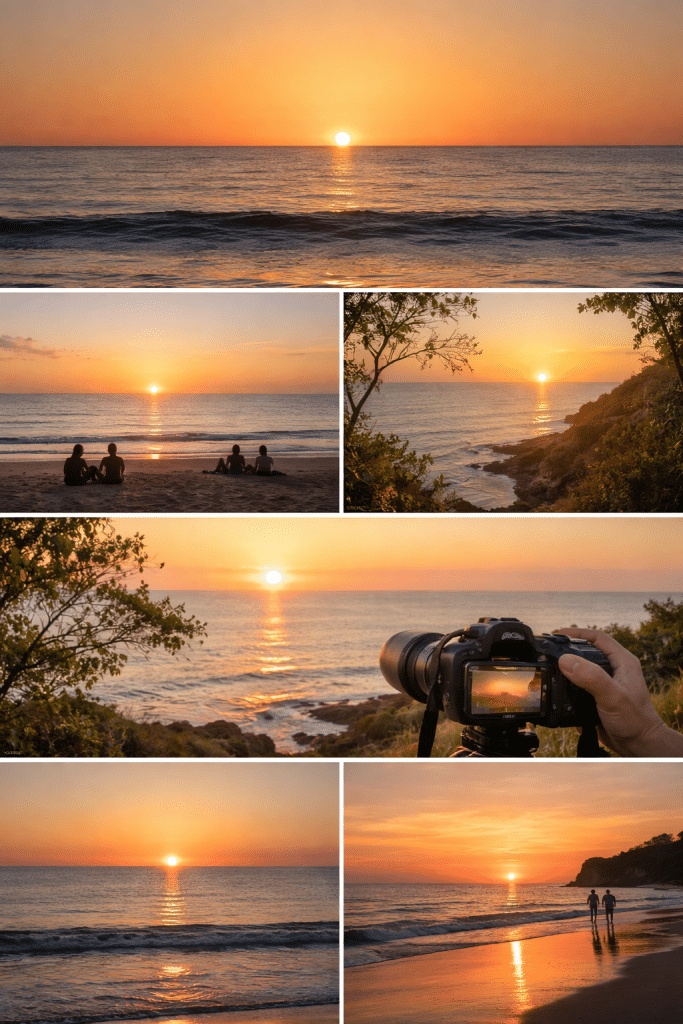
Yes—if you use burst shooting and a steady setup, you can dramatically increase your odds of capturing it even if your eyes miss it. The green flash is so fast that cameras often “see” it more reliably than we do, especially when you shoot a rapid sequence during the final seconds.
Practical camera tips (simple, not technical overload):
-
Use burst/high-speed shooting for the final 10–20 seconds
-
Stabilise with a tripod or a rock-solid surface
-
Use a telephoto lens if you have one (even a phone with a strong optical zoom helps)
-
Tap focus on the sun’s edge earlier, then don’t fiddle at the last second
-
Keep shooting until the sun is fully gone
And here’s the funny part: many people only discover they caught it when they scroll their photos later, zoom in, and suddenly there it is—an emerald razor line they didn’t consciously register in the moment.
What’s it like when you finally see it?
It feels like you’ve been let in on a secret the ocean has been keeping. One second you’re watching a familiar golden sunset, the next second the sun wears an emerald crown—then it’s gone, leaving you half-laughing because you’re not sure your brain didn’t just make it up.
That’s why green-flash hunting becomes a ritual. You don’t “go to see it” in the same way you go to see a waterfall. You show up, you give the horizon a clean chance, and you accept that nature might say “not tonight.” Then, on the rare evening it happens, you’re suddenly the person telling the story that other people used to doubt.
What are the most common “false alarms”?
Green flashes are often confused with lens flare, camera artefacts, or the green afterimage you can get from staring at bright light. If you’re serious about it, you’ll want to know the difference.
Watch out for:
-
Lens flare: usually looks smeared or moves oddly with the camera angle
-
Afterimage: happens when you stare too long; the green spot lingers when you look away
-
Screen processing: phones sometimes oversaturate sunsets and invent colours
-
Cloud-edge glow: greenish tints can appear along clouds, not on the sun’s rim
The true green flash is tied to the sun’s upper edge at the final moment—that’s the key clue.
FAQ: Green Flash in Costa Rica
Can you see the green flash with the naked eye?
Yes, many people do—but it’s so brief that you might only notice it as a quick green wink.
Is the green flash more common at sunrise or sunset?
Sunset is more commonly observed because more people are watching, but it can happen at sunrise under the same conditions.
Do you need perfect weather to see it?
You need a clear view of the horizon and minimal haze near the sun’s touchdown point. The rest of the sky can look lovely, but the horizon area must be clean.
What time should I start watching?
Start paying close attention about five minutes before the sun reaches the horizon. The flash occurs right at the end.
What’s the best coast in Costa Rica for seeing it?
The Pacific coast is the best because the sun sets over the ocean, giving you a crisp horizon line.
Can I capture it on my phone?
Sometimes, yes—especially with a phone that has strong optical zoom and burst mode. Even then, it’s easier with a stable position and clear air.
Is it dangerous to watch?
It can be if you stare too long or use magnifying optics without proper filters. Watch casually, blink, look away, and avoid unsafe gear.
Pirates of the Caribbean 20075:59:166:00:476:01:076:01:256:01:26

Former Navy Journalist, published author and international speaker. Howler executive since 2019.