

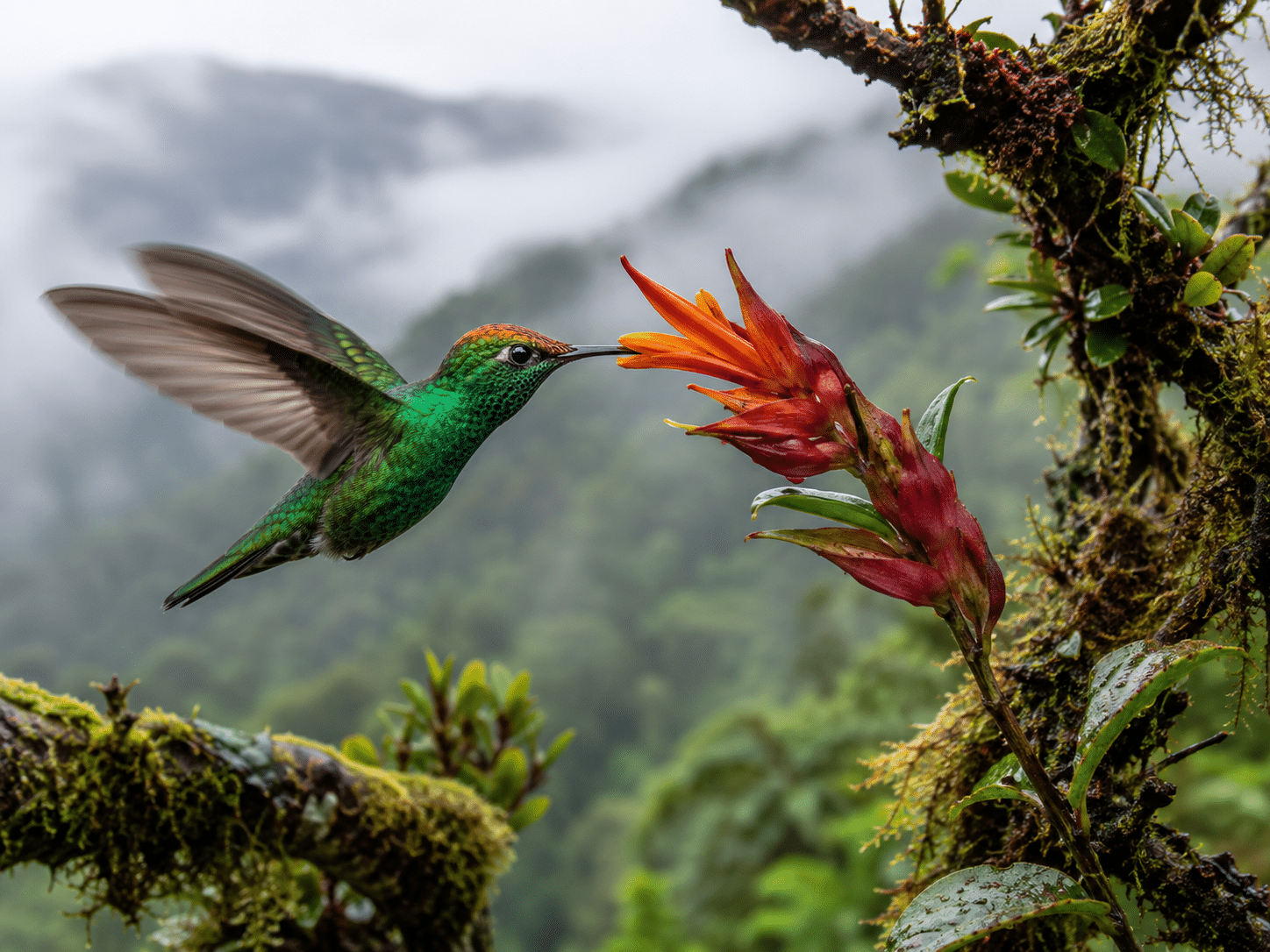
Lead photo suggestion: A coppery-headed emerald hummingbird hovering beside a bright cloud forest flower, with soft mist, mossy branches, and a blurred Costa Rican mountain forest behind it.
What birds are only found in Costa Rica?
Costa Rica has a small but remarkable group of birds found nowhere else on Earth. These are known as endemic birds, meaning their natural wild range is limited to Costa Rican territory.
That sounds simple, but bird ranges are messy. Some species once described as Costa Rican endemics have later been recorded close to the Panama border, while others live only on remote Cocos Island, more than 500 kilometres off the Pacific coast. The official Costa Rica bird list for 2025–2026 recognises the country’s modern checklist using Clements/eBird taxonomy, while Avibase notes that Costa Rica’s national list follows Avilist 2025 and continues to be updated as records change.
The clearest Costa Rica-only birds include:
- Cocos Cuckoo
- Cocos Flycatcher
- Cocos Finch
- Coppery-headed Emerald
- Cabanis’s Ground-Sparrow
- Mangrove Hummingbird
- Black-cheeked Ant-Tanager
Some guides also discuss near-endemics shared with western Panama, but this article focuses on birds most strongly associated with Costa Rica alone.
Why does Costa Rica have birds found nowhere else?
Costa Rica has endemic birds because mountains, islands, mangroves, and isolated forests create natural boundaries where species evolve separately. A bird on Cocos Island is cut off by open ocean. A hummingbird in the highlands is shaped by cool forests, specific flowers, and elevation. A ground-sparrow in the Central Valley is tied to scrubby habitat that has become increasingly rare.
Costa Rica’s endemic bird life is shaped by:
- Cocos Island isolation
- Highland cloud forests
- Mangrove ecosystems
- Pacific lowland forests
- Central Valley grasslands and scrub
- Very specific food and nesting needs
- Rapid changes in land use
The country may be small, but it is ecologically layered. That is why birders can travel a few hours and feel as if they have entered a completely different bird world.
Which endemic birds live on Cocos Island?
Cocos Island has three bird species found only there: the Cocos Cuckoo, Cocos Flycatcher, and Cocos Finch. These birds are among Costa Rica’s most geographically exclusive species because their world is a remote volcanic island in the Pacific.
The Cocos Island endemics are:
- Cocos Cuckoo (Coccyzus ferrugineus)
- Cocos Flycatcher (Nesotriccus ridgwayi)
- Cocos Finch (Pinaroloxias inornata)
Cocos Island conservation sources list these three species as birds found only in Cocos Island National Park, along with an endemic yellow warbler subspecies. BirdLife also describes the Cocos Finch as endemic to Cocos Island, where it is the island’s most common landbird.
For most travellers, these are not casual sightings. Cocos Island is remote, protected, and best known for marine life, but for bird lovers it is also a tiny evolutionary laboratory with feathers.
Which Costa Rica-only birds can be found on the mainland?
Costa Rica’s mainland endemic birds include the Coppery-headed Emerald, Cabanis’s Ground-Sparrow, Mangrove Hummingbird, and Black-cheeked Ant-Tanager. These birds live in very different habitats, which makes them a perfect introduction to Costa Rica’s ecological variety.
Key mainland endemics include:
- Coppery-headed Emerald — a small hummingbird of highland forest edges and gardens
- Cabanis’s Ground-Sparrow — a threatened bird of the Central Valley and nearby scrubby habitats
- Mangrove Hummingbird — a specialised hummingbird tied to Pacific mangroves
- Black-cheeked Ant-Tanager — a rich red forest bird associated with southern Pacific lowlands
Birding sources describe seven strict Costa Rican endemics, including three from Cocos Island and mainland species such as Coppery-headed Emerald and Cabanis’s Ground-Sparrow, while noting that some species have complicated border-area records.
Why is the Coppery-headed Emerald special?
The Coppery-headed Emerald is special because it is a tiny hummingbird found only in Costa Rica’s highland region. It is one of the country’s most charming endemic birds, often seen around flowers in cloud forest gardens and mountain edges.
Look for:
- A small green body
- A coppery-toned crown
- Fast, precise flight
- Visits to flowering shrubs and forest edges
- Highland locations such as Monteverde and the Central Highlands
For many visitors, this is the most accessible Costa Rica-only bird. You do not need an expedition ship or a secret research permit. You need patience, flowers, binoculars, and the willingness to stand still while something jewel-like whirrs past your ear.
Why does Cabanis’s Ground-Sparrow need attention?
Cabanis’s Ground-Sparrow needs attention because it depends on disappearing Central Valley grasslands, thickets, and semi-open habitats. Unlike a cloud forest hummingbird, this bird is tied to areas where human development has been intense.
Its challenge is simple and serious: the habitat it needs is also the habitat people like to clear, build on, tidy up, or convert.
This bird matters because it:
- Represents Costa Rica’s overlooked Central Valley wildlife
- Depends on scrubby, imperfect-looking habitat
- Shows why conservation is not only about pristine rainforest
- Reminds us that messy edges can be full of life
Not every important bird lives in a national park postcard. Some survive in the rough margins, where grass, shrubs, and patience still have a chance.
Where can birdwatchers see Costa Rica’s endemic birds?
Birdwatchers can see Costa Rica’s endemic birds in highland forests, mangroves, southern Pacific forests, Central Valley scrub, and Cocos Island. The best place depends entirely on the species.
Useful starting points include:
- Monteverde and Central Highlands: Coppery-headed Emerald
- Central Valley and nearby foothills: Cabanis’s Ground-Sparrow
- Pacific mangroves: Mangrove Hummingbird
- Osa Peninsula and Golfo Dulce region: Black-cheeked Ant-Tanager
- Cocos Island National Park: Cocos Cuckoo, Cocos Flycatcher, Cocos Finch
For voice search, people may ask: “What birds are only found in Costa Rica?” or “Where can I see endemic birds in Costa Rica?” The answer is best given species by species, because these birds do not all share one habitat.
How can visitors help protect Costa Rica’s endemic birds?
Visitors can help by hiring ethical birding guides, supporting reserves, respecting habitat, and not chasing birds too aggressively for photographs. Endemic birds are valuable precisely because their ranges are small.
Simple ways to help include:
- Book local naturalist and birding guides
- Stay on marked trails
- Avoid playback overuse
- Support habitat restoration
- Visit community conservation projects
- Choose lodges that protect forest or mangroves
- Keep distance from nests and feeding birds
- Share accurate information about rare species
The best birdwatching leaves the bird behaving as if you were never there.
FAQ: Birds Only Found in Costa Rica
What does endemic bird mean?
An endemic bird is a bird naturally found in one specific area and nowhere else in the wild. In this article, it means birds whose natural range is limited to Costa Rican territory.
Are toucans only found in Costa Rica?
No, toucans are not only found in Costa Rica. Species such as the keel-billed toucan also live in other parts of Central and South America.
Is the resplendent quetzal endemic to Costa Rica?
No, the resplendent quetzal is not endemic to Costa Rica. It also lives in other Central American countries, although Costa Rica is one of the best places to see it.
What is the easiest Costa Rica-only bird to see?
The Coppery-headed Emerald is one of the easiest strict endemics for many visitors to see, especially in highland gardens and cloud forest regions.
What endemic birds live only on Cocos Island?
The Cocos Cuckoo, Cocos Flycatcher, and Cocos Finch are found only on Cocos Island.
Are all Costa Rica endemic bird lists the same?
No, endemic bird lists can differ because taxonomy changes and new sightings near borders may alter how species are classified. That is why modern bird lists should be checked regularly.