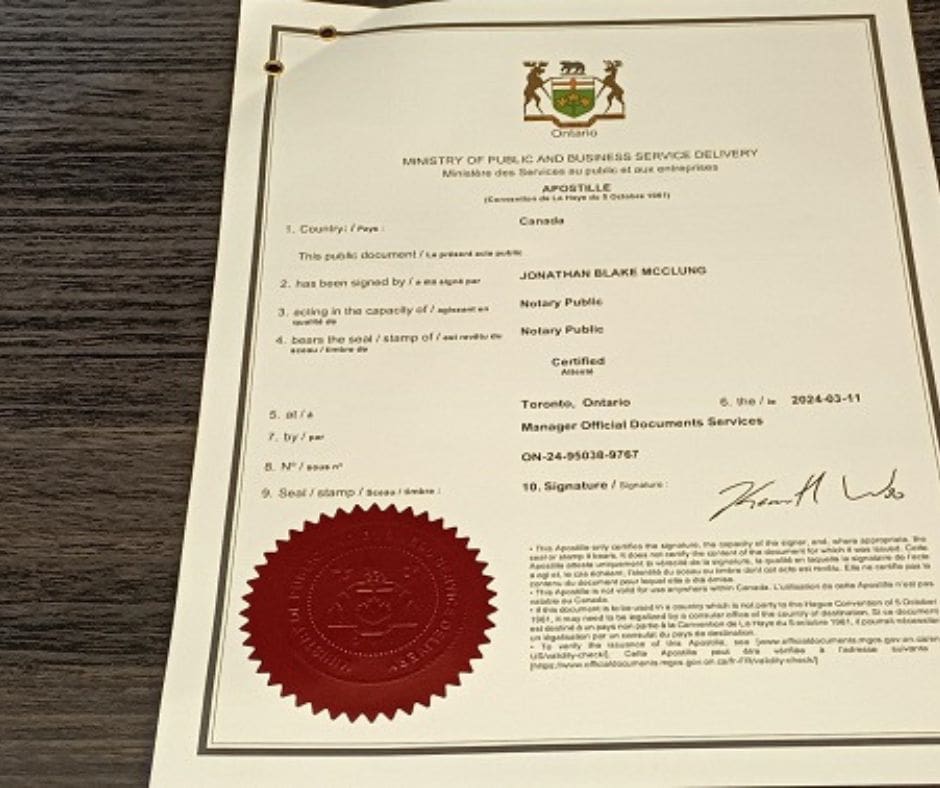
The Hague Convention on the Apostille (CONVENTION FOR THE ELIMINATION OF THE LEGALIZATION REQUISITE FOR FOREIGN PUBLIC DOCUMENTS is known as the “CONVENTION OF THE APOSTILLE”). Through this convention, public documents or certificates- such as birth, marriage, or death certificates, judgments, extracts of registers, or notarial attestations and other official documents – are recognized in any of the countries that have signed the Hague Convention.
An Apostille Stamp certifies only the legal validity and the origin of the public document to which it relates. It verifies the authenticity of the signature or seal of the person or authority that signed or sealed the document and their official capacity. However, an Apostille does not certify the content of the public document.
Only countries part of the Hague Convention are authorized to issue the Apostille stamp, and such documents are intended for use only in another signatory country.
The United States of America and Canada are signatories of the Apostille Convention. This means that documents issued by their authorities with an Apostille Stamp are recognized as legal and valid to use in Costa Rica without further legalization before any consulate or government institution.
To confirm whether a country is a part of the Hague Convention signatory, visit: https://www.hcch.net/en/instruments/conventions/status-table/?cid=41
Most signatory countries charge a fee for issuing each Apostille. For precise information on pricing and specific requirements, consult the competent authorities of the respective country.
Not all Apostille stamps look the same or have the same name. For example, in New York, it is called a “Certificate of Authentication,” while in Texas, it is called an “Authentication of Documents”. Despite these differences in names, the Apostille must include the following essential elements:
- They must be identified as an Apostille, include the short version of the French title of the Convention (Convention de La Haye du 5 octobre 1961),
- Contain a box with the 10-numbered standard informational items.
- Each country may include additional information, and the Apostille Stamp must be affixed to the public document.
An official translator may be required to translate the apostilled certificates into Spanish for particular diligence, such as CR residency applications or immigration matters.
At GM ATTORNEYS, we are glad to address your inquiries and provide guidance on this and other related legal matters. Feel free to contact us at info@gmattorneyscr.com or visit our website and blog section at https://gmattorneyscr.com/blog/