

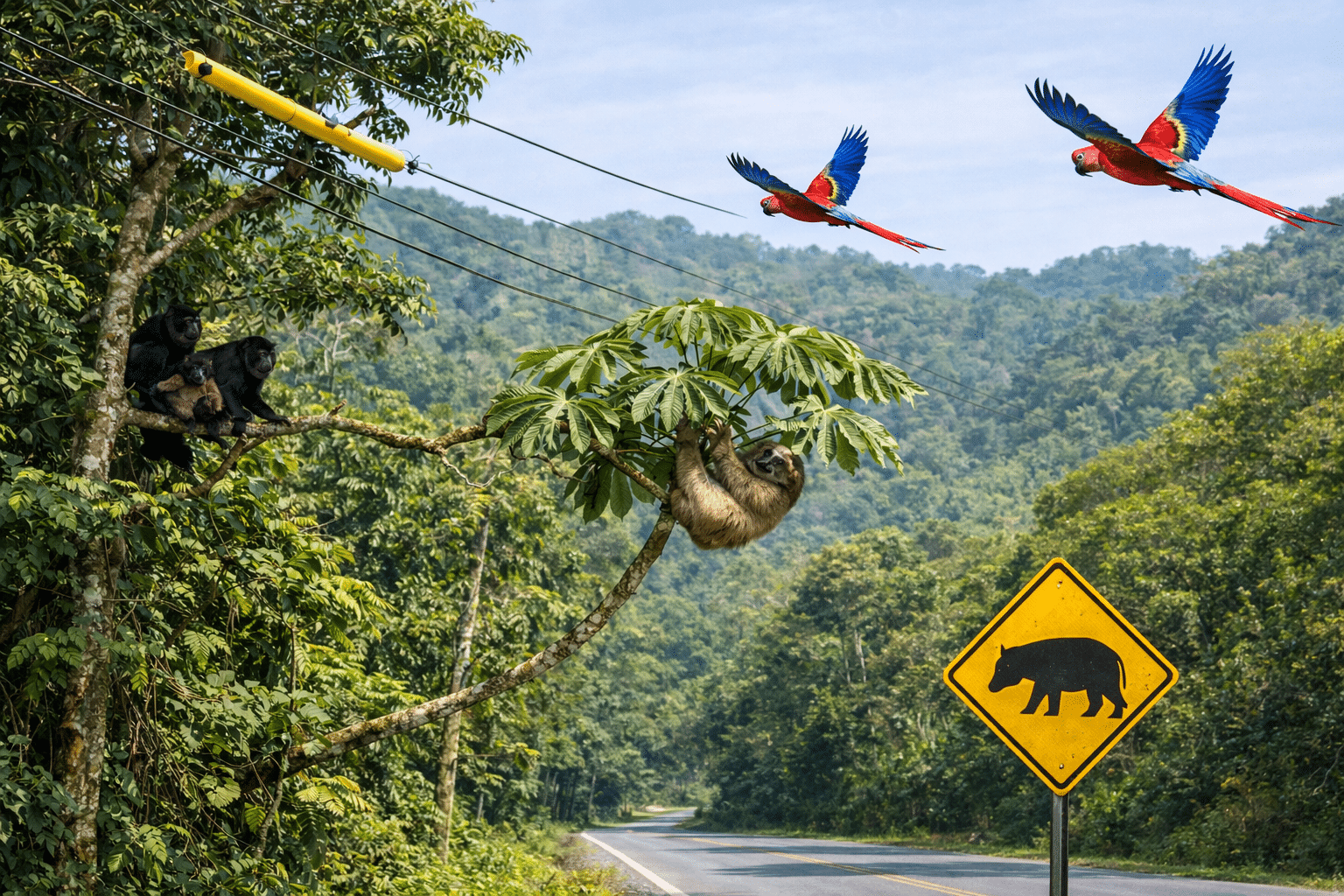
A troop of howler monkeys roaring from a roadside tree line can feel like pure Costa Rica magic – until you notice the power lines above them, the traffic below, and the shrinking patch of forest around them. That tension sits at the heart of Costa Rica’s wildlife conservation. This is a country celebrated for extraordinary biodiversity, but its wild success story has never been automatic. It has been built, defended, and constantly adjusted.
Costa Rica holds an outsized place in the global conservation conversation because it punches far above its size. In a relatively small territory, the country shelters sea turtles, scarlet macaws, tapirs, jaguars, sloths, humpback whales, poison dart frogs, and hundreds of migratory and resident bird species. Visitors often experience this richness as effortless abundance. The reality is more complex. Protected areas, reforestation, research, regulation, and community participation all help make those sightings possible.
Why Costa Rica’s wildlife conservation matters so much
Costa Rica’s biodiversity is not simply a scenic asset for postcards and vacation photos. It is part of the country’s identity, economy, and long-term resilience. Healthy forests protect watersheds, stabilize soils, support pollinators, store carbon, and create habitat that allows species to survive. Healthy marine ecosystems support fisheries, tourism, and coastal livelihoods. Wildlife conservation here is inseparable from the quality of life.
That is one reason Costa Rica became a global reference point for conservation policy. The country made notable investments in national parks and protected areas, and over time, it embraced approaches such as payments for environmental services, biological corridors, and ecotourism development. These efforts helped reverse severe deforestation trends seen in earlier decades. The result is not a perfect model, but it is a powerful one.
For international readers considering travel, relocation, or investment, this matters in practical terms. The natural beauty that draws people to Costa Rica depends on systems that need continued protection. A beach town, mountain valley, or jungle-fringed community can remain desirable only if development respects the ecosystems that made it special in the first place.
The real wins behind the success story
Costa Rica has earned its reputation. Roughly a quarter of the country is under some form of protection, and forest cover has recovered dramatically compared with the low point reached in the late 20th century. In several regions, wildlife has returned to areas where habitat once looked unlikely to rebound.
You can see the results in places where scarlet macaws now arc over the Pacific coast, where sea turtles continue to nest on protected beaches, and where reforested land reconnects fragmented habitats. Biological corridors have become especially important. A protected park on its own can still function like an island if farms, roads, and urban growth cut animals off from movement. Corridors help species feed, breed, migrate, and maintain genetic diversity.
Marine conservation has also become more central to the national picture. Costa Rica’s waters are home to dolphins, sharks, rays, whales, and critical migratory routes. Protecting ocean territory is harder than fencing off a forest, but the country has made meaningful moves toward larger marine protected areas and stronger attention to offshore ecosystems.
Where conservation gets difficult
The feel-good version of the story leaves out the pressure points. Costa Rica still faces habitat fragmentation, illegal wildlife trafficking, irresponsible tourism behavior, coastal overdevelopment, pollution, and road mortality for animals. Climate change intensifies nearly all of it.
A sloth or monkey injured by electric lines is not an abstract conservation issue. Neither is a turtle nesting beach lit up by beachfront construction, or a wetland degraded by runoff. The challenge is rarely one single villain. More often, it is the cumulative effect of small decisions made by many actors – developers, municipalities, visitors, businesses, and residents.
Tourism itself is a good example of the trade-off. Ecotourism has funded conservation, created jobs, and given standing forest more economic value than cleared land in many regions. At the same time, popularity can strain the very places people come to admire. Trails erode, wildlife becomes habituated to humans, boats crowd marine life, and demand for infrastructure expands into fragile areas. Good tourism helps conservation. Bad tourism consumes it.
What protects wildlife on the ground
Costa rica wildlife conservation is sustained by a web of institutions, nonprofits, researchers, rescue centers, local guides, volunteers, and community leaders. National parks and wildlife refuges are the visible backbone, but much of the daily work happens beyond park boundaries.
Wildlife rescue centers care for animals injured by vehicles, dog attacks, electrocution, or the pet trade. Their work is essential, although rescue is only part of the picture. Prevention matters more. Insulating power lines in key wildlife corridors, designing safer crossings, preserving mature trees, and enforcing building setbacks can prevent harm before an animal ever reaches a clinic.
Community conservation is another major force. In many parts of the country, local residents protect turtle nests, restore mangroves, monitor birds, or manage tourism with a long view of environmental value. This local stewardship tends to be more durable than outside attention alone because it ties conservation directly to pride, income, and place-based identity.
Private landowners also matter more than many visitors realize. Some of the country’s most important habitats lie outside formal protected areas. Farms, eco-lodges, and private reserves can all play meaningful roles when they maintain forest cover, protect riparian zones, and treat wildlife presence as an asset rather than a nuisance.
What travelers and future residents often get wrong
Many people arrive in Costa Rica assuming nature is so abundant that individual behavior barely matters. It does. Feeding wildlife for a close photo, touching marine animals, using bright beachfront lighting during turtle season, speeding through forested roads at dusk, or booking operators who crowd animals all contribute to the problem.
The better approach is less glamorous and more responsible. Choose tours led by naturalist guides who respect distance. Stay in accommodations that manage waste and water carefully. Support businesses that preserve habitat rather than strip it. If you are buying property or building, ask hard questions about environmental permits, drainage, tree cover, and ecological impact. A view is not sustainable if it came from clearing the slope.
This is where informed media and long-view local reporting make a difference. Readers who follow Costa Rica through a platform like Howler Media often come away with a fuller picture – not just where to go, but how the country actually works and what responsible presence looks like.
Conservation and development are not enemies, but they do clash
Costa Rica is still growing. More people want to visit, move, retire, invest, and open businesses here. That growth can support conservation through jobs, tax revenue, and better environmental standards. It can also chip away at habitat if short-term profit sets the agenda.
The smartest path is not anti-development. It is disciplined development. That means land-use planning, legal compliance, infrastructure that accounts for watersheds and wildlife movement, and a clear understanding that environmental damage is expensive even when the invoice arrives years later. A degraded river, eroded coastline, or silent forest lowers the value for everyone.
For buyers and investors, this is not just an ethical point. It is a practical one. Properties and communities that protect their natural surroundings tend to hold stronger long-term appeal. In Costa Rica, environmental stewardship is not an optional branding exercise. It is part of the destination’s core value.
The future of Costa Rica’s wildlife conservation
The next chapter will depend less on broad admiration for nature and more on execution. Costa Rica has already proved that recovery is possible. Now the question is whether it can maintain that momentum under modern pressure from climate volatility, infrastructure demands, and rising visitation.
That will require better enforcement in some areas, smarter design in others, and continued public support for conservation policies that may not always be convenient. It will also require humility. No country, even one with Costa Rica’s credentials, gets to declare victory over ecological pressure.
Still, there is good reason for optimism. Few places have built such a strong cultural link between national identity and living nature. That connection is visible in classrooms, protected lands, family-run tourism businesses, research initiatives, and everyday conversations about rivers, forests, and coastlines. It is one of the country’s great strengths.
The most helpful way to see Costa Rica is not as an untouched paradise, but as a living landscape where people keep choosing – again and again – to give wildlife a fighting chance. If you visit, move here, or invest here, that choice becomes partly yours, too.