


New businesses that survive and thrive in Costa Rica tend to share a handful of practical “winning distinctives”: they fit the local market (often around sustainability, services, or tourism), know how to navigate bureaucracy, leverage the talent and ecosystem in place, and build strong local relationships.
1. Strategic fit with Costa Rica’s strengths
Successful ventures usually align tightly with sectors where Costa Rica already has an edge.
- Sustainability and eco‑tourism: eco‑lodges, nature tours, wellness, conservation-related services, organic products.
- Knowledge and tech services: nearshore software, BPO, shared services, digital products tapping the educated, bilingual workforce.
- Value‑added agriculture and food: exports and niche local markets around specialty coffee, cocoa, organics, and agro‑processing.
- Digital and e‑commerce plays that reach both local and international markets.
These businesses don’t try to fight the country’s macro-structure; they plug into it.
2. Mastery of regulation and formalities
Surviving firms respect that Costa Rica is rule-heavy and design around it instead of ignoring it.
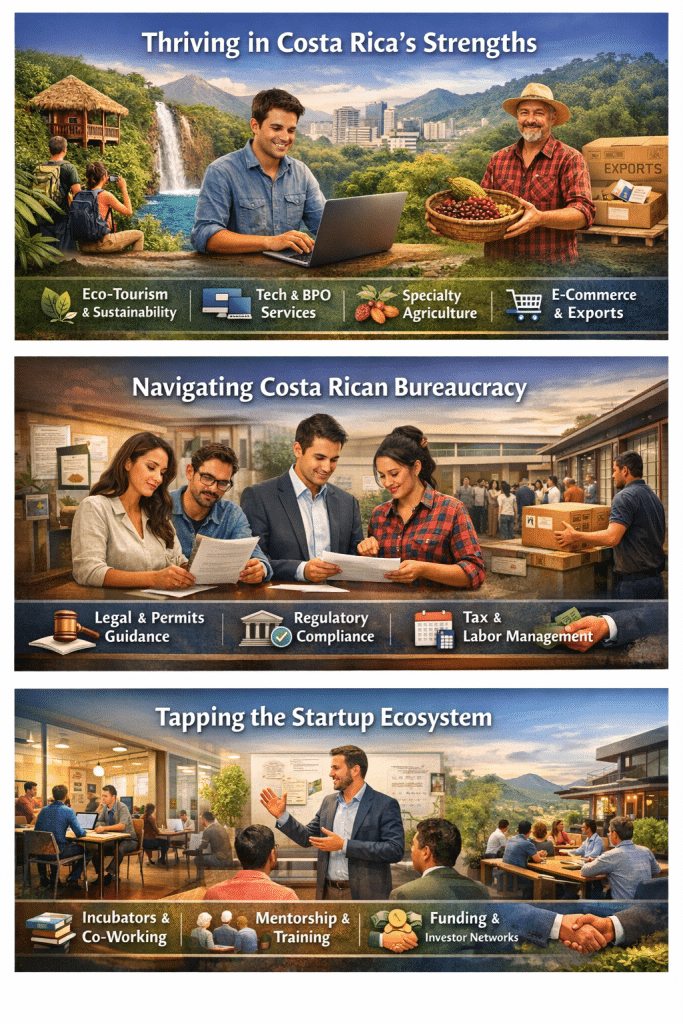
- They invest early in legal/accounting guidance for entity type, permits, labor law, taxes, and sometimes immigration status for founders.
- They build realistic timelines and cash buffers for municipal permits, health/ministry approvals, environmental requirements, and social security onboarding.
- They take compliance as a strategic asset: transparent books, proper contracts, and correct social charges give them durability with banks, partners, and the state.
A common pattern in failure stories is underestimating bureaucracy and labor rigidity; the survivors plan for it.
3. Use of the startup and support ecosystem
The companies that scale tap into the growing entrepreneurship infrastructure instead of going it alone.
- Incubators, coworks, and hubs (e.g., TEC/TEC incubators, Blackbox Cowork, innovation centers, free‑trade‑zone parks) for mentorship, networks, and shared services.
- Programs and agencies like CINDE, PROCOMER, INA, chambers, and accelerators for training, export support, and sometimes grants or introductions to investors.
- Local and regional angel/VC networks, especially in tech and innovation.
This ecosystem support shows up very clearly in tech and service startups that endure.
4. Local integration and relationship building
Winning businesses become genuinely Costa Rican in how they operate, even if the founders are foreign.
- Strong ties with local staff, municipal authorities, suppliers, and nearby communities.
- Language and cultural fluency: at least one decision‑maker who really understands Spanish, norms, and how business is done.
- Participation in chambers, associations, community projects, and sector networks; this builds resilience when rules, politics, or markets shift.
Immigrant-entrepreneur stories consistently highlight how much smoother things go once they lean on local advisors and community relationships.
5. Financial realism and operational discipline
Because costs (especially utilities and formal labor) are relatively high, survivors run lean and disciplined.
- Conservative financial planning that accounts for high electricity/water, mandatory benefits, and slower-than-expected ramp-up.
- Business models with healthy gross margins (services, specialized tourism, high-value exports, IP-based products) rather than low-margin retail copies.
- Early digitization: online sales, remote delivery of services, and digital tools to improve efficiency and reach beyond the small domestic market.
An illustrative pattern: tech and service firms that combine local talent with foreign markets (e.g., US clients) often have better survival odds because they earn in stronger currencies while spending in colones