

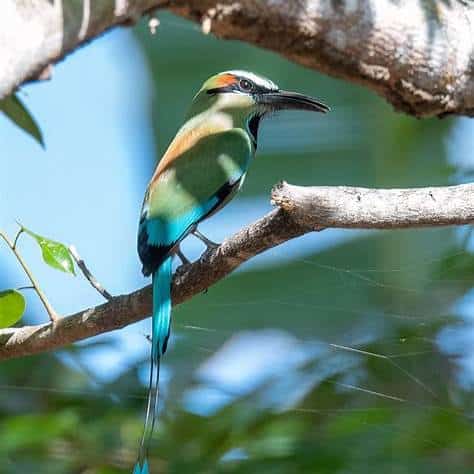
There’s a moment that happens in Costa Rica’s forests when the light turns leafy-green and quiet, and a bird appears like it’s been painted with a highlighter and a steady hand. A motmot doesn’t rush the reveal. It simply is—perched, still, almost smug—until the tail gives a slow side-to-side swing, like a tiny tropical metronome keeping time in the shade.
What is a motmot, in plain English?
A motmot is a colourful, medium-sized forest bird that often sits motionless on a perch, then darts out to grab prey, and many species have a distinctive “racket” on the tail. (carolinabirds.org)
Motmots belong to the Neotropical bird family Momotidae, and Costa Rica is one of the best places on Earth to meet them because you can see multiple species across very different habitats—dry forest, rainforest, foothills, and even leafy gardens near forest edges.
How many motmot species live in Costa Rica, and which ones are easiest to see?
Costa Rica has six motmot species, and four of them are realistic targets for most travellers: Turquoise-browed, Lesson’s, Rufous, and Broad-billed, while Tody and Keel-billed are the “you might need patience (or luck)” pair. (Birding Craft)
If you only see one motmot on your trip, it’s often Lesson’s Motmot (also called Blue-diademed Motmot) in the greener parts of the country, or Turquoise-browed Motmot in the drier northwest.
Where can I see a Turquoise-browed Motmot in Costa Rica?
You’re most likely to see a Turquoise-browed Motmot in open, warm lowlands—think dry forest edges, scrubby woodland, and fence-line perches where it can hunt from a lookout. (Anywhere Travel)
This is the motmot that behaves like it owns the roadside. It will perch on a branch, wire, or exposed limb, scan the ground, then drop down for a meal with a quick, confident swoop. It’s also the species that often sells people on the whole motmot obsession: bold eyebrow, minty greens, turquoise flashes, and those two long tail streamers finishing in perfect rackets.
Where should I look for Lesson’s, Broad-billed, and Rufous Motmots?
You can treat these three like a habitat “ladder” from gardens to deeper forest:
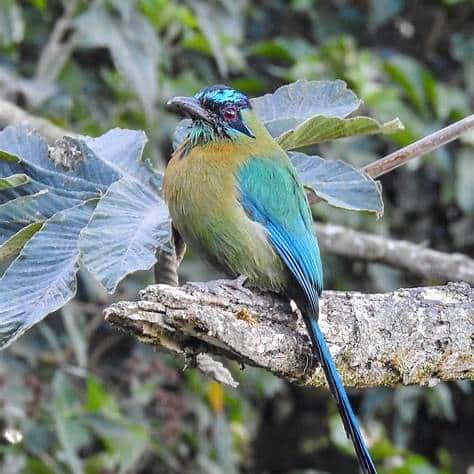
- Lesson’s Motmot (Blue-diademed): common in humid lowlands, foothills, and forested neighbourhoods—often surprisingly close to people where there’s cover and fruit. (Monteverde edges and many forest-lodge gardens can be good.) (Birding Craft)
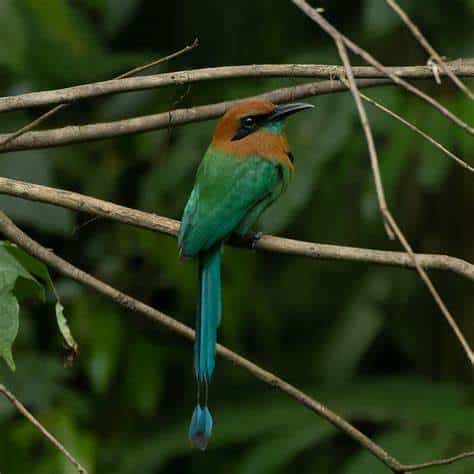
- Broad-billed Motmot: a rainforest specialist that likes shady forest interiors and dense edges, where its turquoise-and-green tones melt into the understory. (Birding Craft)
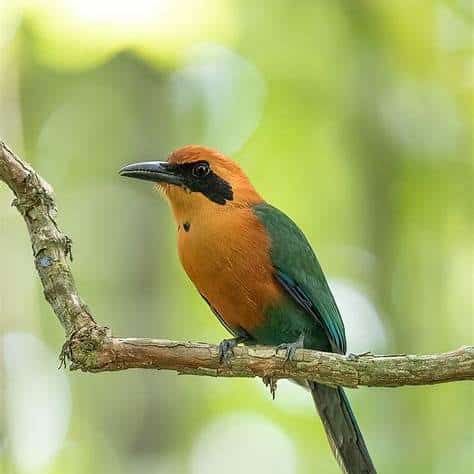
- Rufous Motmot: the larger, richer-coloured option—often seen in wetter forest where it can sit low and still, letting the forest do the hiding for it. (Birding Craft)
Why do motmots swing their tails like a pendulum?
Motmots often wag their tails side-to-side, and research-backed thinking suggests it can function as a “pursuit deterrent” signal—basically, “I see you, don’t bother chasing.” (Watching Birds Costa Rica)
For birders and photographers, the tail wag is a gift: it’s frequently the first movement that gives away a bird you’ve walked past three times.
How is the famous “racket tail” actually formed?
The racket shape isn’t made by the bird plucking feathers; the barbs on part of the tail feathers are more weakly attached and tend to fall away with wear and preening, leaving the bare “shaft” section and the spoon-like tips. (Watching Birds Costa Rica)
That’s why a motmot’s tail can look so perfectly designed and yet so biologically odd—like the bird is carrying two tiny, elegant paddles behind it.
What do motmots eat, and how do they hunt?
Motmots eat a mix of insects and other small prey (like lizards) and will also take fruit, depending on species and season. (carolinabirds.org)
A very “motmot” hunt looks like this:
- sit still on a shaded perch
- scan quietly (often for longer than you’d expect)
- drop or dart to the target
- return to the same perch like nothing happened
That stillness is why people miss them: your brain expects a tropical bird to be loud and busy. Motmots prefer calm confidence.
Where do motmots nest in Costa Rica?
Motmots typically nest in tunnels dug into earth banks—including riverbanks, forest banks, and sometimes road cuttings—then both parents help with raising the young. (Watching Birds Costa Rica)
This behaviour is also why you can occasionally spot motmots near human-made slopes: a fresh road cut can mimic the kind of bank they’d naturally excavate.
When is the best time of day to spot a motmot?
Early morning and late afternoon are strong windows because motmots can be more active around low light, and their stillness is less “invisible” when the forest is quieter. (Watching Birds Costa Rica)
Practical tip: when you’re on a trail, pause more often than you walk. Motmots reward the person who stops.
How do I photograph a motmot in a way that gets the shot and respects the bird?
You’ll get better photos by working with motmot behaviour—slow, patient, predictable—rather than trying to push closer.
- Stand still and let the bird relax into its perch-hunt rhythm
- Use a longer focal length instead of closing distance
- Watch for the tail wag (it’s the moment that makes the image feel alive)
- Avoid playback in sensitive areas or near nesting banks
- Shoot through gaps in leaves—motmot portraits often look best framed by natural greenery
Quick ID cheat sheet: which motmot am I looking at?
Here’s a fast field-friendly way to sort the usual suspects:
- Turquoise-browed: often in more open/drier areas; bold “eyebrow”; happily perches in view.
- Lesson’s (Blue-diademed): common in greener zones; rich blue crown/face tones; frequently near forested gardens.
- Broad-billed: deeper rainforest vibe; heavy bill; tends to stay shaded and secretive.
- Rufous: warm rufous head and chest with green body; feels like a forest ember with a long tail.
FAQ
Are motmots rare in Costa Rica?
No—several motmot species are regular in the right habitats, but they can feel rare because they sit so still.
What’s the easiest motmot for beginners to see?
Turquoise-browed in drier open country and Lesson’s in greener forest edges are often the easiest starters. (Birding Craft)
Why do motmots look like they have two “spoons” on their tails?
Those are the racket tips, formed when feather barbs fall away along part of the tail, leaving a bare section and the rounded ends. (lauraerickson.com)
Do motmots migrate?
Most motmots you’ll see in Costa Rica are resident birds, and you can look for them year-round (with the best daily viewing often early and late).
Are motmots friendly around people?
They can be surprisingly tolerant if they feel covered by foliage; the key is moving slowly and not crowding them.
What should I listen for?
Some motmots give low, hooting or hollow calls; but your best “sound” clue is often silence—then a single tail wag.