
By John Quam, Editor in Chief
When I first moved to Costa Rica almost twelve years ago, I was stopped mid-sentence by something small but world-shifting. I’d casually said I was “American.” A Tico friend smiled and, with no hint of sarcasm, replied, “So am I.” It was a simple correction, but it cracked open a truth I had never questioned: that the word America doesn’t belong to one country. It belongs to the Americas’ two continents, stretching from the Arctic to Patagonia, bound by history, geography, and shared humanity.
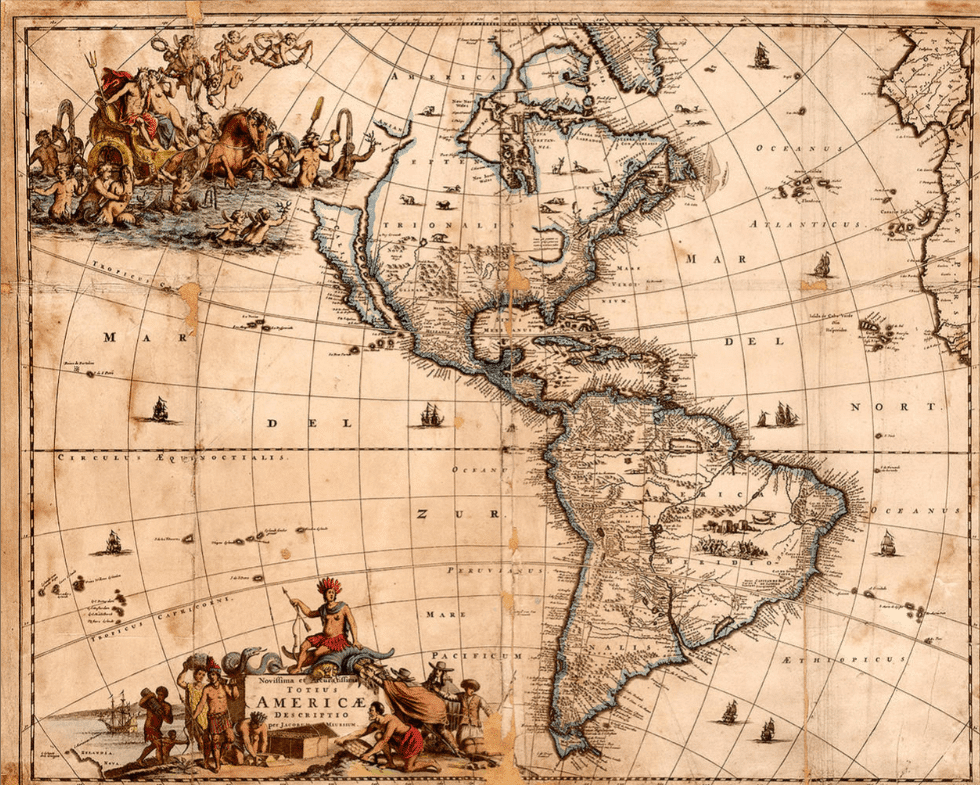
Let’s start with the basics. The word America first appeared in 1507, on a map drawn by German cartographer Martin Waldseemüller, who labeled the newly charted lands after Amerigo Vespucci, an Italian explorer. Vespucci was one of the first to recognize that these territories were not Asia, as Columbus believed, but an entirely new landmass. Waldseemüller’s map titled Universalis Cosmographia immortalized the name “America,” originally referring to South America, before it was later used for the northern continent as well. In other words, the word America predates the United States by more than two and a half centuries.
By definition, “America” refers to the combined landmass of North and South America, including 35 independent countries and over 1 billion people. Yet today, say the word “America,” and most people instinctively picture the United States. Hollywood, politics, and global branding made sure of that. Somehow, over time, one nation managed to appropriate a name meant for an entire hemisphere. It’s linguistic colonization, the quiet kind that seeps into speech until it sounds natural.
It’s almost comical when you think about it. Imagine if France called itself Europe or if Egypt renamed itself Africa. The world would scoff. But when the United States did it, the planet simply nodded along. Living in Costa Rica taught me how absurd that sounds to everyone else. Down here, being “American” isn’t a nationality, it’s geography. Costa Ricans, Guatemalans, Brazilians, Canadians, we are all Americans by the literal definition of the word. So now, when someone asks where I’m from, I say, “I’m from the United States.” It’s not just more accurate, it’s more respectful.
And that brings us to the linguistic irony of the U.S. identity. In Spanish, there’s a clear word for a person from the United States: estadounidense. It means “United Statesian.” In English, we don’t have that option. We default to “American,” as if there were no one else sharing the title. It’s convenient, sure, but it carries a quiet arrogance that the rest of the hemisphere notices, even if most Americans never do.
Culturally, the dominance of “America” as shorthand for the U.S. erases an incredible diversity. When people say “America,” the world doesn’t think of Peru’s mountains, Colombia’s music, or Costa Rica’s rainforests it thinks of the White House, baseball, and fast food chains. The richness of the Americas becomes background noise in a story told from Washington.
Here’s a bit of trivia that deserves repeating: the Americas span more than 42 million square kilometers, from the tundra of Canada to the beaches of Brazil. Yet only one country, representing less than half the population of this hemisphere, insists on being called by the name of it all.
And then there’s the “Gulf of America.” Yes, that’s a real phrase that’s floated around political circles in the United States, as if a simple rebranding could redraw history. The Gulf of Mexico, a body of water that has existed long before any flag ever flew over it, suddenly becomes the Gulf of America. You almost have to laugh. Maybe next they’ll rename the Caribbean “the American Sea.” The irony is perfect: a country trying to claim a gulf it shares with Mexico and Cuba, by using a name it borrowed from an Italian explorer that referred to continents it doesn’t own.
The arrogance of calling the United States “America” isn’t always intentional, but it’s certainly careless. It subtly tells the rest of the hemisphere that their identities are secondary. Yet the truth is much greater. The story of the Americas is not red, white, and blue; it’s a thousand shades of culture, history, and connection. From the volcanoes of Costa Rica to the plains of Argentina, from the Amazon to the Arctic, we are all America.
Maybe it’s time for a little linguistic humility. The United States can still be powerful, proud, and pioneering — but it doesn’t need to own a hemisphere’s name to do so. When we say America, let’s mean what the mapmakers intended over 500 years ago: a shared world, stretching from pole to pole.
After all, if we can learn to share oceans and air, surely we can share a name.