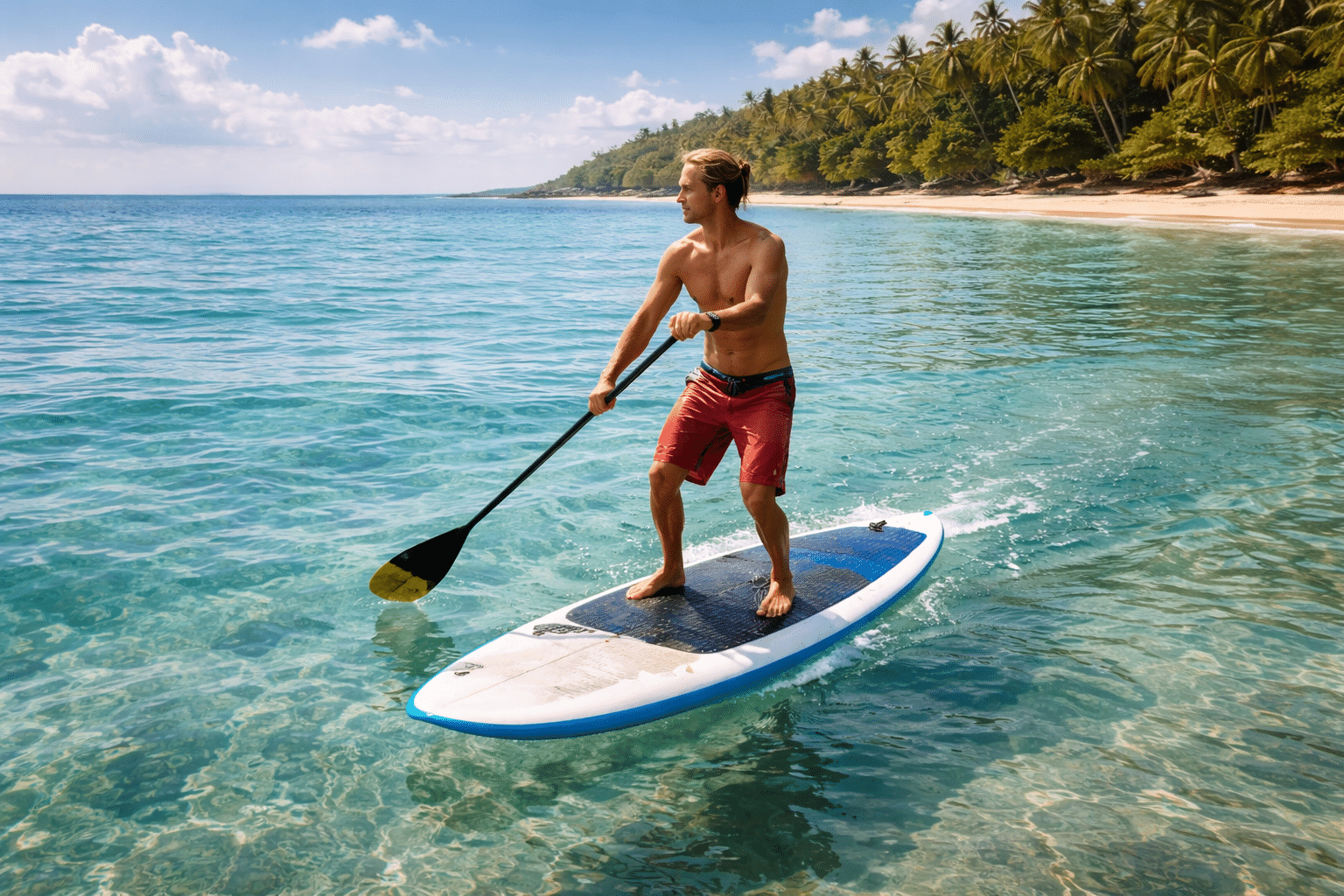
…historically, humans have regarded paddling small watercraft while standing up as an efficient and ergonomic way to fish and travel in the ocean…
Stand-up paddleboarding (SUP) looks modern, but the idea is ancient: humans have been standing to paddle small craft for efficiency, visibility, and control for a very long time. SUP surfing is the wave-riding branch of the sport—part training tool, part proper surf discipline, and part “why is this so fun?” moment when you glide into a clean little runner and feel like you’ve found a secret gear.
Lead photo suggestion: A 16:9 horizontal, photoreal image of a SUP surfer trimming along a small, glassy wave at sunrise on Costa Rica’s Pacific coast—gold light, a clean horizon, and spray flicking off the rail.
What is SUP surfing?
SUP surfing is surfing waves on a stand-up paddleboard while using a single-bladed paddle. Unlike flatwater SUP, where the goal is distance or cruising, SUP surfing is about reading the wave, positioning early, and using the paddle as both engine and steering wheel.
Key things that make it “SUP surfing” (not just paddling around):
-
You’re catching and riding breaking waves
-
You’re turning and trimming like a surfer
-
You’re using the paddle for balance, acceleration, and control
Why do people get obsessed with SUP surfing so quickly?
SUP surfing hooks people because it combines fitness, ocean time, and a surprisingly smooth learning curve on smaller waves. It can feel less intimidating than traditional surfing at first, because the paddle helps you move, stabilise, and adjust position earlier.
People love it because:
-
It’s a full-body workout without feeling like “gym time”
-
You can catch more waves in a session (especially in softer surf)
-
You see more from standing—sets, currents, channels, wildlife, everything
-
It can be social: families, mixed abilities, different ages
Where did stand-up paddling really come from?
Standing to paddle is old-school human problem-solving: it improves visibility, leverage, and efficiency on water. Across different cultures, standing up gave paddlers a better view for fishing, navigation, and avoiding hazards.
Examples often cited in SUP history:
-
Africa: some warriors paddled standing with spears for stealth and speed
-
South America (Peru): fishermen used reed craft (often linked to the caballito de totora) and could surf waves back to shore
-
Hawai‘i: long boards and paddling were part of early surf culture, with later “beach boy” traditions in Waikīkī
-
Central America: dugout canoes and lake craft have long been paddled standing for control in currents and shallows
The big takeaway is simple: standing wasn’t a gimmick—it was practical.
How did modern SUP surfing start?
Modern SUP surfing took off when surfers used paddles on oversized boards to catch tiny waves and train when surf was weak. In the early 2000s, riders like Laird Hamilton and Dave Kalama helped popularise the approach in places like Maui, and board builders began shaping specifically for surfing rather than cruising.
What changed as it evolved:
-
Boards went from huge and heavy to shorter, lighter, and more performance-focused
-
Paddles shifted from “modified kayak” style to purpose-built SUP paddles
-
Technique matured: the paddle became part of turning, bracing, and power delivery
What makes SUP surf boards different from flatwater SUP boards?
A SUP surf board is designed to turn quickly on a wave, while a flatwater board is designed to track straight and glide. If you try to surf a long, narrow touring board, it’ll feel like steering a bus in a car park.
Typical SUP surf board traits:
-
Shorter length for manoeuvrability
-
More rocker (curve) to fit into wave faces
-
Different rail shapes for grip and release
-
Tail designs that help turning (squash, round, pin—varies by style)
Typical flatwater/touring traits:
-
Longer length for speed and glide
-
Narrower outline to cut through water
-
A straighter rocker line for tracking
-
Storage points and comfort features for distance paddling
What gear do you actually need for SUP surfing?
You need the right board, a suitable paddle, and safety basics that match the conditions. You don’t need a garage full of gadgets, but the essentials matter more in surf because moving water adds risk and unpredictability.
A sensible SUP surfing kit usually includes:
-
A SUP surf board suited to your size and ability
-
A paddle that feels comfortable (not too long, not too heavy)
-
A leash appropriate for surf use
-
A buoyancy aid if local rules or conditions call for it
-
Wax or deck grip you trust
-
Sun protection that won’t blind you when it runs into your eyes
If you’re new, a lesson with a qualified instructor is worth more than upgrading your paddle three times.
How do SUP surfing paddles affect performance?
The paddle is your third point of contact, so it directly affects balance, speed, and turning. In SUP surfing, you’re not just paddling in a straight line—you’re bracing, planting, and using the blade to stabilise your stance during turns.
What surfers typically look for:
-
A comfortable grip and shaft feel (your hands will notice fast)
-
Blade size that matches strength and cadence
-
Materials that reduce fatigue over long sessions
-
A flex pattern that feels smooth, not jarring
The goal is simple: less strain, more control.
Is SUP surfing a good workout?
SUP surfing is one of the most complete “fun workouts” you can do, because it trains balance, strength, and endurance at once. You’re constantly adjusting through legs and hips, stabilising through the core, and working shoulders and back with every stroke.
Common fitness benefits people report:
-
Core stability and rotational strength
-
Leg endurance from micro-squats and stance changes
-
Shoulder and upper-back conditioning
-
Cardio boosts from paddling back out and catching multiple waves
It’s also mentally calming in the best way: you can’t doom-scroll while you’re reading a moving ocean.
What safety and etiquette should beginners know?
SUP surfing is safest and most enjoyable when you choose mellow conditions and give other surfers plenty of space. The board is larger than a standard surfboard, which means more momentum, so awareness and courtesy matter.
Smart habits that keep sessions friendly:
-
Choose uncrowded, small, gentle waves while learning
-
Keep a wide buffer zone around others
-
Don’t paddle straight through the main take-off spot
-
If you fall, try to fall away from the board and protect your head
-
Respect priority: don’t snake waves just because you can stand and see sets earlier
-
When in doubt, sit down or kneel to reduce your footprint and risk
And if conditions feel “just a bit much,” that’s your cue to switch to flatwater or wait for a calmer day.
What are the most common mistakes that make SUP surfing harder?
Most SUP struggles come from using the wrong board for the conditions or trying to muscle the ocean instead of reading it. When SUP feels frustrating, it’s usually fixable with small changes.
Common beginner mistakes:
-
Taking a touring board into surf and wondering why it won’t turn
-
Using a paddle that’s uncomfortable, heavy, or poorly sized
-
Standing too stiff instead of letting knees and hips absorb movement
-
Looking down at the board rather than where you want to go
-
Paddling in the wrong place and getting bounced by whitewater repeatedly
A calmer break, smaller waves, and a board matched to your ability can transform the whole experience.
What’s SUP surfing like in Costa Rica?
Costa Rica can be brilliant for SUP surfing because there are plenty of sheltered bays and mellow waves when you time it right. On small days, SUP can turn “barely breaking” into a proper session, and the warm water makes practice far more inviting.
What makes Costa Rica a natural fit:
-
Warm temperatures that encourage year-round time on the water
-
A mix of beach breaks and point/reef setups (varies by region)
-
Plenty of light-wind mornings that suit paddling
-
Easy access to lessons and rentals in many coastal towns
The practical move is to ask local operators about tides, currents, and beginner-friendly spots—conditions change quickly, and local knowledge keeps you out of trouble.
What does the future of SUP surfing look like?
SUP surfing is likely to keep growing because equipment keeps improving and the sport fits modern lifestyles. As boards become lighter and more specialised, and as technique continues to evolve, performance keeps stepping up—without losing the simple pleasure of standing on water and sliding across a wave.
Trends you’ll keep seeing:
-
More refined “short SUP” shapes for performance surfing
-
Lighter, stronger construction that reduces fatigue
-
More women and juniors pushing progression
-
Better coaching, safer practices, and more organised events
SUP’s best feature is also its most timeless one: it makes the ocean accessible in a new way.
FAQ: Stand-Up Paddle Surfing
Is SUP surfing harder than regular surfing?
SUP surfing is often easier to start on small waves, but harder to master at high performance. The paddle helps with balance and wave count, but turning and timing can get very technical.
Can beginners try SUP surfing safely?
Beginners can try SUP surfing safely in small, uncrowded waves with proper instruction and the right gear. Calm conditions and good etiquette reduce risk dramatically.
What size board should I use for SUP surfing?
The best board size depends on your weight, skill, and the type of waves you’ll surf. Most people learn faster on a stable board, then size down as balance and technique improve.
Do I need a different paddle for surfing vs flatwater?
A surfing paddle can feel more responsive and less tiring during turns and bracing than a cruising paddle. Many paddlers use one paddle at first, then specialise later.
Is SUP surfing good for weight loss?
SUP surfing can support weight loss because it burns calories and builds muscle, especially when you go consistently. Results come from regular sessions plus sensible eating, like any sport.
What’s the biggest etiquette rule in SUP surfing?
The biggest rule is to avoid endangering others by giving extra space and respecting wave priority. A larger board means you’re responsible for wider margins.