
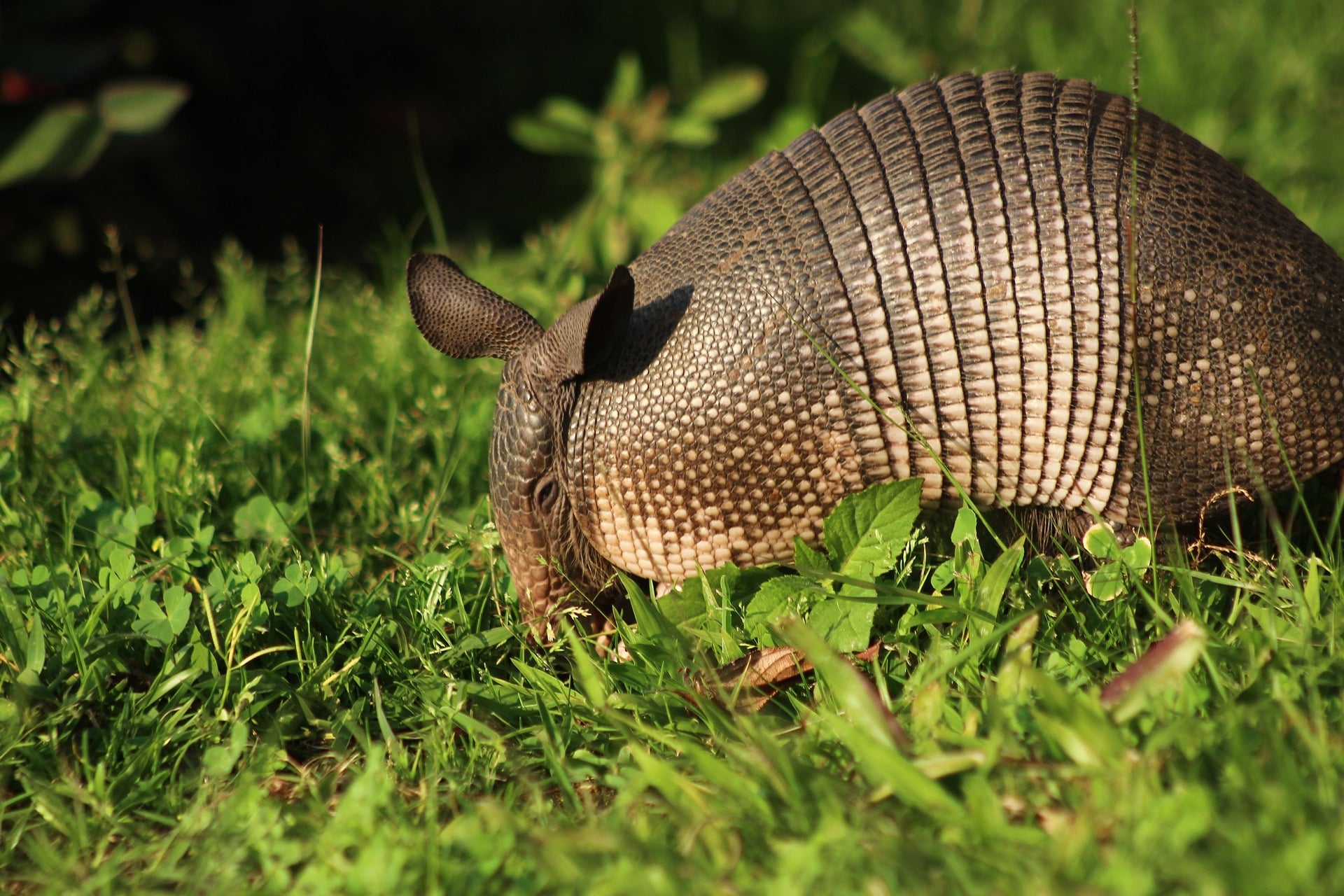
The nine-banded armadillo is one of those animals that looks as though nature had a sense of humour and a practical engineering streak at the same time. Covered in tough, flexible armour and built low to the ground with a long snout and sharp digging claws, it is a medium-sized mammal that seems half tank, half vacuum cleaner. Despite its name, it does not always have exactly nine bands. Depending on the individual, the number can vary, and that only adds to its charm. It is also the official small mammal of Texas, where it has become one of the state’s most recognisable wild animals.
Its story begins far to the south. The ancestors of the nine-banded armadillo originated in South America and later moved north when the Isthmus of Panama connected the continents. That land bridge opened one of the great wildlife migration routes in the Americas, and the armadillo took full advantage of it. Today, the species ranges from South America through Central America and well into the southern United States, with its range still pushing outward in some areas.
What makes the nine-banded armadillo especially entertaining is that it is full of surprises. Unlike the South American three-banded armadillo, it cannot roll itself into a neat protective ball. Instead, it relies on a stranger set of survival tools. When frightened, it can leap several feet straight up, which may startle predators but also explains why so many are struck by cars. It can also cross water in ways that seem almost made up: it may inflate its intestines to increase buoyancy, or it may hold its breath and walk along the bottom of a stream or pond. That breath-holding ability can last up to about six minutes.
Although people often think of armadillos as strictly nocturnal and shy, that is not the whole story. They are most active from dusk through night, but they do forage in daylight as well. In warmer regions like Costa Rica, you may spot one nosing through leaf litter under bushes or along a trail, apparently very busy and only mildly interested in the outside world. Part of that calm behaviour comes from the fact that armadillos have poor eyesight. They rely much more on smell than sight, sweeping their snouts close to the ground to locate insects and other prey hidden below the surface.
Food is where the nine-banded armadillo really earns its keep. It is primarily an insect-eater, feeding on ants, termites, beetles, larvae, worms, and other small invertebrates it finds by digging. It uses powerful foreclaws to tear into loose soil, rotting wood, and leaf litter, then laps up prey with its long sticky tongue. That constant rooting can make it unpopular in gardens, lawns, and around nesting areas of some ground-dwelling animals, and in some places it is considered a pest. Still, from the armadillo’s point of view, it is simply doing exactly what it was built to do.
Ecologically, the armadillo is more important than its comic appearance suggests. Its digging turns over soil, disturbs hidden insects, and creates burrows that other animals later use for shelter. Abandoned armadillo burrows have been used by a range of species, and researchers have also documented fan-tailed warblers following nine-banded armadillos to catch prey stirred up by their foraging. So even when an armadillo seems to be wandering alone, it may be quietly supporting a much larger community around it.
Costa Rica suits the nine-banded armadillo very well. The species does best in warm environments with enough moisture and workable soil, and colder weather helps limit how far north it can spread. In other words, Costa Rica offers the kind of mild climate, water availability, and rich ground conditions that make life easier for a mammal that spends much of its time sniffing, digging, and searching for insects just below the forest floor.
Its reproductive life is every bit as remarkable as its armour. Nine-banded armadillos are famous for producing genetically identical quadruplets from a single fertilised egg, with litters usually made up of four young of the same sex. That fact alone makes them one of the more unusual mammals in the Americas. Yet even with such efficient reproduction, they face serious threats. Road mortality is a major one, and humans have long hunted them as well. During the Great Depression, they were even nicknamed “Hoover hog” and “poor man’s pork,” which says as much about hard times as it does about armadillos.
The nine-banded armadillo may not have the elegance of a jaguar or the bright glamour of a toucan, but it has something just as memorable: resilience. It is ancient in design, oddly gifted, and perfectly adapted to a life of digging, dodging, and surviving. In Costa Rica, it remains one of those wonderful creatures that rewards anyone willing to slow down and look closely at the ground beneath the forest, because sometimes the most fascinating wildlife is not in the canopy at all.
FAQs
Why is it called a nine-banded armadillo if it does not always have nine bands?
Because the name is more traditional than exact. Individuals can show anywhere from about seven to eleven bands across the midsection, even though “nine-banded” is the common name.
Can a nine-banded armadillo roll into a ball?
No. That trick belongs to other armadillo species, especially the three-banded armadillo. The nine-banded armadillo relies on running, jumping, digging, and crossing water to escape danger.
Are nine-banded armadillos active during the day?
Mostly they are active from dusk through night, but they can be seen foraging in daylight too. Daytime sightings are not unusual, especially when conditions suit them.
Can nine-banded armadillos swim?
Yes. They can float by gulping air and inflating their intestines, or they can hold their breath and walk along the bottom of shallow water.
What do nine-banded armadillos eat in Costa Rica?
Mostly insects and other small invertebrates such as ants, termites, larvae, grubs, and worms. They forage by smell and dig through soil and leaf litter to find them.
Why are nine-banded armadillos important to the environment?
Their burrows provide shelter for other animals, and their digging helps disturb soil and uncover prey that other species can use. They are small ecosystem engineers.
#howlermag #howlermagazine